The imaginary friend
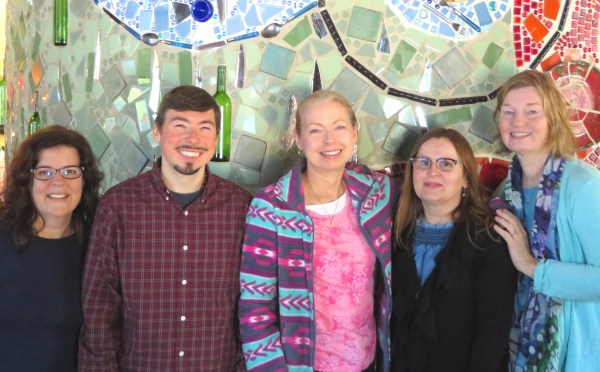
Imagination to reality: meeting (again) in person, the smiles say it all.
Laurie, Matt, me, Kelly and Alys at Rustico’s in Old Town Alexandria, April 2017
“Writing is a job, a talent, but it’s also the place to go in your head. It is the imaginary friend you drink your tea with in the afternoon.” ― Ann Patchett
I think most everyone who writes can identify with this quote. But for those of us who blog, the line takes on a magnificent blur as the imaginary friend we reach through our writing may, from time to time, step through the mist and become real to us. And for many of us, this might happen again and again, with several different people who read our words, and whose words we read, leaving us with an entire family of friends we might never meet face to face.
Just last week I was exchanging emails with a woman in a distant city whom I know only through this blog. Though she does not blog herself, nor comment very often, she writes to me privately and has sent me several precious tokens of friendship in past years. I was able to tell her in all honesty that, though we had never met, I thought of her as a true friend.
Of course, sometimes we do meet in “real life,” which is a unique and exciting kind of joy. And sometimes the friendships we maintain through writing are the continuation of ties we formed in person when we lived in geographic proximity to each other long ago. But regardless of these details, once the friendship is formed, it flourishes through correspondence as surely as it would in person. As with handwritten letters, online correspondence that leads to friendship cannot be rushed. Instagram and Twitter are fun and sometimes useful, but they can’t connect us to another person deeply with only random soundbites and snapshots. But through emails or blogging, unconfined by a limited number of characters, and set free from geographic borders and boundaries, we can transform the imaginary friends into real ones.
That’s not exactly what Patchett meant, of course; she is referring to the writing itself– the process– becoming the imaginary friend. And I don’t disagree that can happen. But how dimensional and vibrant it becomes, when that imaginary friend of writing introduces us to all sorts of fascinating people who also love to read, and write, and visit, through this historic form of communication that has remained vital from the age of quill pens right up to the era of digitally “instant” contact.
So I invite you to join me at the imaginary tea party that is always going here, or as Sheila and I might say, at various Club Verandah locations all over the world. We can chat and have lots of fun even if we never meet face to face. And if we ever do meet, it will be even more festive and magical.
This post was first published seven years ago. As many of you know, Patchett’s quote has taken on an entirely different dimension since I began formally studying writing at Oxford, where some of the friendships are formed in online cohorts, some in face-to-face classes, and some (delightfully!) include both, as summer brings us together from all over the world. Though I’m not writing new posts here as often as I’d hoped I would, I am definitely writing more than I ever have, and it remains the deep joy it has been for decades.
The original post, comments and photo are linked, along with two other related posts, below. These links to related posts, and their thumbnail photos, do not appear in the blog feed; they are only visible when viewing the individual posts by clicking on each one. I have no idea why, nor do I know how they choose the related posts. That’s just the way WordPress does things.
- Posted in: Uncategorized
- Tagged: blogging, chatting over tea, communication, connection, conversation, correspondence, discovery, expression, friendship, writing


 Defeat Despair
Good morning, Julia!
When I wrote for work, which is often, my writing doesn’t have the engaging quality of personalities that characterize fiction. Still, I’ve heard it said of others’ works, “it’s his ‘baby’,” or “it’s her ‘baby’,” as if the writing had an intimate relationship with the author, and I have sometimes felt a bit put out when someone comes in and edits the words I’ve carefully chosen.
With collaborative work, I feel closer to people who have struggled with me to create a reasonable rationale or well- substantiated document.
I expect your Oxford associates proof each other’s work and make suggestions? How does that work for you all?
Susan, editing is always tough, but I don’t mind it as long as the finished result is better than the draft. Long ago I worked as a stringer for a paper in California, and I had a good editor to start with. But then a new person came along who clearly didn’t even know grammar. After a couple of stories appeared in print with my byline over numerous (edited) glaring grammatical errors, I quit in disgust. I didn’t want to see my byline over such obvious mistakes. And I’m no grammar expert, but even I knew better.
At Oxford, we don’t “proof” each other’s work. We read, digest, comment, elaborate, react– all online, of course, except in the summer on-campus sessions. Some of our work is collaborative — we recently had to write an epic poem working together in groups — but in the end, we are only graded on our own individual assignments submitted anonymously for grading (and the grading itself has to be evaluated on a complex, three-tier review system to ensure that the tutor is fair and accurate in the grading, something I’ve never seen in any other university). The idea is to hone our skills in the group forums , leading up to the graded assignments. It has been quite an invigorating process so far. As I discovered in my first class at Oxford during the 2020 shutdown (my 2017 summer class there was under my PhD program at an American university, which I had to quit after Jeff died, due to not having any help with Matthew– but no regrets; I didn’t’ miss it at all), Oxford is quite a different place to learn, and it’s a setting I have enjoyed more than any formal or informal class since my MLIS at the University of Hawaii, an equally singular experience. These two programs have set a high bar in terms of what I can tolerate in a learning environment.
Wow, thank you for all that detail about the grading system at Oxford. That is so interesting. It probably gives you more feedback to work with, too improve your skills even more.
That’s so great that you’ve had so many varied experiences with writing (except for the lousy editor you had). Keep writing, keep growing! (This advice is selfishly provided to you for my own benefit! 😄)
Susan, thanks for your encouraging words. The Oxford grading system is even more intricate than I thought! At summer session, they informed us that none of us will technically be enrolled for Michaelmas Term until after we start classes (Fall quarter; Oxford has 4 terms each year: Michaelmas, Hilary, Trinity and Summer). The reason for this is that all our marks (grades) will have to be approved and our final scores high enough to permit formal enrollment in the 2nd year. Then, although we are set to graduate at the end of that year, we learned this summer that even when we finish, actual graduation ceremonies (at the Sheldonian, so definitely worth attending!) will not take place until March 2026. Probably combination of the many-layered scoring and approval system, coupled with the constantly full schedule at the Sheldonian. It reminded me of the time lag for everyone buried at Arlington National Cemetery.
WOW! How exciting!
I imagine there will only be a limited number of people that you can invite to attend your graduation. Fortunately, we’ll all know that you are graduating well in advance of the ceremony, so people can plan their travel, to attend!
I looked up Michaelmas, and I think I should adopt the celebration of that name into my annual calendar, since this time of year otherwise brings some slight dread over the impending cold season.
Susan, it would be so cool if you could come! BTW all our marks have now been approved except for our portfolios, which should be officially approved soon (or so they say). So I’m still not officially into my second year, although my first major unit of Michaelmas term already is complete and the assignment for that is due soon. I first learned the names of Oxford calendar terms when Drew spent Michaelmas Term there in 2005. Yes, it’s a charming name for what can be a challenging time!