Too important
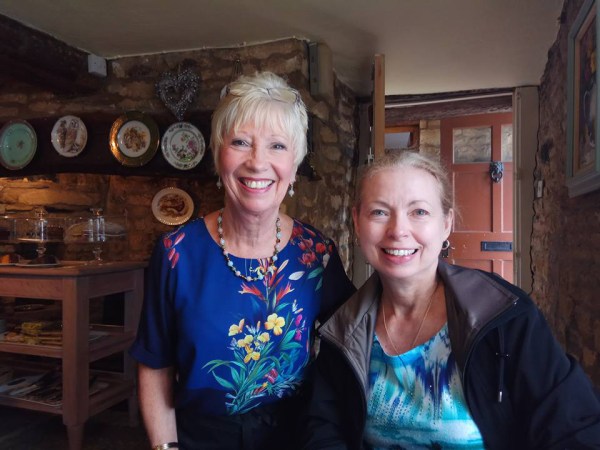
Teresa photographed me with our lovely waitress at the Small Talk Tea Shop in England.
For more on Teresa and this photo, taken in July, 2017, read this post.
“Human beings are too important to be treated as mere symptoms of the past. They have a value which is independent of any temporal process──which is eternal, and must be felt for its own sake.” ― Lytton Strachey
I had a rough week, interacting with robotic systems that were creating errors related to banking, finance and other necessities of daily life. By jumping through various automated obstacles, I contacted actual human beings to try to correct such mundane problems as my checking and saving account statements being sent, for no apparent reason, to an outdated address that was changed nine months ago. I was chagrined to discover how powerless the employees are, to correct or even understand the computer-driven systems that have taken over most business tasks in today’s world.
Even though my problems were “escalated” (to use popular business lingo) to higher-level departments, the people at those levels were equally stymied in their attempts to figure out what was happening, and why. I was left mulling over the brave new world of artificial so-called intelligence that now controls and too often bungles so many aspects of daily life. My conclusion is that I am finished with robots. All is over between us, insofar as I can manage to disentangle myself from such systems. Of course, much is already beyond our ability to control it, but I will continue to seek out humans for as many interactions as I possibly can.
The first thing I did was take steps to sever a 31-year dependence on online banking, which served us well through many military moves, but which is no longer functioning efficiently or even adequately. (My recent problems were part of an ongoing pattern of similarly inexplicable errors.) I went to an actual brick-and-mortar bank branch and opened several accounts to which I intend to transition all my business. While the bank is part of yet another gargantuan corporation that relies, as all do, on computers, at least I had contact with real people to whom I can turn when such problems surface in the future, as they undoubtedly will. This represents an improvement over calling an 800 number and getting a different person each time, telling the same story over and over.
There are other ways to step away from impersonal encounters with robots. Months ago, I began doing something many of you already are doing: making an effort to deal with local businesses insofar as I reasonably can. Other small steps include focusing on face-to-face interaction as often as possible, writing real, physical letters in my own unique handwriting, and reminding myself to make eye contact and smile at people I encounter, however briefly, in the course of a day. Interacting primarily with machines can make us lose our humanity– I really believe that– and I’m not going to give it up without a fight.
Another thing I realized is that technology allows us to stay home far too much, especially in cold weather. There’s nothing wrong with being happy to stay home. Feeling content in our own cozy nest is one of life’s great pleasures. But there’s a risk: it can lead to becoming increasingly isolated from our communities, robbing us of what other people have to offer us, and depriving them of our own contributions.
I think travel is so invigorating because it forces us out of our cocoons and puts us face to face with people who are friendly, often fascinating, and completely new to us. We have much to learn from people we have not yet met. All such encounters are helpful insofar as they allow us to practice courtesy, communication and congeniality, all of which atrophy when we deal mostly with robots.
I’m no Luddite. I love technology, and my presence here at this blog is exhibit A that demonstrates my enthusiasm for the gifts of digital progress. However, in addition to the reservations described above, there is a darker side to technology that became apparent to me as I dealt with the frustrations of the past week. I noticed how much easier I found it to become hostile and rude with people with whom I spoke over the phone when they seemed unhelpful or dismissive of my difficulties.
When not face to face with another person, it’s far too easy to vent and even shout when I become irritated. This is especially true if I’m speaking with a nameless person I’m unlikely ever to reach again, at one of those branched-out call centers with locations in multiple cities, teeming with employees whose conversations one can overhear buzzing in the background. Such inadequate approaches to customer service underscore how minuscule any one person’s problems must seem to this mammoth corporation. Call center employees are normally powerless to do much, and rarely can they even return a phone call or pass the problem on to someone who might be able to help. No wonder it’s so infuriating to deal with them.
However understandable my anger might be in such situations, venting it accomplishes nothing good. Accordingly, I’m going to avoid such call centers as much as I can. That might not be possible in many cases, but there still do exist businesses that have local representatives one can consult in person. Even if it costs more to deal with them, I’ve decided it’s worth it.
Many of us have been raging against the machine for a long time, but I’m ready to do more than rage. One way I am choosing to defeat despair is to go retro with how I conduct my business. How about you? Do you have any happy encounters to relate, whether in your home town or on the road, that will inspire us with faith that the robots have not yet irrevocably taken over? Can you point us to companies that have made a commitment to put people over profits? As Strachey says, people have a value that transcends any temporal process. How can we live out our understanding of that eternal truth?
This post was first published seven years ago today. Need I say that it seems more true now than ever? The brick-and-mortar bank I mention in this post has since closed, so now I have to go to another of their branches that is farther away. It so much easier, most of the time, to do everything by computer. But digital access has grown ever more robotic, with obstacles to reaching even a low-ranking human customer “service” agent who is helpless to do anything but recite scripted apologies and excuses.
I’m aging rapidly, with less energy than I had when this was written, but I still travel quite a bit. I still need to venture out into the “real world” where I deal with people face to face, whether relatively nearby or halfway around the world. The convenience of technology is seductive indeed, but there is a very real price to pay for such a radical transformation of the world as it was a few short decades ago. I continue to disobey the robots as much as I possibly can.
The blog is not designed for viewing on cell phones, but you can get a less distorted version of the photos if you click on the “view on blog” link at the top right of the screen. The original post, comments and photo are linked, along with two other related posts, at the individual post views. These links to related posts, and their thumbnail photos, do not appear in the blog feed; they are only visible when viewing the individual posts by clicking on each one. I have no idea why, nor do I know how they choose the related posts. That’s just the way WordPress does things.
- Posted in: Uncategorized
- Tagged: community, connection, face-to-face, humanity, interaction, isolation, machines, people, people over profit, reclamation, resistance, technology


 Defeat Despair
Good morning, Julia!
I recently read that unlike previous generations, where each generation has been smarter and accomplishes and learns more than their ancestors, the generation that was first given tablets as part of their elementary school learning tools is actually not smarter than the previous generation.
Considering recent politics, we seem to be less wise, as well.
Thanks in no small part to our “brave new world of artificial so-called intelligence,” I’m sure.
Thank you for relating your experience with online banking. There are certainly times that I’ve been shuffled and on hold for longer than it would take to drive to the nearest bank or credit union.
Love and Blessings to you!
Susan, I agree with you. We may never know the many hidden costs of the screen-driven world we now inhabit. But I think many are waking up to it. Do you know the books of Jonathan Haidt? I’ve read a few and highly recommend them. Here is a quick summary of one of them: https://www.ted.com/talks/jonathan_haidt_are_smartphones_ruining_childhood