To share our pain

Photo by Milada Vigerova via Unsplash
“When we honestly ask ourselves which person in our lives means the most to us, we often find that it is those who, instead of giving advice, solutions, or cures, have chosen rather to share our pain and touch our wounds with a warm and tender hand.”
— Henri Nouwen
“…losing love
Is like a window in your heart
Everybody sees you’re blown apart
Everybody sees the wind blow.” — Paul Simon
The past six years, and really the past 32 years, have left me with far more questions than answers, but observation has firmly established the truth of some generalizations about humans. Among them is the unmistakable tendency for people to shy away from anything that can’t be easily fixed. We live in a throwaway culture where objects, animals and even other people are discarded or disregarded when they lose their practical value or don’t perform as expected.
Because of this I spend almost all of my days and hours alone, seeing nobody who isn’t paid directly or indirectly to be in either Matthew’s life or mine. Matthew is the only person who is reliably present face-to-face in my life, and of course, his ability to communicate well enough to share my pain (or his own) is sadly limited. I miss countless things about Jeff, but losing the gift of his presence in daily life is the greatest sorrow of all. His devotion to us manifested itself on many levels, but the most profoundly beneficial was his steadfast proximity to all the details of our lives. He never needed a reason or an occasion to be there; he chose to be with us, as we did him, over and over again.
If you have known the prolonged isolation that too often accompanies chronic or catastrophic suffering, you will understand what I am talking about. Most people my age or younger don’t know yet what that particular form of alienation is like, but I believe almost everyone will experience it if they live long enough.
Meanwhile, even if you have no clue what it’s like– even if you feel impatient when your well-intended suggestions aren’t adopted, and you just want to shake that despondent individual and tell her to SNAP OUT OF IT– realize that nobody expects or even needs you to solve an unsolvable problem. Sometimes, all that’s needed is someone to be there.
Chances are there is a person in your life right now who might like to hear your voice or see your face, and it wouldn’t have to be more than a brief visit. It won’t pay your bills or raise your social status or get your to-do list checked off. It’s almost certainly not a priority with you. But it might change someone’s life. Maybe even your own.
This post was first published seven years ago today. The original post, comments and photo are linked, along with two other related posts, below. These links to related posts, and their thumbnail photos, do not appear in the blog feed; they are only visible when viewing the individual posts by clicking on each one. I have no idea why, nor do I know how they choose the related posts. That’s just the way WordPress does things.
The thing that is left
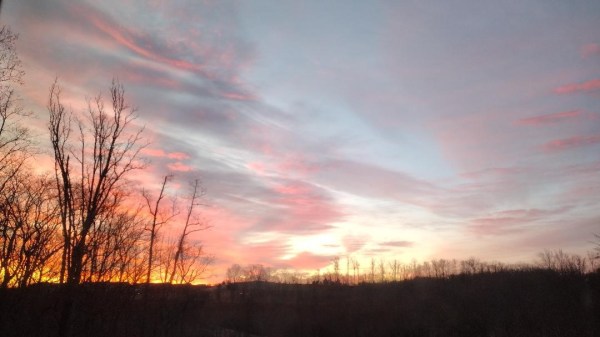
“As long as there is one upright man, as long as there is one compassionate woman, the contagion may spread and the scene is not desolate. Hope is the thing that is left to us, in a bad time. I shall get up Sunday morning and wind the clock, as a contribution to order and steadfastness.
Sailors have an expression about the weather: they say, the weather is a great bluffer. I guess the same is true of our human society—things can look dark, then a break shows in the clouds, and all is changed, sometimes rather suddenly. It is quite obvious that the human race has made a queer mess of life on this planet. But as a people we probably harbor seeds of goodness that have lain for a long time waiting to sprout when the conditions are right. Man’s curiosity, his relentlessness, his inventiveness, his ingenuity have led him into deep trouble. We can only hope that these same traits will enable him to claw his way out.
Hang on to your hat. Hang on to your hope. And wind the clock, for tomorrow is another day.” —E. B. White
E. B. White wrote this letter in 1973, but it’s more relevant today than ever. Just as his children’s books became timeless classics, so his words of wisdom have stood the test of time. So let’s wind our clocks, whether figuratively or literally, and hang onto our hope. When sunrises are consistently so glorious, it’s hard to sink into despair as long as we continue to be granted fresh new days. Tomorrow is another day indeed, and for that I thank God every morning when I awaken, and the last thing before I go to sleep.
Conversation partners
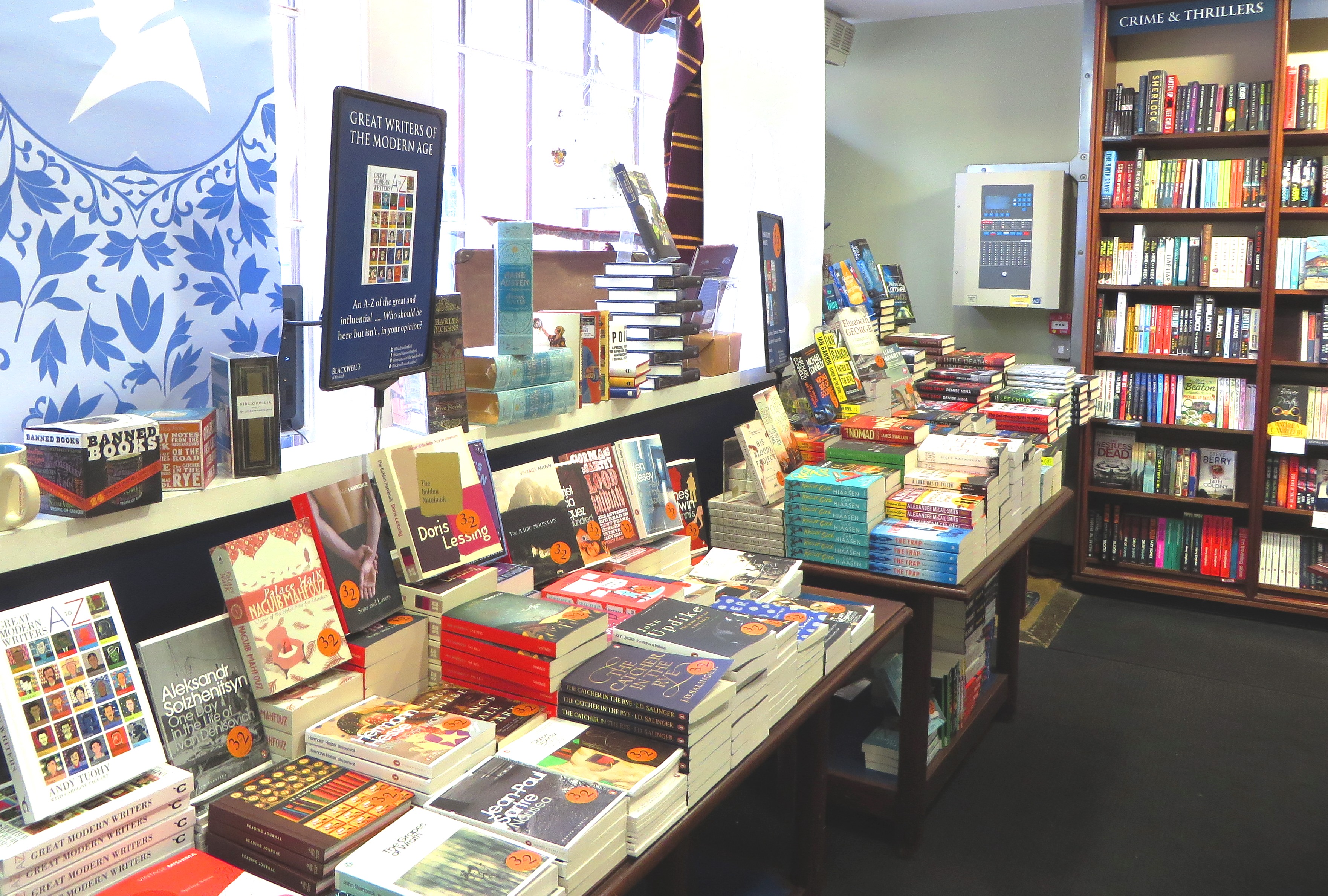
Meet some fascinating people. Blackwell’s bookstore, Oxford, UK, June 2017
“The borders between reading and writing and living are fluid. I do not take time out from life to write, nor do I take time out from life to read. When I quote somebody, I’m not hiding. I’m introducing you to one of my conversation partners.” — Patrick Henry (no, not that one, this one)
When I first started this blog, I my intent was to hide behind the quotes. In fact, initially I planned to have nothing but one quote and one photo each day. My very first post here was intended to be the permanent format. But then I added a few words, and as the comments and questions began to come in, the borders I had drawn expanded. The rest is history, 1036 posts and counting, available here in neatly archived sequence for anyone who cares to explore.
For me, Henry’s quote explains why I ended up doing more than posting a quote and a photo each day. Reading and writing are so much a part of my life that I find it hard to separate them from everything else, such as posting a blog entry. And the librarian in me, the one who will never retire, loves nothing better than to introduce people to potential conversation partners. Among those whose words I’ve shared here are some of the most intriguing, inspiring and imaginative individuals you could ever hope to meet. Each has, in one way or another, helped me defeat despair. I hope they do the same for you.
This post was first published seven years ago today. The original post, comments and photo are linked, along with two other related posts, below. These links to related posts, and their thumbnail photos, do not appear in the blog feed; they are only visible when viewing the individual posts by clicking on each one. I have no idea why, nor do I know how they choose the related posts. That’s just the way WordPress does things.
No endings
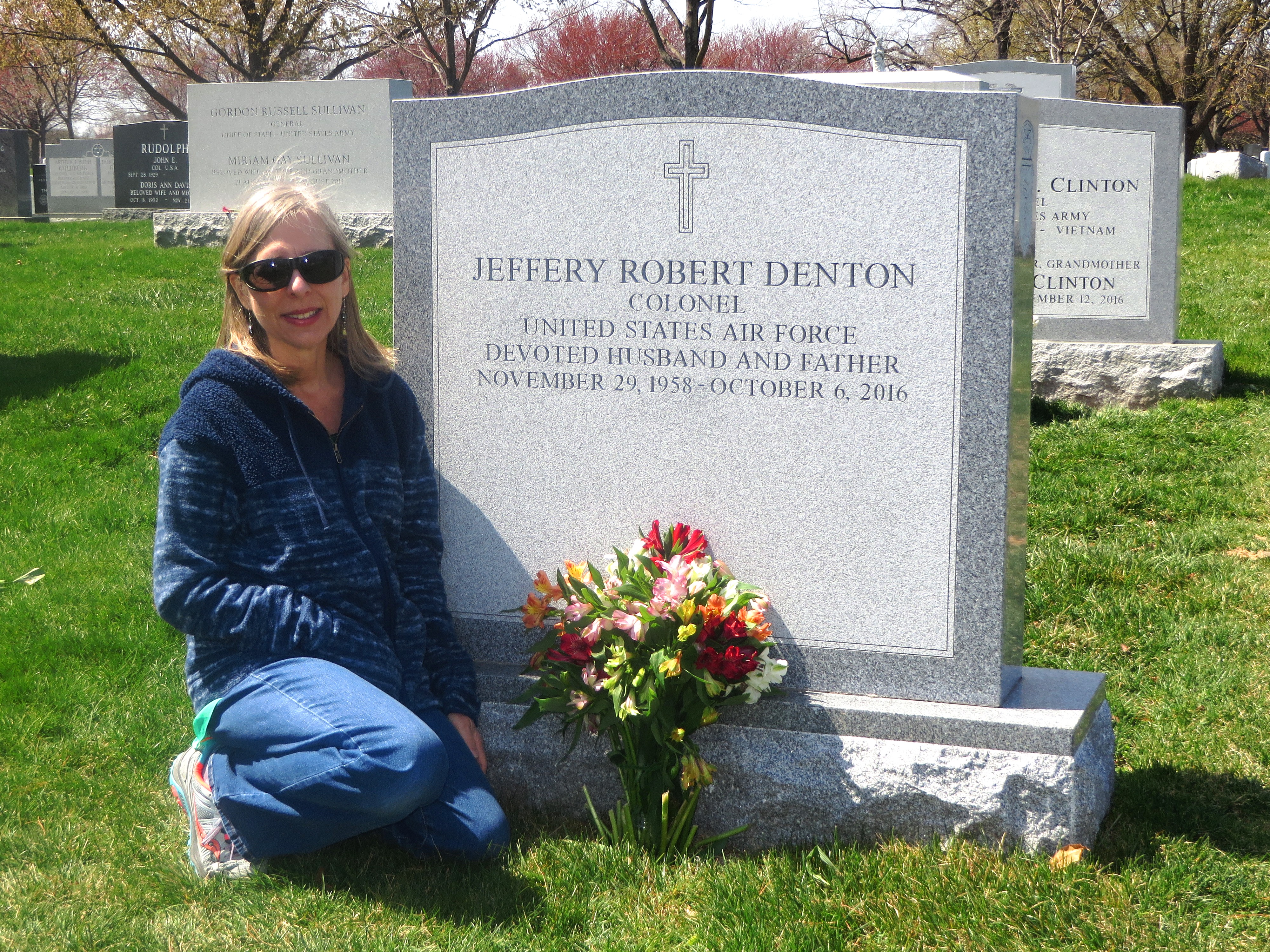
Kathy at Jeff’s grave, Arlington National Cemetery, April 2018
“There are no endings. If you think so you are deceived as to their nature. They are all beginnings. Here is one.” ― Hilary Mantel
“…life is eternal
And love is immortal
And death is only a horizon
Life is eternal
As we move into the light
And a horizon is nothing
Save the limit of our sight.” — Carly Simon
During the past week my friend Kathy was visiting me from Texas. We went out to Arlington National Cemetery and from there into DC on a lovely spring day. The cherry blossoms were just past full bloom, still beautiful, and it was the kind of afternoon that is a balm for the sorrows of a cold and dreary winter.
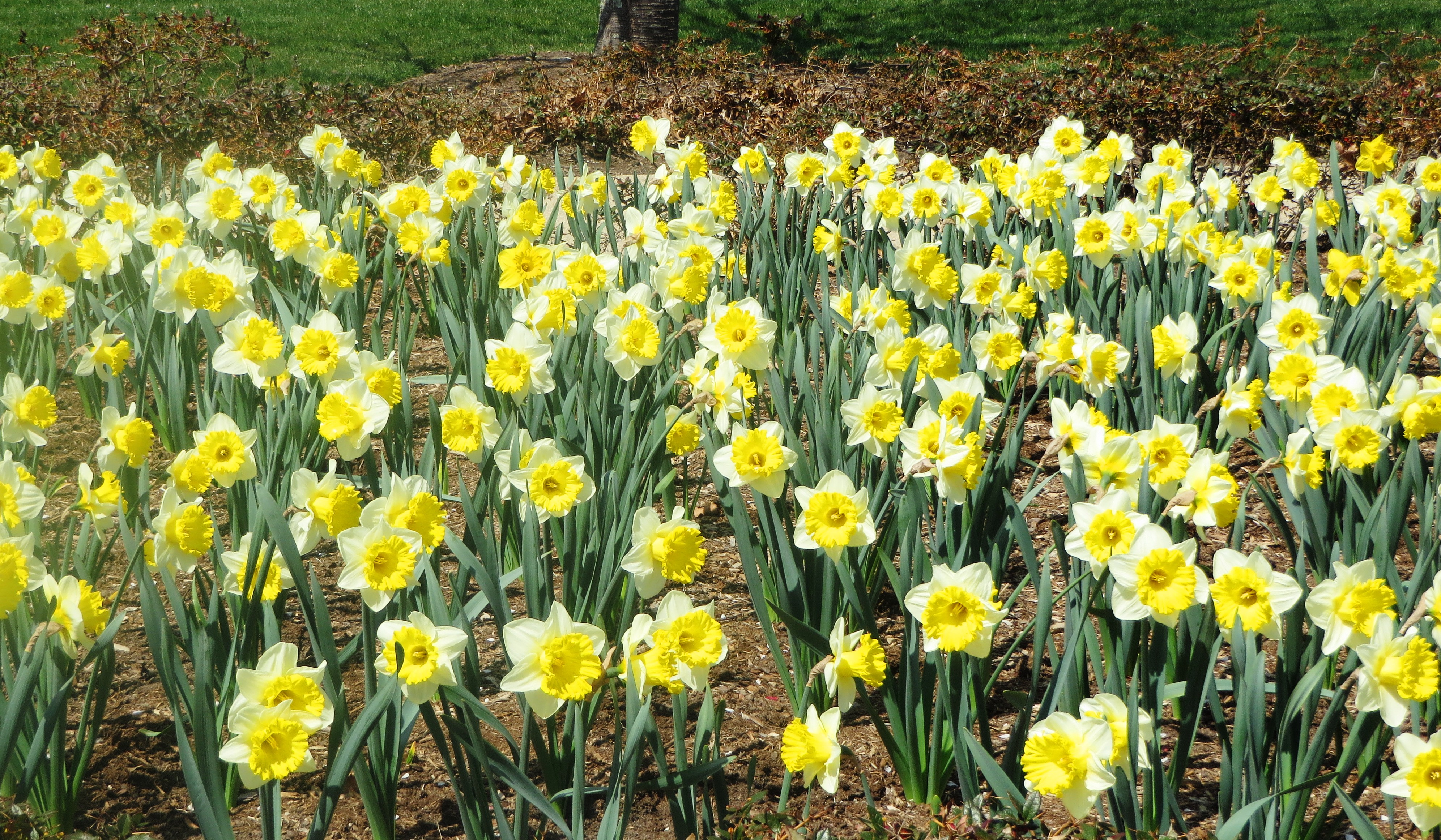
Daffodils were blooming throughout Arlington and in the District.
These were a short stroll from Jeff’s grave.
I don’t have many words today, but I do wish you lovely April afternoons to fill you with peace and reassurance that cannot be fully described or understood.
This post was first published seven years ago today. The original post, comments and photo are linked, along with two other related posts, below. These links to related posts, and their thumbnail photos, do not appear in the blog feed; they are only visible when viewing the individual posts by clicking on each one. I have no idea why, nor do I know how they choose the related posts. That’s just the way WordPress does things.
Nourishment

Photo by Vitaly Gariev on Unsplash
“There is nourishment in books, art, history, philosophies—in holiness and in mirth. It is in honest hands-on labor…And it is in the green world—among people, and animals, and trees for that matter, if one genuinely cares about trees.” —Mary Oliver
Do you pay as much attention to your psychological nourishment as you do to your physical nourishment? Most of us have plenty to eat, but we’re increasingly aware of the need to choose healthier options over empty calories. And there are plenty of books, articles and news stories to guide us along that path. We can usually sense when it’s time to eat something wholesome. We always feel it when physical hunger urges us to sit down to a hearty meal.
But what about nourishing the soul? Do we neglect our spiritual wellbeing? Do we feed our minds junk food? I can always tell when I’m not getting a diet that is good for my mental health. Just as I feel bloated and sluggish when I eat too much sugar, salt or fat, I feel despondent, listless or agitated when I don’t make good choices about what to feed my mind.
Of course, mental and physical health are inextricably linked. That’s another reason it’s crucial to take care how we feed our souls. Proverbs 4:23 tells us “Above all else, guard your heart, for everything you do flows from it.” (NIV). I invite you to join me in paying close attention to what we allow into our thoughts, minds and hearts. As Oliver points out, we have abundant resources to nourish our souls, and most of it costs nothing except our care and attention. Making time to focus on guarding and nurturing the spirit is an investment that always pays manifold dividends.
Inverse correlation
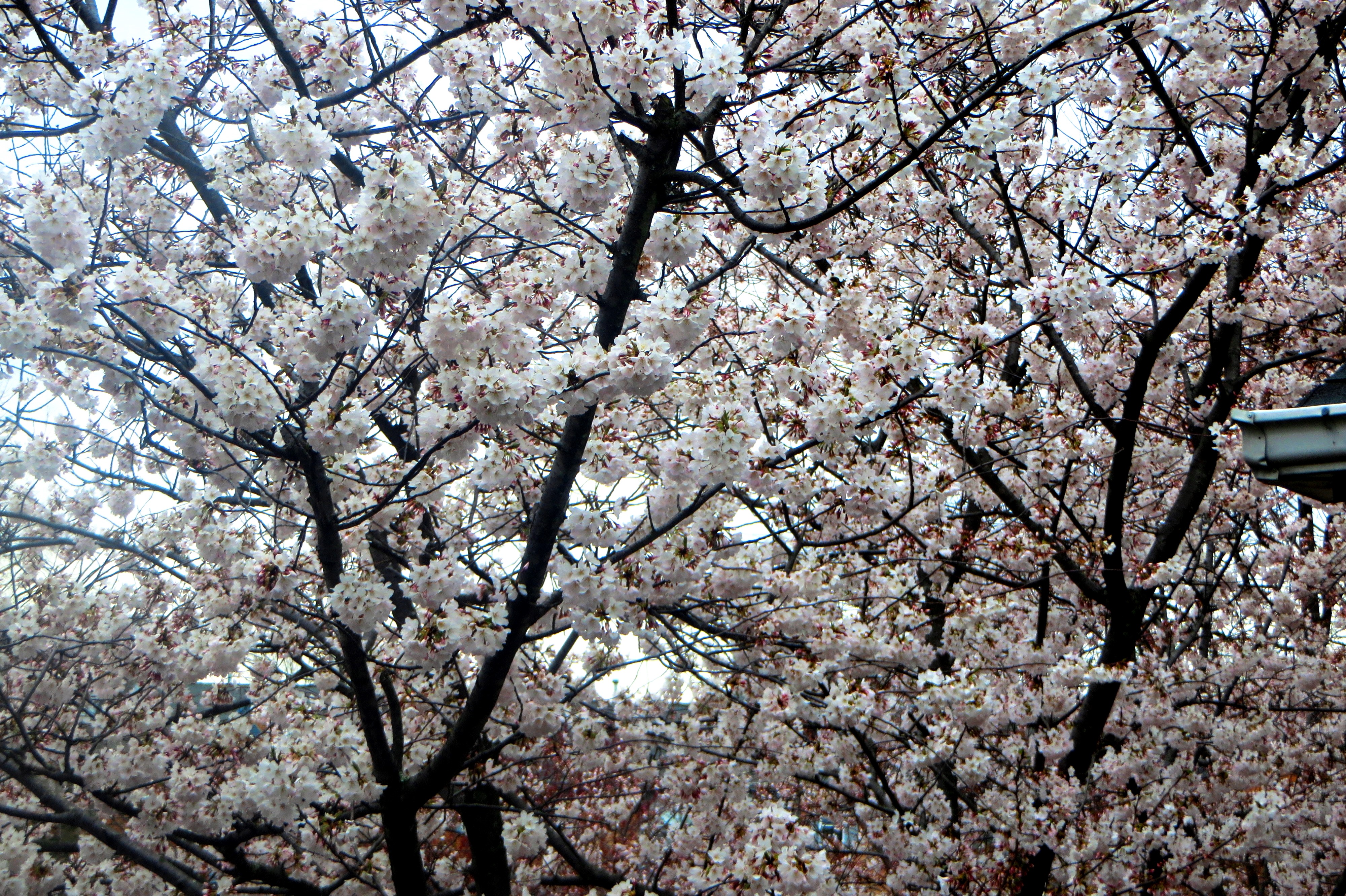
Free– and priceless: the view out my upstairs window last Friday, April 2018.
“There are things money can’t buy. I don’t think standard of living equates with cost of living beyond a certain point. Good housing, good health, good food, good transport. There’s a point you start getting inverse correlation between wealth and quality of life…
I have everything I need to have, and I don’t need any more because it doesn’t make a difference after a point.”— Warren Buffett
That quote might make way more sense if it wasn’t being said by one of the all-time richest men in the entire world. But there’s a strange way in which it’s more credible coming from Buffet, who is famously cheap frugal in the way that he lives, especially when one considers his literally unimaginable wealth.
Buffet knows first hand that no amount of money can purchase what isn’t for sale at any price. Beyond obtaining the basic necessities of a healthy life, money is never going to be the route to happiness, because more is never enough.
Most of us who read this blog will know this to be true because of the joy we experience when we work in the garden, or savor a cup of tea, or laugh with a loved one. If you are reading this post, chances are good that you are rich! Maybe not financially, but in all the ways that really count, the blessings among us are abundant.
You may be thinking something along the lines of what my friend Ashleigh Brilliant once wrote: “All I ask is a chance to prove that money can’t make me happy.” Most of us will never get that chance, but we need look no further than the headline stories in the news to see the “inverse correlation” Buffet mentions, creating all sorts of havoc in countless lives. We don’t need to find out first hand about that inverse correlation. It’s all around us.
Instead, let’s focus on the positive truth of his claim. What will you be doing today that might inspire Buffet to point to you and say “See what I mean about quality of life that can’t be bought?” You are invited to meet Sheila and me on the Virtual Verandah for an imaginary tea party, and share some of your own cheap frugal comforts with us there, or in the comments below. While you are at it, enjoy that clever “Foolish dragon” haiku at the Motley Fool article linked above. It makes me smile every time I see it.
This post was first published seven years ago today. I had no idea when I first posted it that I would be re-posting it just after the biggest and most abrupt market downturn in recent memory. However, the “sage of Omaha” is more relevant than ever, with his wisdom about the limits of earthly wealth. Of course, the book of Proverbs and the parables of Jesus were way ahead of him on that.
The original post, comments and photo are linked, along with two other related posts, below. These links to related posts, and their thumbnail photos, do not appear in the blog feed; they are only visible when viewing the individual posts by clicking on each one. I have no idea why, nor do I know how they choose the related posts. That’s just the way WordPress does things.
But one has seen
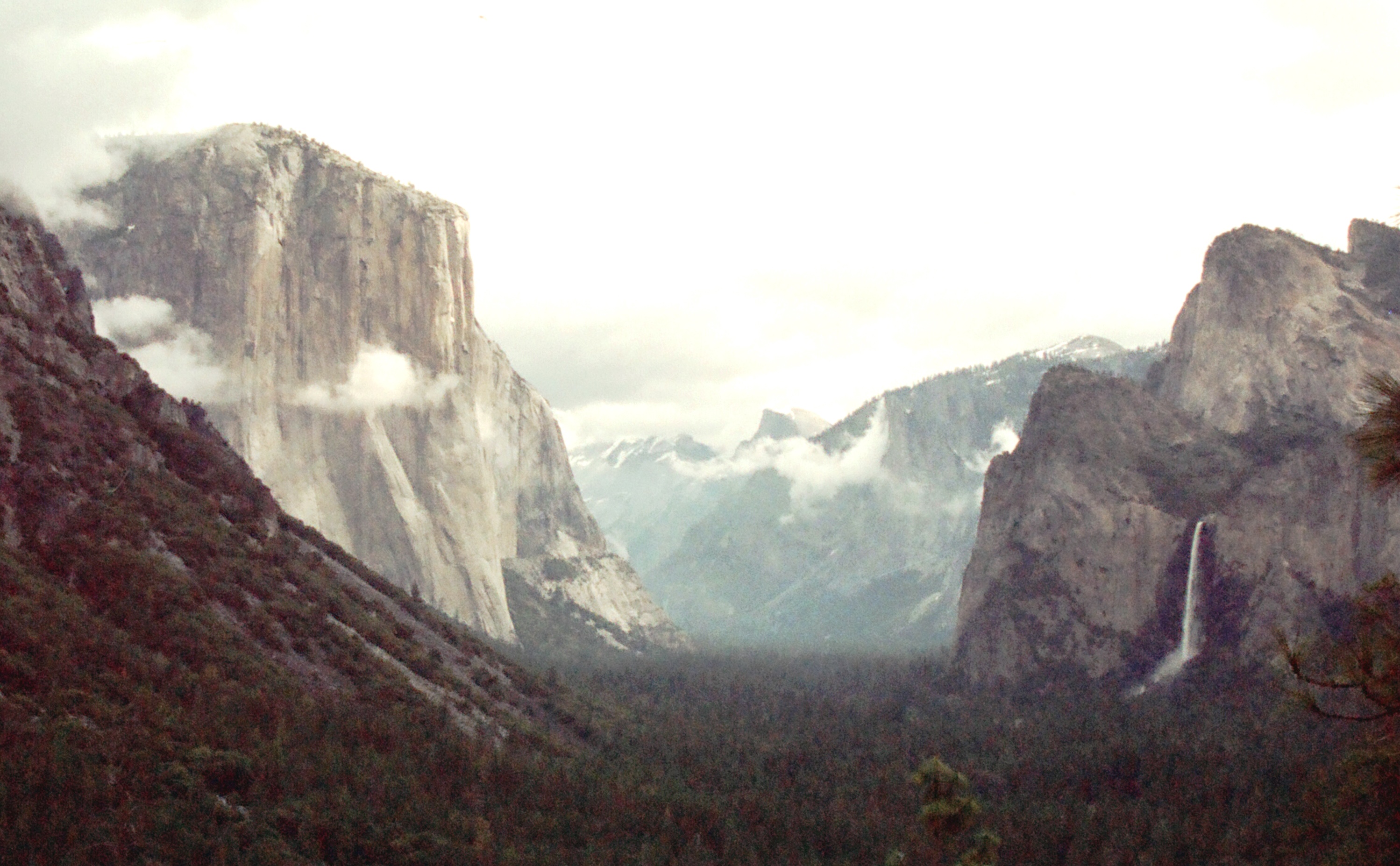
We only visited once, but I’ve never forgotten it.
Yosemite National Park, California, 1992
“You cannot stay on the summit forever; you have to come down again. So why bother in the first place? Just this: What is above knows what is below, but what is below does not know what is above. One climbs, one sees. One descends, one sees no longer, but one has seen. There is an art of conducting oneself in the lower regions by the memory of what one saw higher up. When one can no longer see, one can at least still know.”
― René Daumal
Daumal’s words are likely to ring true for most of us, I think. Whether we glimpse that “higher up” view through our religious experiences, through the satisfaction of attaining a long-sought goal, or through supreme moments of joy with friends and loved ones, our souls will feed on the memory long after the exaltation has passed.
When I read the quote above, I was reminded of a song my friend Ellis used to play on her guitar and sing to me during our college years. It was called “John Henry Bosworth” and it was written by Paul Stookey. As with many of the songs with which Ellis could always sing my blues away, the entire thing has stuck with me all these years and I’ve sung it often. This despite my never having heard the original version by Peter, Paul & Mary until I looked it up on YouTube to hear it while writing this post. (I must admit, I liked it better when Ellis sang it, even though I generally enjoy Peter, Paul & Mary. Their version is a bit more “twangy” which is not my favorite style. But I digress.)
The song has a very appealing message of a family whose happiness transcends the turbulent circumstances in the world around them. The story of Bosworth and his family is summed up in this final verse:
And I was wondering if you had been to the mountain
To look at the valley below?
Did you see all the roads tangled down in the valley?
Did you know which way to go?
Oh the mountain stream runs pure and clear
And I wish to my soul I could always be here
But there’s a reason for living way down in the valley
That only the mountain knows
Most of us are blessed with at least a few of these mountaintop experiences that give us the ability to see beyond our immediate situation. While some have many more such happy memories than others, the opportunity is there for each of us to climb higher up and get the unique perspective that will inform our conduct as we live in the valleys. Of course, in this life we cannot remain at these lofty heights. But as Daumal reminds us, what we cannot see, once glimpsed, becomes something we can still know.
This post was first published seven years ago. The original post, comments and photo are linked, along with two other related posts, below. These links to related posts, and their thumbnail photos, do not appear in the blog feed; they are only visible when viewing the individual posts by clicking on each one. I have no idea why, nor do I know how they choose the related posts. That’s just the way WordPress does things.
The month of expectation
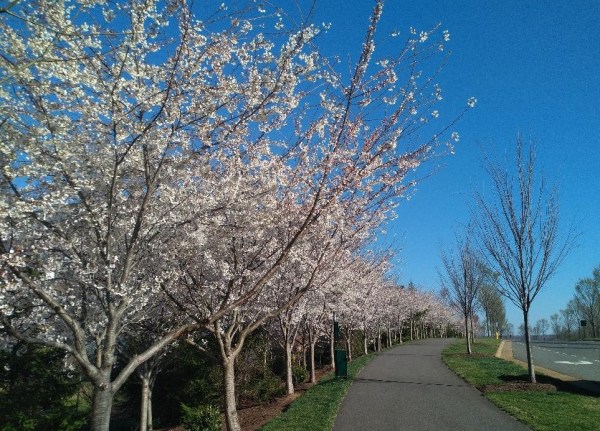
I took this photo on my daily walk to the river, March 27, 2025
“March is the Month of Expectation.
The things we do not know – …” —Emily Dickinson
In springtime, we rejoice in what we do know, or have reason to expect: the reflowering of blooming trees and annuals, the lengthening of daylight, the gradual warming and the sheer delight of those first mild, sunny days. Until reading Dickinson’s, poem, though, I couldn’t remember thinking of March as a month of expectation. But on reflection, I think she is right.
For most of us, spring brings a renewal of hope. We may be emerging from a season of intense grief, or simply weary of the chill of winter. But it’s a rare soul who can be unmoved by the awakening of a new cycle of nature’s growth.
I suspect that the resurgence of the plants and animals is a parallel to what happens to humans. We too feel a sense of expectation, alert to the possibility of new blooms that may spring up within us. We diligently tend the existing growth of our inner gardens, carefully weeding out what is harmful to balanced harmony.
Many of us have learned, not without reason, to be fearful of the things we do not know. But I’ve come to realize that ignorance of what lies ahead can be a great blessing. And there are always enough delightful surprises to keep us looking forward with anticipation. I wish you a springtime filled with “unknown blessings already on the way.”
Hard to imagine
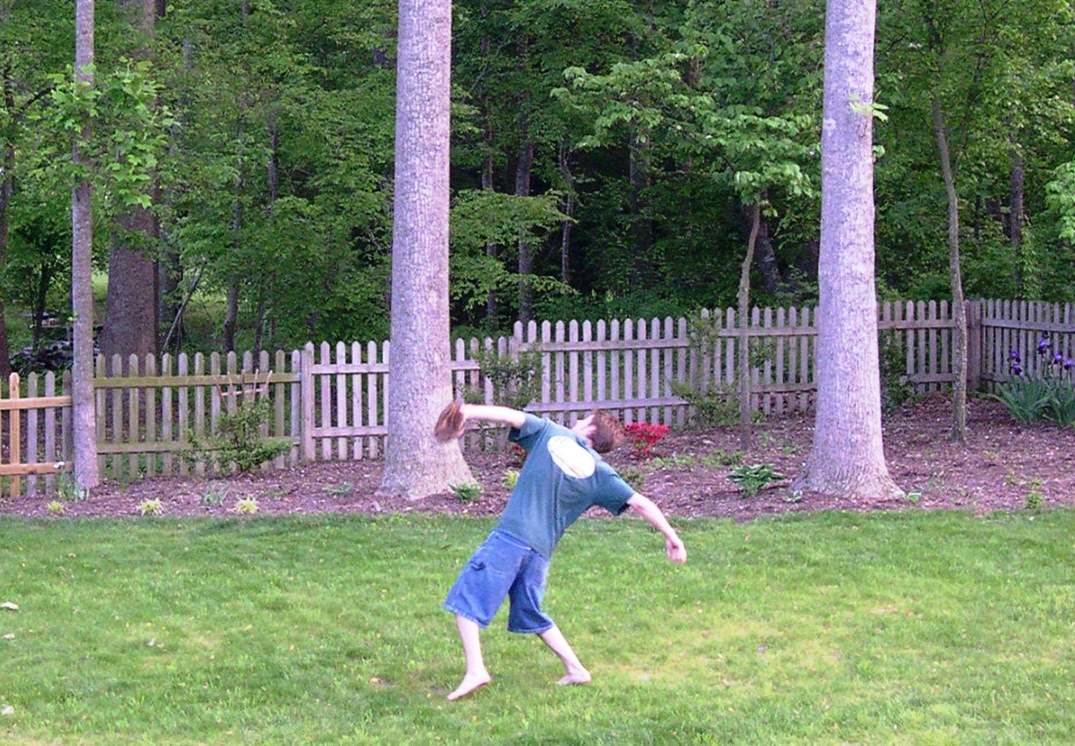
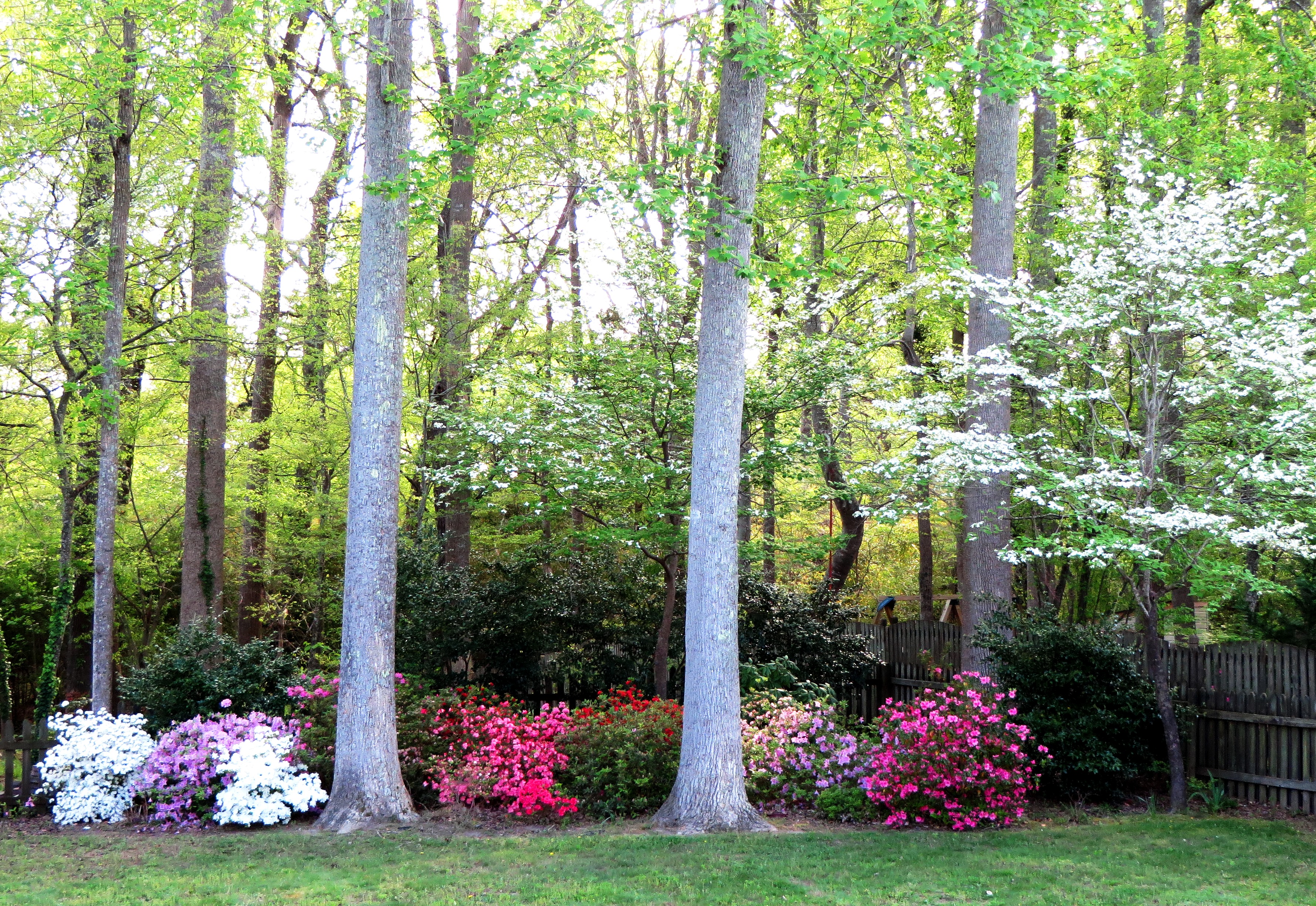
What a difference 12 years can make! Then and now:
our York back yard in 2005, the year after we moved to Virginia, and 12 years later, last spring.
“Instead of running away from our loneliness and trying to forget or deny it, we have to protect it and turn it into a fruitful solitude. To live a spiritual life we must first find the courage to enter into the desert of our loneliness and to change it by gentle and persistent efforts into a garden of solitude. This requires not only courage but also a strong faith. As hard as it is to believe that the dry desolate desert can yield endless varieties of flowers, it is equally hard to imagine that our loneliness is hiding unknown beauty.” ― Henri J.M. Nouwen
Sometimes when I cannot imagine any path to a happy future for myself, it helps to remember that most of life’s changes are gradual, and are as inevitable as the abrupt, more devastating crises. Whether positive or negative, change is happening even when we are scarcely aware of it. And change is not always about loss.
Looking at the photos above, I am startled to see the bare look of that back right corner of the fenced portion of our yard. I honestly don’t remember it ever looking like that, and I’m grateful that this photo I snapped of Drew practicing baseball happened to include it in the background. Otherwise it would have been lost to memory forever, as the azaleas we planted over the next few years grew and bloomed, and the camellias that were barely visible became full and taller than we are.
Though outwardly my life is still encumbered with seemingly as many responsibilities as ever, on a personal level my landscape feels as bare as the corner ground in that first photo. I have no way of knowing whether I will live long enough to see the desert of my loneliness become a garden of solitude; whether I will ever discover any unknown earthly beauty that might be hiding in the future.
One thing is certain: I’m not trying to run away from being alone. I want whatever years I have left to be fruitful ones, and as the author Jan Karon once wrote to me, “Talents are best nurtured in solitude.” She included that quote from Goethe in her inscription of an unexpected gift she mailed me, one of her books of quotations, along with a handwritten letter of encouragement. This timely gift, which felt and still feels like a small miracle, arrived in my mailbox near the end of 2005, the year that first photo was taken. Perhaps Karon’s love of quotations fed mine, and helped to inspire this blog when Jeff was diagnosed with cancer seven years later. The seeds of kindness she planted carried unpredictable possibilities within.
Do you ever feel lonely? Have aging, health challenges, the loss of loved ones, or distance from family members (geographical or emotional) isolated you, leaving bare ground in your life just waiting to be cultivated? As hard as it might be to imagine the results, I invite you to join me in the gentle and persistent effort that, with time and patience, might grace the years to come with blossoms yet unseen.
This post was first published seven years ago. My desert has indeed become a garden of solitude I couldn’t have imagined, sometimes messy but always with a unique beauty. My ordinarily private garden is often populated by others, as solitude now can be with the advent of virtual connection, and sometimes there is the joy of visiting with dear ones in person, whether at home or abroad.
This post was written before the Covid shutdown enabled me to take my first classes online at Oxford, leading to my current studies there. I also wrote it before the multiple crises in Matthew’s health and mine during the past four years. Through it all, there have been continued painful goodbyes along with joyful new connections or re-connections. Looking back, I see unmistakable confirmation of God’s continued blessing and mercy.
The original post, comments and photo are linked, along with two other related posts, below. These links to related posts, and their thumbnail photos, do not appear in the blog feed; they are only visible when viewing the individual posts by clicking on each one. I have no idea why, nor do I know how they choose the related posts. That’s just the way WordPress does things.
Slow walking
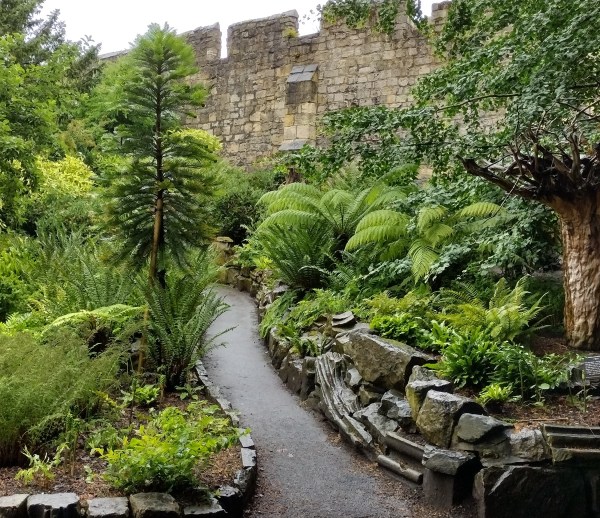
This path leads to one entry point of the York Wall, great for slow walking.
York, England, July 2023
“…as a pilgrim, travel is made holy in its slowness. I see things that neither the passengers of the train nor the drivers of the automobiles see. I feel things that they will never feel. I have time to ponder, imagine, daydream. I tire. I thirst. In my slow walking, I find me.” ― Kevin A. Codd
For me, walking is an activity that never grows old. I hope to be able to indulge my love of walking for many years to come, but at my age, I rejoice in every day that I’m able to do it easily and without pain.
One reason I so love England is that it’s a wonderful place to go walking. Even with the difficulties of those charming cobblestones so often found there, or the frequency of rainy weather, or the temptation to use their wonderful train and bus systems, my favorite memories are of the times I’ve spent there walking as slowly as I like, taking pictures and loving the feeling of simply being there.
The ancient city of York has a wall that circles the town, and in 2023 I decided to walk it again. I had walked part of it during my visit there in 2001, but didn’t remember much of it. On walking the entire two miles on my recent trip, I realized I had only seen a relatively short part of it before. There was a light rain, and terrified as I was of falling off the steeper and more precarious areas, I kept going even where there were no protective railings or anything to hold to for safety. One thing that kept me going was realizing that turning back was likely to be just as risky as going forward! So I pressed on, praying for safety and pausing frequently to snap a picture or two. I wouldn’t do it again, but I was glad to be able to complete that walk and see things from a vantage point unavailable any other way. And I have some great photos to prove I lived to tell the tale!
But I don’t have to be walking some challenging path such as the York Wall to enjoy the energizing effect of a good walk. I don’t even need to be in England. My own neighborhood is perhaps my favorite walk of all, and I felt the same way about the long walks I took daily from our Yorktown home. Just as you can’t step in the same river twice, you can never take exactly the same walk twice. And while you’re walking, you’ll be experiencing new thoughts and daydreams, making the walk more than just a routine. If you’re not a fan of walking, I invite you to try it. It may be an acquired taste for you, but there’s no telling what you’ll discover– outside or inside your mind!

This marker is a few steps from the path pictured above.
These informative signs are placed at several points along the wall.
Mostly standing still
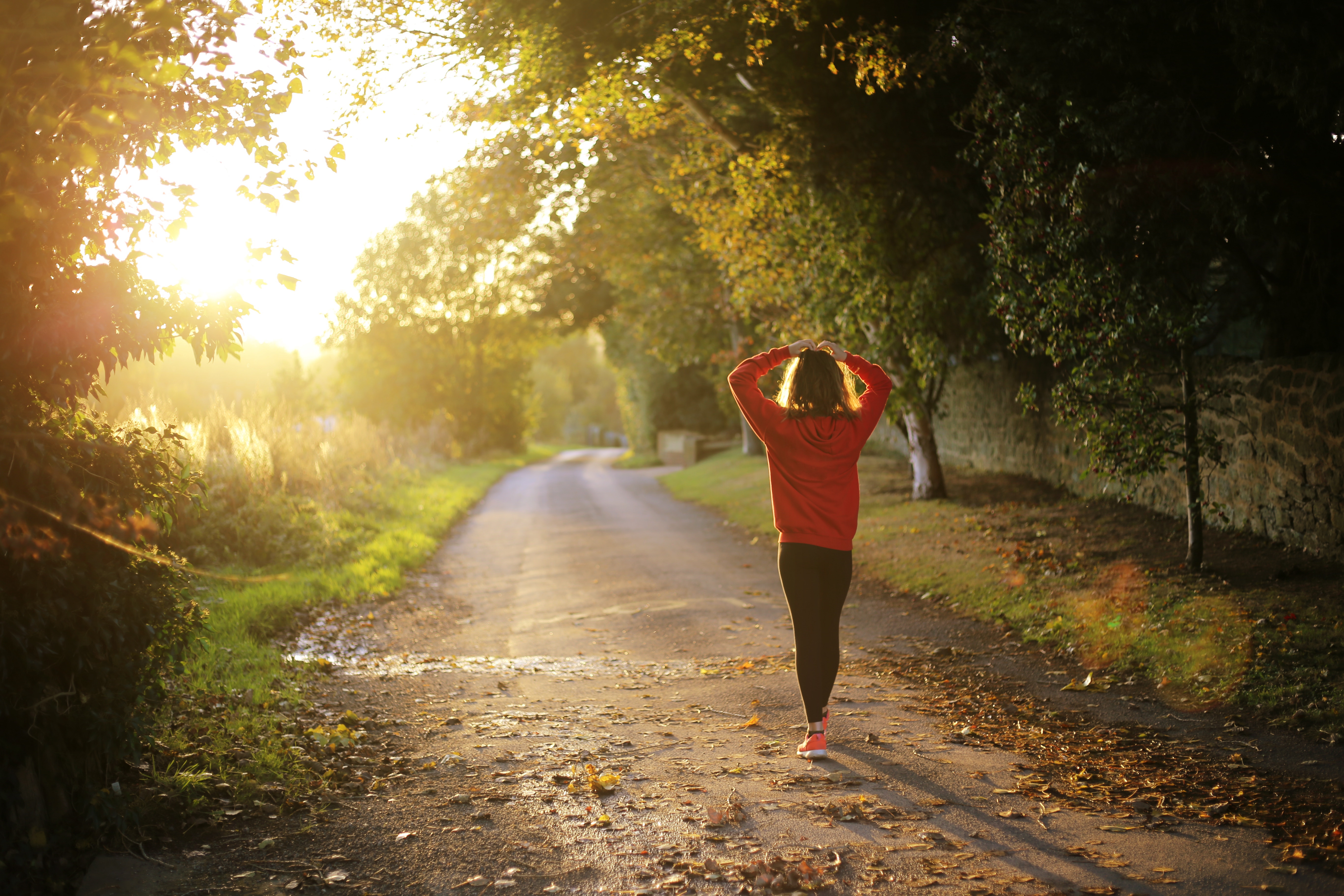
West Sussex, England — Photo by Emma Simpson on Unsplash
Are my boots old? Is my coat torn?
Am I no longer young, and still not half-perfect? Let me
keep my mind on what matters,
which is my work,
which is mostly standing still and learning to be
astonished. — Mary Oliver
Bereavement, grief and aging are slicing through much of what once seemed inviolable to me. Not only has my life changed; I’ve changed as well. And I find that other people in my life have changed, too, whether from circumstances in their own lives, a discomfort with proximity to the magnitude of what I’ve endured, or some combination of both.
It’s painful to realize that most of what once lent meaning to my daily effort is now gone, rendered irrelevant or exposed as illusory. The blessing in the falling away of so many distractions is the increased time for standing still and learning to see larger, more impressive vistas that may have been obscured by busyness or trivial worries. And very little, it turns out, is about me at all. What a relief!
For those of us granted a long life, so much abides through the seemingly endless losses. How breathtakingly enormous a universe, that even our limited portion of it is filled with wonder and delight! What astonishes you today? Start with the view outside your window right now, and let your mind wander into infinity briefly before you return to your less important work.
This post was first published seven years ago. As so often before, I find it remarkable that the thoughts I expressed here have only grown more relevant to my life after the passage of seven years. How could I have already known then what now seems so tied to recent experience? And what am I doing now that will seem meaningless seven years hence, if I am still alive? That larger vista grows ever more impressive!
The original post, comments and photo are linked, along with two other related posts, below. These links to related posts, and their thumbnail photos, do not appear in the blog feed; they are only visible when viewing the individual posts by clicking on each one. I have no idea why, nor do I know how they choose the related posts. That’s just the way WordPress does things.
Rejoice in spring
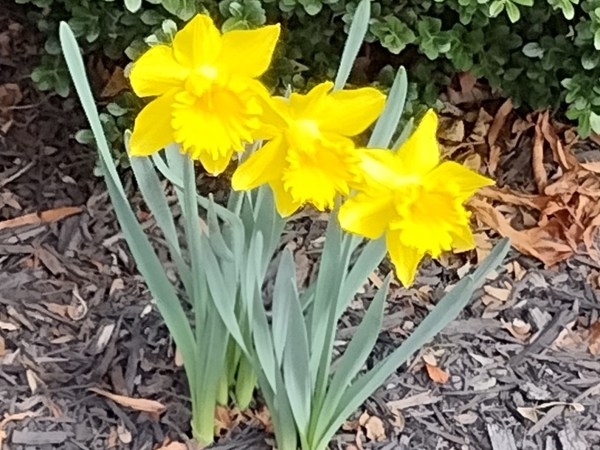
These faithful flowers just broke into bloom yesterday.
Here they are on March 1, 2023.
“I rejoice in the spring, as though no spring ever had been.” —Theodore Roethke
Spring was later to arrive this year than I can ever remember. Or did it only seem that way because I was so eager for it? A bit of photographic research gave me the picture above, which I took on March 1, 2023. To be fair, these blooms had probably arrived at least a few days before that, because they do last a long time if one avoids the temptation to cut them and bring them indoors. Although even then, they last a surprisingly long time. That’s one reason I love them.
Usually the daffodils and Okame cherry blooms surprise me with how early they arrive. Not so this year. In fact, other than the calendar, the first sure sign I had of springtime was the nightly song of the tree frogs, which I confused with birdsong the first year I moved here. They sing all night long, into the dawn, but I only hear them from my bathroom. They never disturb my sleep.
I was especially grateful to those sweet frogs this year, for reassuring me that spring really was on the way even if the flowers and trees seemed not to have awakened yet. I remember how much fun my sister and I had watching these adorable tiny green visitors fastening themselves to my patio door, catching insects that were lured by the indoor light as dusk faded to night.
I am still profoundly missing my sister, with whom I shared my joy of springtime in person or through photographs of sunrises and flowers taken in the early mornings. My springtime rejoicing is therefore somewhat muted this year, but all the more needful to me at this season of my life.
Whether you are looking forward to the warming of springtime in the northern hemisphere, or the cooling of autumn south of the equator, I wish you all the joys of cheerful color and milder temperatures. I’m grateful for seasons! Aren’t you?

I took this one yesterday.
The trees and grass aren’t in springtime mode yet, but the Okame is!
Bringing people together
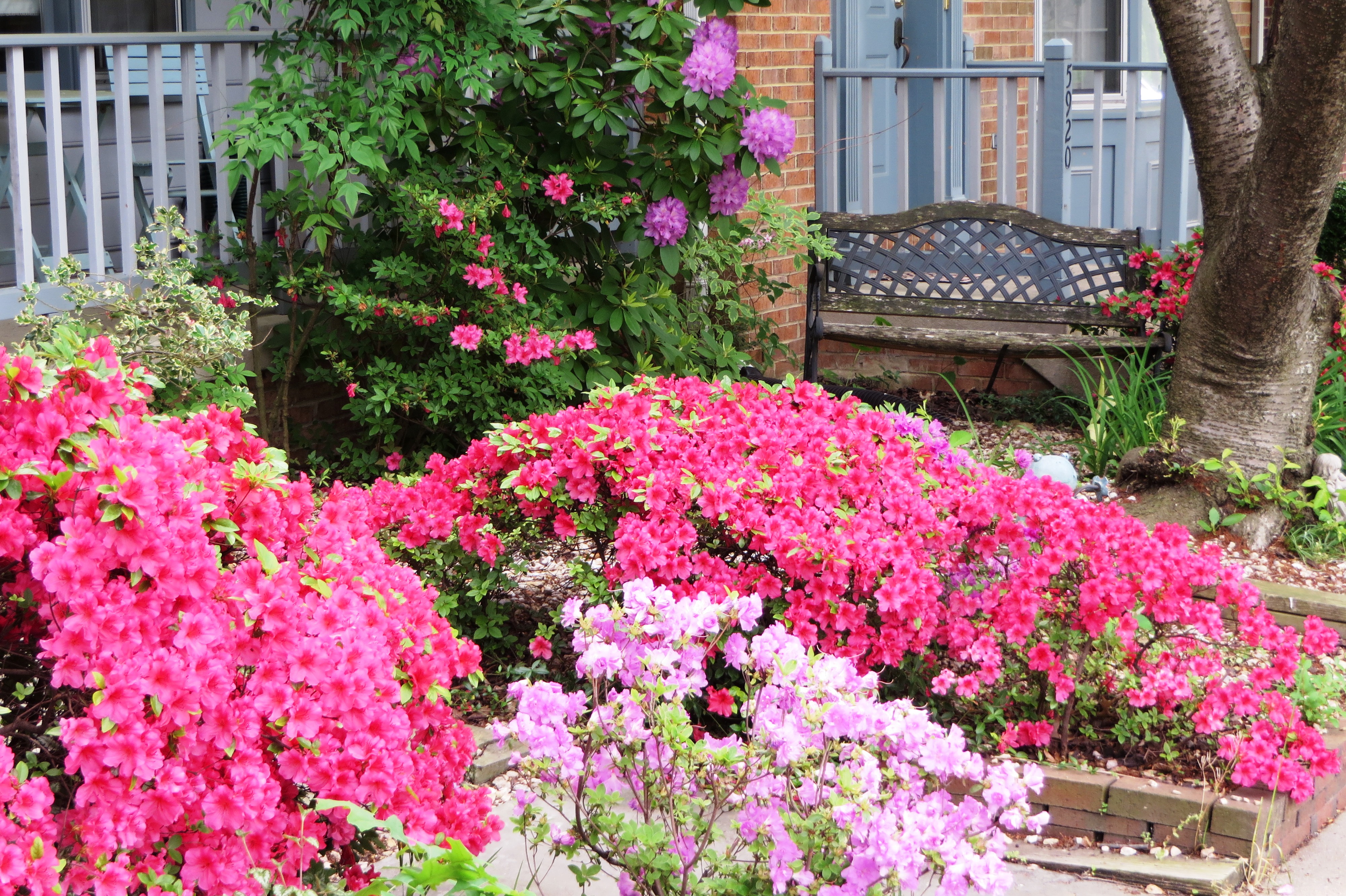
Our neighbor’s front yard is tiny but welcoming. Alexandria, May 2015
“Gardens and flowers have a way of bringing people together, drawing them from their homes.” — Clare Ansberry
As a context for visiting with neighbors, I think gardening is second only to walking a dog. Whenever I’m out working in the yard or the flowerbeds, I always end up having friendly chats with neighbors who stroll by. And when I’m out walking, I love to greet others who are tending their lawns and gardens. We cheer each other on, swap tips and information, and commiserate about the woes of the weather, or hungry rabbits and squirrels and deer and insects, or anything else wreaking havoc with our efforts to beautify our little corner of the world. From neighbors I’ve learned about so many delightful shrubs and annuals and flowering vines, marveling at how much fun it is to enjoy the fruits of someone else’s efforts.
I think Ansberry used an apt phrase when she wrote of gardens drawing people from their homes, and in our era, we need that as never before. I can still remember the days before air conditioning, when adults would sit outside in the evening to enjoy cooler temperatures after heating up the kitchen with cooking dinner, and my neighborhood friends and I would play outdoor games until dark, or even later. For better and worse, those days are gone and I doubt they will ever return.
Now that we are ensconced in climate-controlled comfort, surrounded by abundance and our favorite furnishings, foods and fun, it’s hard to want to leave our indoor nests. We need not feel isolated when we can so easily talk, text or Skype with anyone anywhere in the world, even if we are still in our pajamas and robe. Being at home can combine the best of privacy and sociability, connecting us to each other from the safety of our separate cocoons. Weather, distance, gas prices– none of these things spoil the joy of staying home. But as much as I love spending time inside, I still think we are missing out if we never go outdoors and get to know our neighbors.
Gardening is an ideal way to meet people in a casual, unplanned setting. Whether we tend a flowerbed or just a single plant, we end up with much more than what we start with, even if our botanical results are less than optimal. Scientists agree that it’s therapeutic. For those who live where springtime is on its way, it’s the perfect time of year to get started. If you’re heading into autumn, remember that each season brings fresh delights (and specific tasks) that might be calling your name.
Our weather is expected to be chilly this week, but when I wrap up and work outdoors, I almost always end up peeling off my outer coat because the chores, strenuous or not, warm me up quickly. So I expect to be spending some more time outside over the next few days. I hope you enjoy a some sunny days this week or very soon. Tell us what you are planning and planting– and tell your neighbors hello for us!
This post was first published seven years ago. The original post, comments and photo are linked, along with two other related posts, below. These links to related posts, and their thumbnail photos, do not appear in the blog feed; they are only visible when viewing the individual posts by clicking on each one. I have no idea why, nor do I know how they choose the related posts. That’s just the way WordPress does things.
Do something
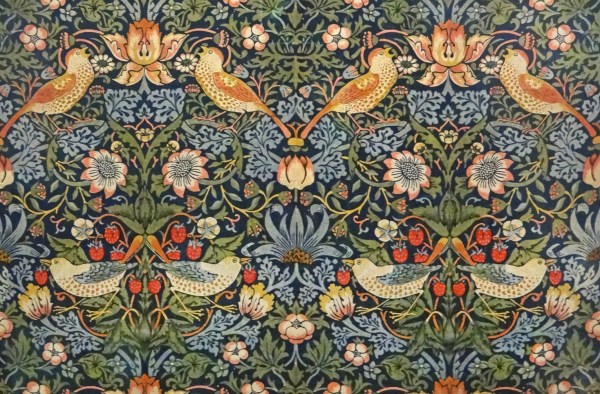
“The Strawberry Thief” print by William Morris.
The Victoria and Albert Museum, via Wikimedia Commons
“A good way to rid oneself of a sense of discomfort is to do something. That uneasy, dissatisfied feeling is actual force vibrating out of order; it may be turned to practical account by giving proper expression to its creative character.” —William Morris
William Morris certainly earned the right to give us this advice. He turned his creative gifts toward practical uses as an architect, furniture and textile designer, artist, and writer. His textile, wallpaper and home furnishing prints remain popular to this day. In fact, I have some lovely placemats and a mug that feature the design pictured above, which is one of his most famous.
Those who have been reading this blog for a few years might recall that I’ve featured three other quotes from Morris in various posts. I admire how he championed the art of making beautiful, practical things, filling homes with items that are both useful and attractive.
His Kelmscott Press brought beauty back to the printed book, inspired by the illuminated manuscripts of centuries past. During graduate school I did a presentation on the Kelmscott Press and and the role Morris had played in publishing over a century ago. My professor arranged for the Rare Books collection of the Hamilton Library (at the University of Hawaii) to loan a few original Kelmscott volumes for use in my lecture. I was familiar with how closely guarded these items were, and how many restrictions were attached to their viewing– nothing could brought into the examination room, gloves had to be worn, and so forth. So I was surprised they agreed to have my professor borrow them temporarily on my behalf.
Wouldn’t you know, I was so nervous about handling them in front of the class that I dropped one of the books! I was immensely relieved to find, on close inspection, that no damage was done whatsoever. This century-old book was still durable and sturdy. So Morris was certainly practical about the binding of this piece of artistry, designing it to endure long years of use.
Aren’t we fortunate that Morris understood the value of useful action as a channel for creative energy? I lack his genius, but I too have learned the wisdom of having many functional ways to occupy myself, each of them creative in its own way. During the many times of crisis and grief I’ve survived the past twelve years, I have never yet seen a time when doing something did not immediately improve my inner climate. It might be taking a walk, washing the dishes, writing a friend, organizing my books, working on crafts, or exercising to some favorite lively music. If weather allows, working outside in the flower beds is perhaps the best therapy of all. And of course, it’s always a good idea to put the kettle on for a fresh cup of tea!
What kinds of activity do you keep on hand in your “defeat despair” arsenal? Have you explored any new ways to give expression to your own creative character?

The fog of the future
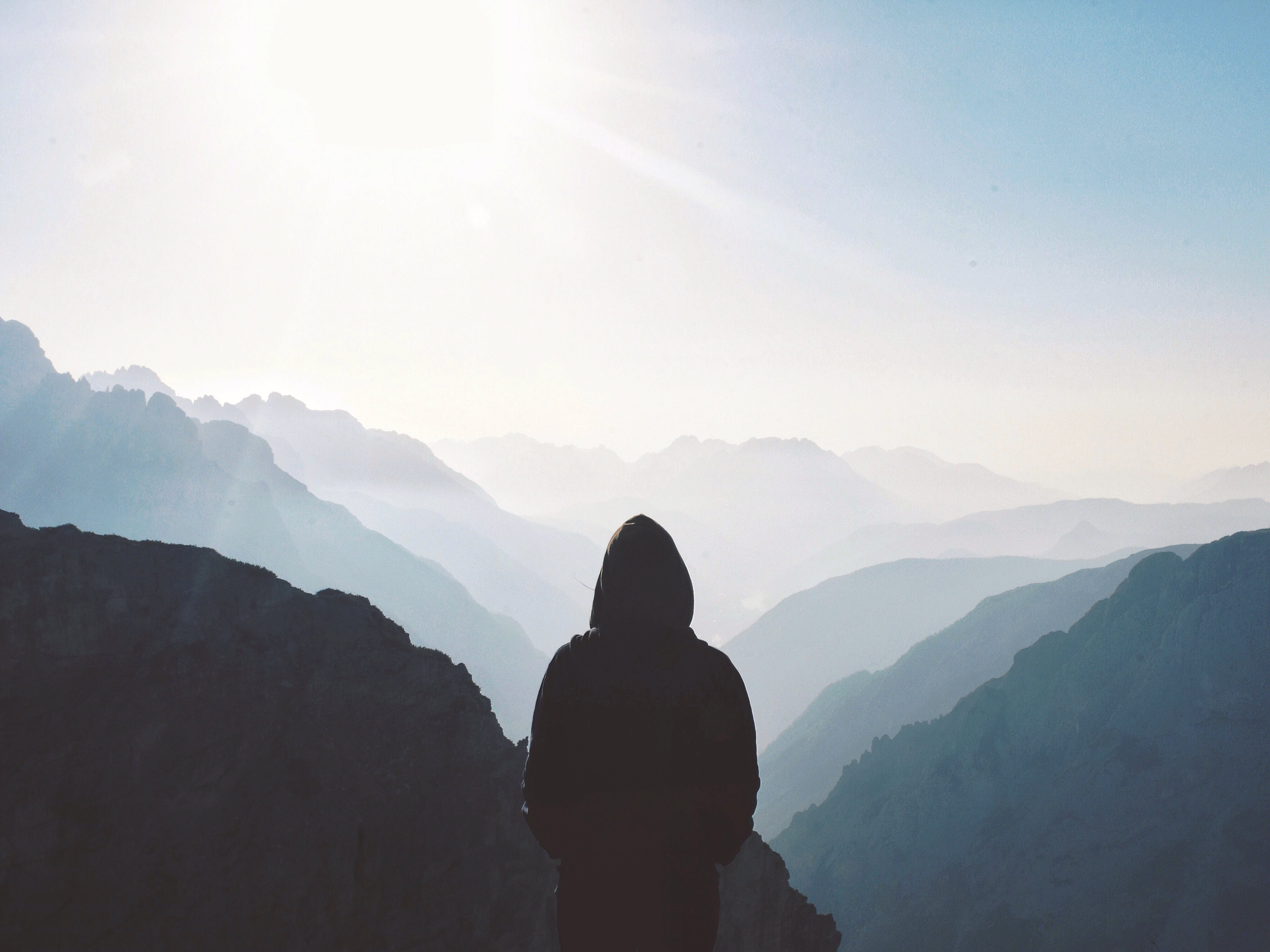
Tre Cime di Lavaredo, Italy, photo by Matt Sclarandis via Unsplash
“Today is mine. Tomorrow is none of my business. If I peer anxiously into the fog of the future, I will strain my spiritual eyes so that I will not see clearly what is required of me now.” – Elisabeth Elliot
I’ve heard it said that anger is really fear in disguise, and I’ve seen a good bit of evidence that this must be true most of the time. Our greatest animosity tends to focus on people or things we perceive, accurately or not, as a threat to our lives, our loved ones, or even more trivial things such as our time, space or convenience.
For most who will be reading this blog, the truly urgent or immediate threats are relatively rare. Yet we still find ourselves anxious about the future, even if what we fear is vague and undefined. I’ve noticed, for example, that I tend to get most frustrated on days when I can’t seem to get as much done as I hope to do. I usually can’t pin this down to a looming deadline, since I long ago retired from work outside the home. I have the luxury of structuring my time according to the daily changes and fluctuating requirements of my own life rather than those of a corporation or a demanding boss. Why, then, do I feel such fear (which almost always manifests itself as frustration, impatience and finally anger) when I am unable to meet some self-imposed goal usually based on generalized worries about the future, whether “the future” is later this week or years from now?
As I work through the layers of grief over the losses of the past few years, one of the most important survival tools is granting myself permission, again and again, to go as slowly as I need to go, and to rest as much as I can, whether or not there are tasks awaiting (as there always are, for all of us). Staying focused on the present allows me to pay more attention to what am doing right now than to what I haven’t yet done. It’s surprising how therapeutic most tasks can be, if I don’t allow my mind to wander and ruminate about how many other things I have left to do.
For some people, the skill of staying in the present seems to come more easily than it does to those of us who are anxious types. If the task at hand is a fairly mindless one, I’ve found that listening to lively music, an interesting podcast or an engaging audiobook can reign in my tendency to let my mind wander into stressful territory. So does making a list of what I want to get done, which somehow seems to transfer the good intentions to a confined space on paper rather than letting them stroll around my psyche calling attention to themselves when I’m busy with something else.
How about you? A few minutes ago, when you read the words “tomorrow is none of my business,” did you find yourself reflexively arguing with that claim, as I did? Do you fear the future, or look forward to it, or some combination of both? How do you avoid spiritual eyestrain so that you can see clearly what most needs your attention now?
Daffodil update:
For those who read last week’s blog, here’s a photo of how they looked when I pulled them out of the refrigerator one week later. As I write this, they look every bit as perky as when I picked them. Now the doubles are blooming out front, and tomorrow I plan to make another bouquet.
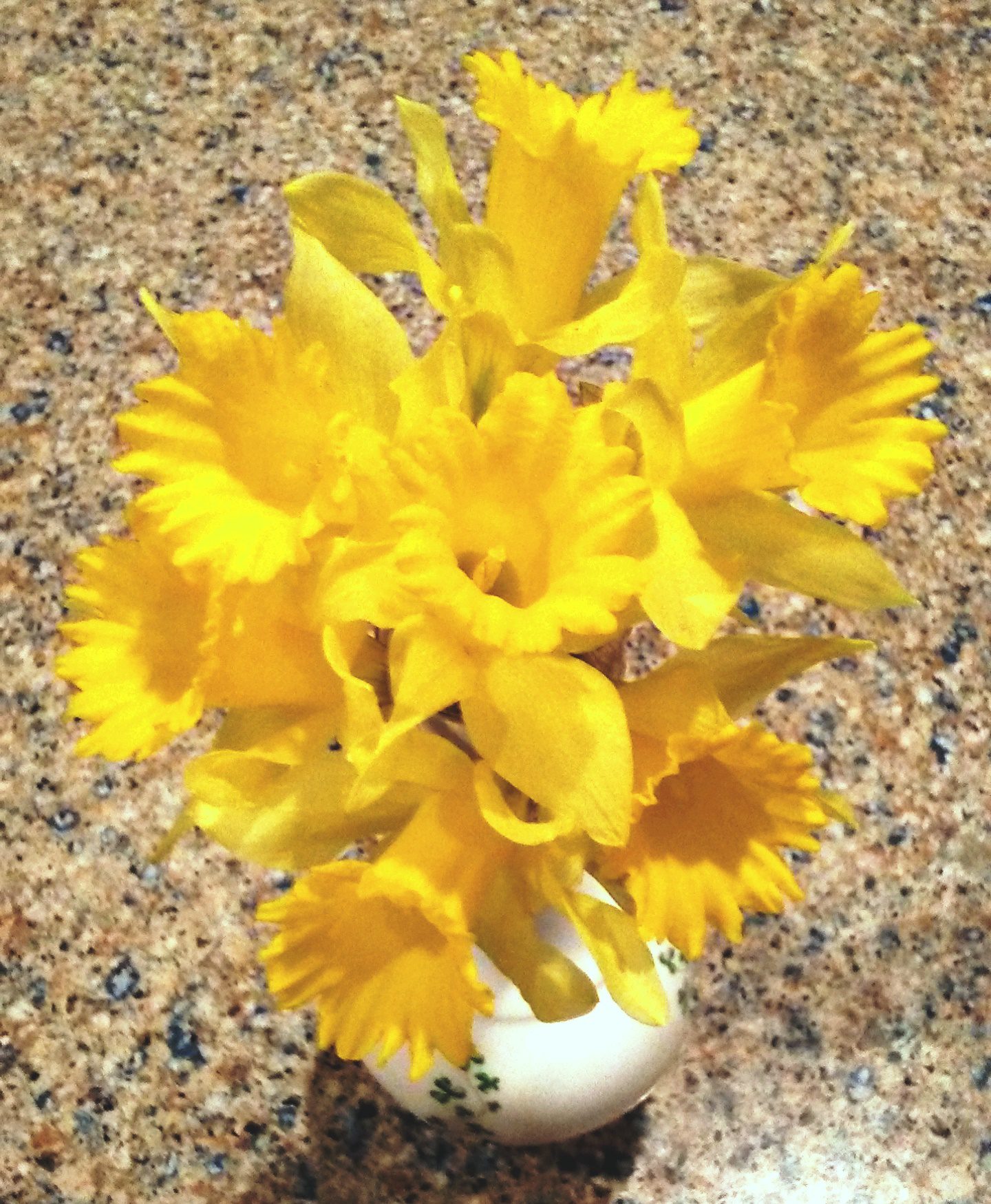
One week later, still bright and cheery!
This post was first published seven years ago. The original post, comments and photo are linked, along with two other related posts, below. These links to related posts, and their thumbnail photos, do not appear in the blog feed; they are only visible when viewing the individual posts by clicking on each one. I have no idea why, nor do I know how they choose the related posts. That’s just the way WordPress does things.
Wonderful silence
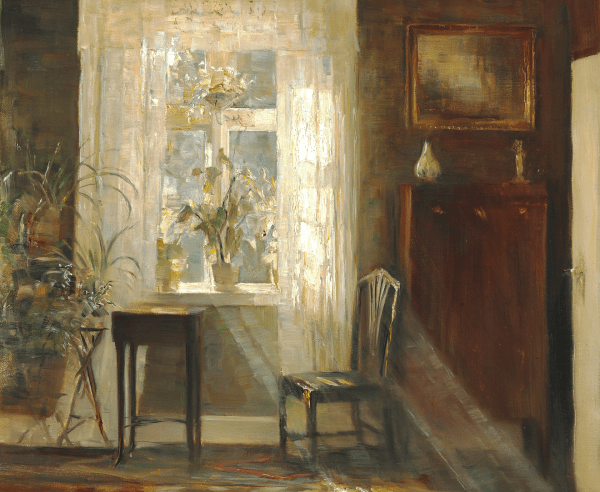
Detail from “Sunshine in the Living Room” by Carl Holsøe.
Public domain image from Wikimedia Commons
“Have you ever heard the wonderful silence just before the dawn? Or the quiet and calm just as a storm ends? Or perhaps you know the silence when you haven’t the answer to a question you’ve been asked, or the hush of a country road at night, or the expectant pause of a room full of people when someone is just about to speak, or, most beautiful of all, the moment after the door closes and you’re alone in the whole house? Each one is different, you know, and all very beautiful if you listen carefully.” ― Norton Juster
After so many years living mostly alone, which followed decades of living with a man who was very quiet in his speech and habits, I have learned to depend on having quite a lot of silence. I’ve never watched television, and I can’t tolerate commercials. I seldom play the radio except when I’m driving. I don’t even talk on the telephone very much, which is something that puzzles and sometimes annoys a few of my friends. Audiobooks, streamed period dramas or favorite music are the sounds I enjoy most often. But I love silence, and I’ve never felt the need to fill it with any sort of background noise.
I know this is fairly unusual; most people are unable to indulge in long periods of quiet even if they want it. If silence is rare for you, or if you’re someone who adores the flurry of activity that makes up a busy life, there will nonetheless be opportunities to grab moments of quiet to savor. Juster points out some that are often overlooked, especially when they come sandwiched between periods of prolonged auditory stimulation or stressful demands. At such times, it can be all the more important to listen for these gifts of stillness. What beautiful things will you hear in the silence today?
One day
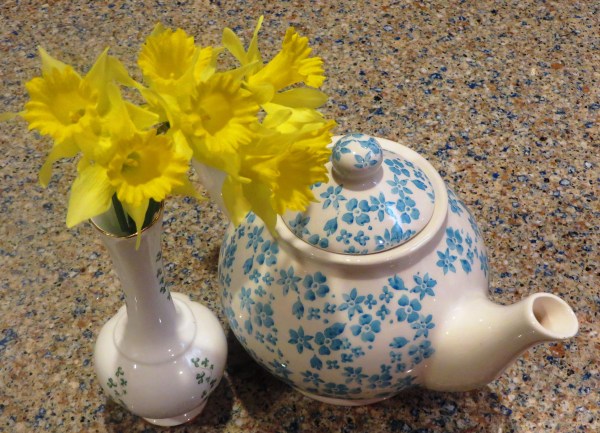
These little flowers brightened my kitchen all week, February 2018.
“I have wandered far upon the desert plain, but in my heart a bird keeps singing, and the daffodils beckon and blow, — and one day I shall wander back.” — Muriel Strode
Last week was a good one for me, but it began on a gloomy note. I spent most of the week at our York home, where I had hoped to get some yard work done in the unseasonably warm weather. But the first day I was there it was rainy and overcast, and there was little I could do outdoors. The rain exacerbated my sad and lonely mood.
I decided that I would at least begin to prioritize what to do if it turned sunny. Taking advantage of the 60-degree temperature that made the soggy ground more bearable, I strolled around the wooded area behind our back yard, which comprises about a third of our lot. This area lies outside the fence, and I jokingly dubbed it the Lower 40 when we first moved there almost 14 years ago. It was only the second time I had been back there since Jeff died. As with so much else, it is still redolent of dashed dreams and lingering loss.
The setting was fraught with that peculiar melancholy common in late winter, when much is dead and bare, left messy and moldering by the weeks of cold. Jeff’s long illness meant that the woodland we had once tended so lovingly was neglected for several years, and I silently resigned myself to the very real possibility that it would remain so as long as I own the property.
As I neared the creek that forms the back boundary of our lot, I was flooded with joy at the unexpected sight of daffodils blooming in mid-February. There is a tiny patch of them on the creek bank that have been growing wild there for as long as we’ve lived nearby. For some reason, though they are growing in full shade, they always bloom earlier than the larger daffodil bulbs I planted in various sunnier spots in the front and back yard.
I love to see them each year, and I’m always tempted to pick them or dig them up and transplant them, since the only eyes likely to see them are mine and those of the deer and other creatures who come to the stream to drink. Usually I decide to leave them where they are, gracing an otherwise drab scene. If I’d had my camera with me, I probably would have taken a photo or two, and left them alone.
But that day, it seemed they had appeared just for me, almost calling out my name. I picked several of them and brought them inside where I enjoyed them all week. They were still blooming when I left, so I changed out the water in the little vase and put them in the fridge to see if they would keep while I was gone. I’ll let you know how that turns out.
By morning light…
I think I’ve mentioned here before that daffodils have always been my favorite flowers. I still have a dried one from the bunch Jeff brought to me at the hospital on the morning Drew was born. They seem irrepressibly cheerful to me, their yellow color and unique form putting a smile on my face no matter how I might feel before I first spot them.
…and when the late afternoon sun hit them.
More than any other flower, they beckon me to believe in the springtime to come, literally and figuratively.
I hope that your week will hold everyday surprises that brighten your days as my little flowers have brightened mine.
This post was first published seven years ago. The original post, comments and photo are linked, along with two other related posts, below. These links to related posts, and their thumbnail photos, do not appear in the blog feed; they are only visible when viewing the individual posts by clicking on each one. I have no idea why, nor do I know how they choose the related posts. That’s just the way WordPress does things.
Neatly-arranged and well-provisioned
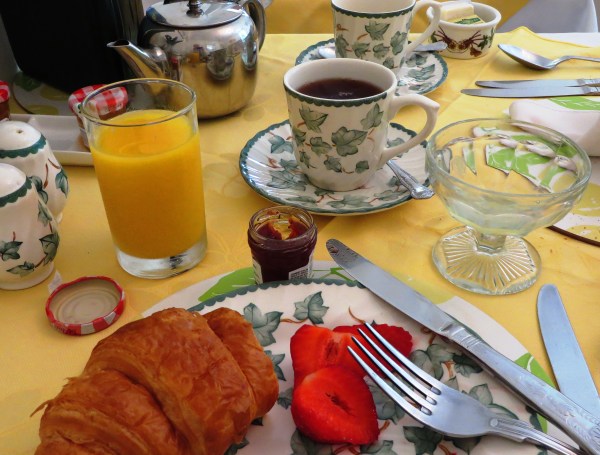
Just the beginning of a sumptuous daily breakfast at Gables Guest House, Oxford, June 2017
“Life, within doors, has few pleasanter prospects than a neatly-arranged and well-provisioned breakfast-table.” ― Nathaniel Hawthorne
I certainly agree with Hawthorne. Perhaps the beautifully bountiful breakfast was as special in his age as it is in ours; likely even more so. I’m sure the time to enjoy a leisurely morning meal was a luxury for his generation, and fresh food was far more scarce and dependent on seasonal vagaries during his era. In any case, sheer delight at the chance to begin the day with a savory selection of tasty fare is a pleasure we have in common with countless people throughout the centuries and all over the world.
My favorite vacation destinations– bed and breakfast inns, cruise ships, and the homes of dear friends– all feature memorable moments lingering over coffee or tea along with an assortment of items such as fresh fruit, eggs, cereals, sides and baked goods. Though it starts rather than ends the day, I’ve always found that a full breakfast feels more relaxed, even when the table is graced with fine linens, crystal and china. I can’t recall ever worrying about which fork to use, or wondering whether anybody noticed that I spilled a few drops of tea every time I poured more into my cup.
Maybe a nice breakfast feels more special because most of us rarely take time for it. Regardless of the age-old (and largely disregarded) advice that it’s the most important meal of the day, I’m guessing that time constraints, less appetite, or force of habit usually mean that many of us eat less in the morning than we do at noon or evening meals. If that’s true for you, I hope that you find the time on weekends or days off to make breakfast a special occasion.
You may have read here that Jeff loved to cook a full breakfast every Saturday, a habit he formed nearly 20 years ago. I’m thankful for each and every weekend he insisted on taking the time for it, right up to the morning he entered the hospital for the last time. It would have been easy for him to say “someday when I retire I’d like to cook breakfast every day.” Instead, he made it a point to enjoy the ritual on the one day each week when he did not have to be up and out too early to allow cooking.
These are now fond memories, and I hope someday to return to cooking breakfast, for friends, family or just myself, complete with a pretty table setting and maybe a fresh flower in a bud vase. I don’t need to tell you the tea kettle would be on, with coffee at the ready. Who knows– maybe some of us now reading this blog together will find ourselves face to face at breakfast someday, again or for the first time. Until then, Sheila and I have the Virtual Verandah Special ready when you are, complete with eggs any style, biscuits, country ham, grits and all the southern favorites, along with the croissants, whole wheat toast, fresh fruit, quiche, crepes and other delights that some of y’all might be more used to. Pull up a chair and get ready to start the day with a smile.
This post was first published seven years ago. The original post, comments and photo are linked, along with two other related posts, below. These links to related posts, and their thumbnail photos, do not appear in the blog feed; they are only visible when viewing the individual posts by clicking on each one. I have no idea why, nor do I know how they choose the related posts. That’s just the way WordPress does things.
A failure of seeing
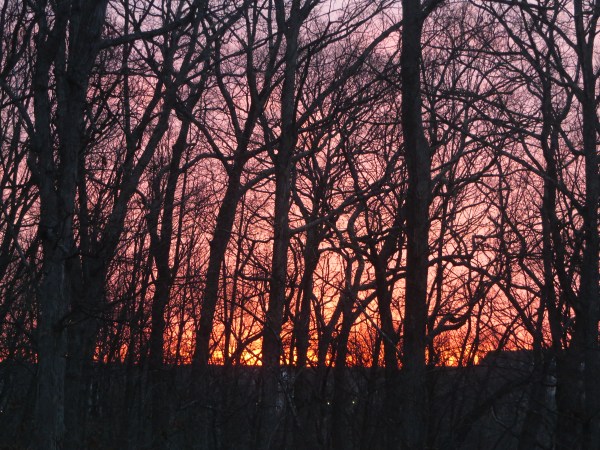
If you think bare trees are ugly, look again.
A winter sunrise from my bedroom window, March 2024
“If you think something is ugly, look harder. Ugliness is just a failure of seeing.”
― Matt Haig
I bought the lot on which my current home was built because it had trees on three sides. I take a lot of fabulous sunrise photos out the east-facing windows of my home, toward the Potomac River. But the back windows have glorious views of blooming trees in spring, bright flowers in summer, and dazzling foliage in the autumn. Winter? Not as spectacular most times of the day. But those sunrise colors are stunning in that direction, too, with the bare trees in dramatic silhouette.
One reason I love to take photographs is that it helps me to focus on beautiful aspects of things that I might otherwise miss. With a camera, I go hunting for lovely images to save. We really do find what we are looking for, and beauty is no exception. So looking out at those gray, leafless trees on a gloomy winter day, I appreciate them. I know that they’ll be green soon enough, and in the meantime, they put on quite a show each morning.
Hopes rise blooming
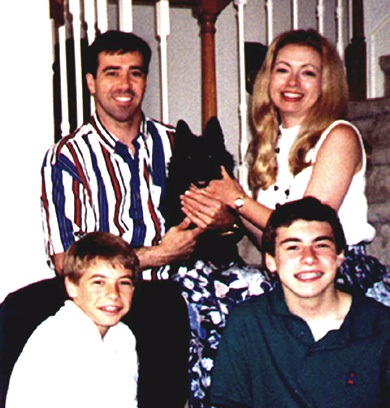
The five of us at our San Antonio home, 1998.
Matt is at bottom right.
Our sweetest hopes rise blooming
And then again are gone,
They bloom and fade alternate,
And so it goes rolling on.
I know it, and it troubles
My life, my love, my rest,
My heart is wise and witty,
And it bleeds within my breast.
— Heinrich Heine
Recently, several of you asked me to update you on Matt. I asked him whether he had anything to say to you, or something he would like me to write about, but he was noncommittal. Unlike Jeff used to do, however, Matt did not specifically ask me not to write about himself.
I haven’t written a great deal in this blog about his teenage years, but going through some recently scanned photos, I found several that I want to share with you. Looking at the photos below, all of which were made before his first manic episode changed our lives, I realize that everyone, each one of us, leaves behind so much of our youth when we enter adulthood. The dreams and goals change, tempered by hard realities, and enthusiastic hope gradually matures into acceptance of life’s limitations.
Matt is no different from anyone else in this regard. His teen years were full of activity, effort, achievement and fun, despite the painful surgeries he endured, and the frustrating disabilities that made goals more difficult to reach. It is a bittersweet experience to look back at the happy photos of those years, whether I am recalling Matt’s youth or Drew’s. Yet, where Matt is concerned, I now wonder how I found the energy to spend hours with him every single day on homework, piano practice, OT, PT and speech therapy exercises, church youth projects, and most of all, daily working to help him overcome his motor skills deficits to become independent with basic living skills that others had mastered with little to no effort during early childhood.
Here’s a side of Matt that many of you have not seen before. I hope you will like these photos.
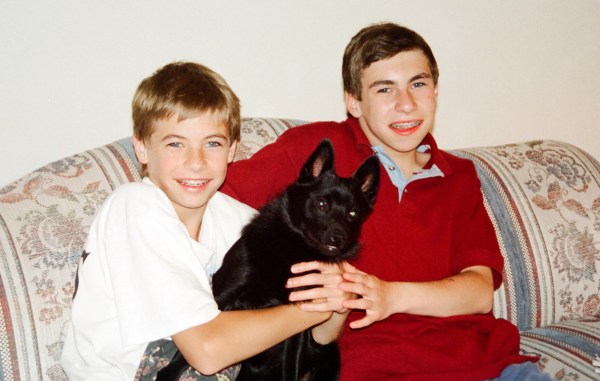
Drew and Matt with a very young Pasha, 1997
Drew is 16 months older than Matt, but Matt hit puberty first, and for a time he was taller than Drew. That’s hard to imagine now that Drew is over six feet tall, and Matt is only 5’5″– but this photo was made during those years.
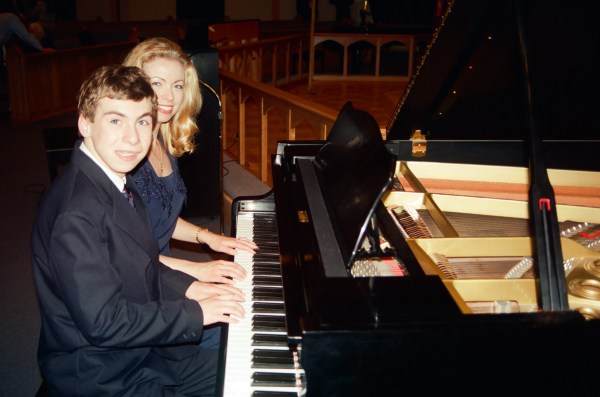
Matt and I played a duet at a spring recital in 1998.
When Matt was in middle school, his teacher immediately noticed his ear for music, and put us in touch with a gifted woman who taught students with disabilities to play piano and other instruments. Though previous school staff and therapists had told us Matt would never learn to move his fingers separately, this amazing music teacher proved them all wrong, and soon Matt was playing fairly well.
He loved being able to make music, and his teacher had high expectations, scheduling performances three to four times every year for all her students, and insisting that they compete in juried guild auditions alongside their non-disabled peers. At these auditions, Matt had to play scales, chords and arpeggios, along with several memorized pieces, and he always passed with high marks. I don’t even want to think about how many hours it took, though.
For the most part, Matt never complained about the hours every day we had to practice for him to get the fingering and timing right. Best of all, this endless exercise for his fingers opened the door for him to be able to use computer keyboards– another thing school IEP teams had formerly told us he could never do. He ended up being able to keyboard all his school assignments at the rate of about 17 words per minute, which was useful since his handwriting has always been illegible.
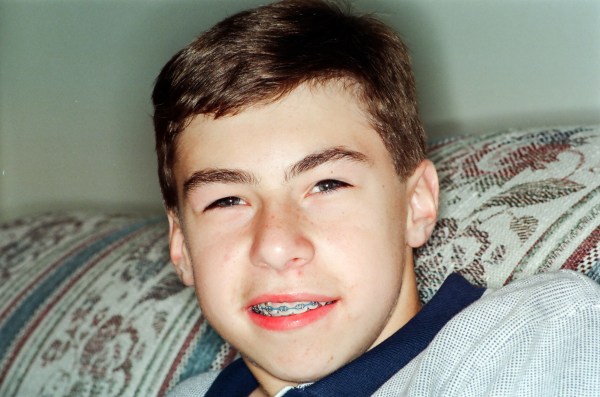
Here’s a close-up of Matt with his braces.
Matt and Drew each wore braces for nearly three years. Sometimes I got really sick of driving back and forth to the orthodontist weekly in heavy afternoon traffic. Since I was working full time for much of that time, life was pretty stressful. I certainly don’t miss that aspect of having teenagers!
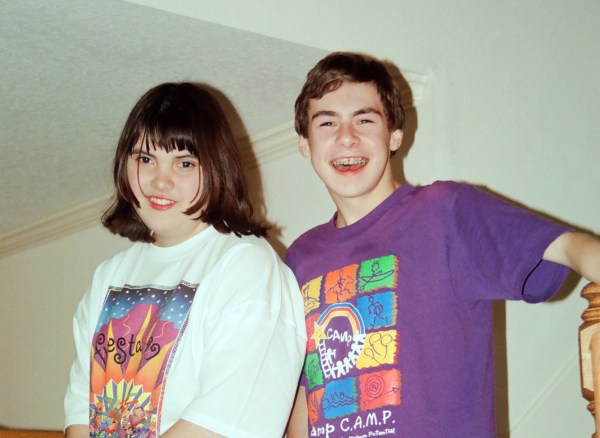
Matt with his all-time favorite girlfriend, Katherine, in 1998.
Our years in San Antonio were filled with social activities for Matt. During that time I once remarked that our entire calendar was built around his many scheduled and unscheduled outings with friends. Luckily, I really enjoyed being with all the other Moms, since we ended up playing chaperones. I had the blessing of friendships with some of the strongest and liveliest women I had ever known, and Matt loved his friends’ mothers almost as much as he loved me. It was wonderful, a golden time that I missed so much when we moved to California in 1999.
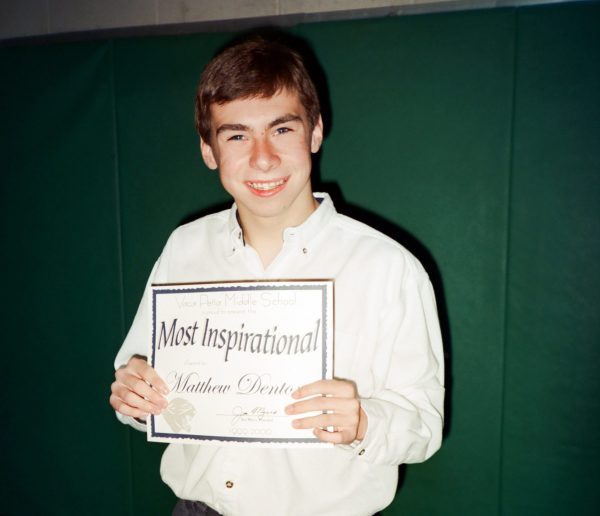
Matt was chosen “Most Inspirational” at his middle school graduation in California, 2000.
Despite having to leave his friends and spend his final year of middle school at a new campus in northern California, Matt continued to bloom, staying very active in a music conservatory with another gifted piano teacher, singing in the school chorus (even singing a solo at one performance) and making friends everywhere he went. Jeff and I both noticed that after only a few weeks in California, we could hardly go to any store or fast food place in our little town without someone excitedly calling “Hi Matthew!” I will always be grateful for what an easy transition he had from a fantastic situation in Texas to a very different but equally rewarding time in California. Things were far from ideal in either location, but both times were filled with blessings for him despite the hard work and continual challenges.
Matt has long been a favorite topic of mine, so I could go on and on, but perhaps this is more than enough. I hope you have enjoyed getting to know him just a little bit better. Whenever my heart is bleeding inside, I have to remind myself that even the happiest times were far from easy, and though we bloom in different ways as we grow older, yet still we bloom. I really believe that.
This post was first published seven years ago. During that time, Matthew has endured three more heart surgeries, a broken arm and subsequent diagnosis of cardiac-related cirrhosis, a near-death bout with endocarditis during which he coded for the first time in his life, and an ever-increasing round of “routine” medical appointments to monitor his increasingly complex health situation. Despite his worsening prognosis and quadrupled cardiac medications, he remains essentially the same sunny, indomitable self, with occasional bouts of sadness the only clue that he does understand more than he tends to express. His presence in my life becomes more and more precious to me, and the two of us enjoy our time together more than ever, thankful for the blessings that remain.
The original post, comments and photo are linked, along with two other related posts, below. These links to related posts, and their thumbnail photos, do not appear in the blog feed; they are only visible when viewing the individual posts by clicking on each one. I have no idea why, nor do I know how they choose the related posts. That’s just the way WordPress does things.
Strenuously in Search
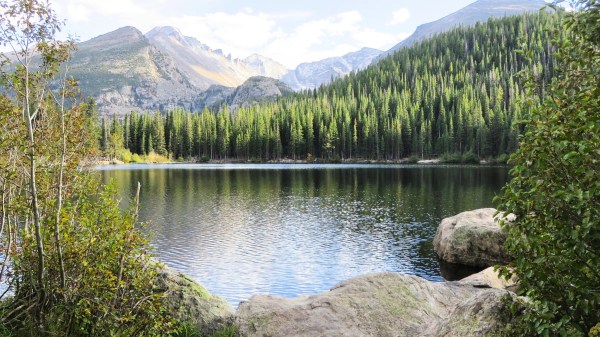
It was only a short hike to this lovely spot.
Rocky Mountain National Park, September 2024
“The traveler was active; he went strenuously in search of people, of adventure, of experience. The tourist is passive; he expects interesting things to happen to him…”
—Daniel J. Boorstin
No doubt about it, I’m a traveler. I prefer to go with a friend, but I’ll go by myself if no one is free to join me. And there are special joys to traveling alone, although age is beginning to lessen my enthusiasm for leaving my cozy home where everything is designed to accommodate my individual preferences. As with other trade-offs in life, the risk-to-benefit ratio of traveling alone is usually favorable enough to induce me to set out on yet another adventure.
I’ve never liked taking tours of any kind. I’ve tried them, but they are far too one-size-fits-all for me. And when I read this quote, I realized another reason I don’t like tours. They are a form of entertainment, where everything is pre-packaged in advance to provide the traveler with a series of “sights” that are often rightly famous. But there is little of exploration or discovery about a pre-planned tour.
Granted, I enjoy cruising, because I like having no worries about finding restaurants or hotels. But still, my purpose on a cruise is either to relax in a different climate, or to explore the ports. I almost never go to any of the shows or other entertainments. I’d far rather sit on the verandah and gaze out at the sea (or, okay, go get some ice cream or another cup of tea).
But by far, my most memorable travels have been treks of discovery, where I met people, saw new places, and had all sorts of interesting experiences. For me, travel has never been about entertainment. There is nothing passive about the way I travel, even when I’m on a plane or a train or a bus. I’m always taking it all in, making mental or physical notes, and often taking pictures to go with those notes.
Sometimes people ask me why I chose to continue my schooling at Oxford. It’s because I love the combination of stimulating classes and assignments in a setting that is rich with undiscovered paths and many centuries of history still evident, carefully preserved. And of course, those English breakfasts and teas are famous for a reason. But also, it’s a great setting in which to meet people of all ages from all over the world. At school I am part of a group where I belong, yet am undeniably different from everyone else. I’m a perennial newcomer, a traveler, an explorer, no matter how familiar I have grown with parts of London or England over the years.
I’m not sure how much longer I’ll manage to travel extensively in person, but even if I grow too old to go comfortably on foot, my mind will always go “strenuously in search” through books, art, music and conversation. How about you? Do you prefer being a traveler, or a tourist?
Bursting the bounds
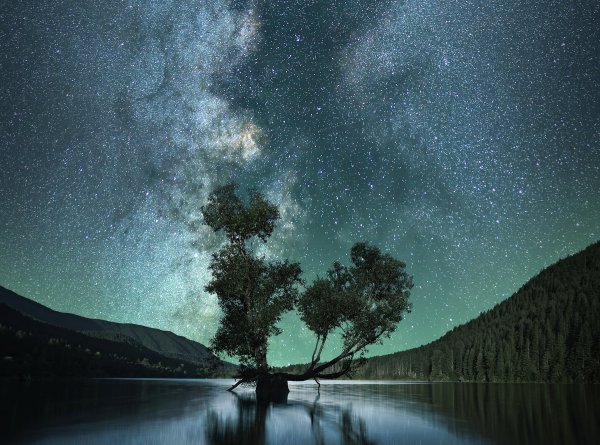
The Great Rift is a section of non-luminous clouds within the Milky Way.
Rattlesnake Lake, Washington, photo by Nate Rayfield via Unsplash.
Because today’s quote is long, I’m going to save it for the end and try to keep my comments relatively short. I found myself unable to find any part of the passage that could be cut out into a short sentence or two.
In addition to sharing a birthday with each other, Jeff and I shared a birthday with three of the most remarkable authors I ever read: C. S. Lewis, Louisa May Alcott, and Madeleine L’Engle. The “baby boomers” among us may remember L’Engle as the author of the Newberry Award winner A Wrinkle in Time, a book which made an unforgettable impression on me during my childhood. Long before George Lucas gave us Star Wars, L’Engle took us to other worlds in the story of Meg Murray and her family, in what one biographer called “her most audaciously original work of fiction.” I’ve resolved to read it again soon, along with the other books in that trilogy. For now I’m enjoying a daily devotional book that is a compilation of passages from L’Engle’s works.
Reading the quote below, I thought how A Wrinkle in Time quite possibly began germinating in the tiny child whose earliest memory of the stars was deeply etched into her psyche. If you’ve ever experienced seeing a starry sky on a clear night, especially from a mountain top or from out on the water, you likely will identify with at least part of what L’Engle describes here. I hope you enjoy her reflections as much as I do.
One time, when I was little more than a baby, I was taken to visit my grandmother, who was living in a cottage on a nearly uninhabited stretch of beach in northern Florida. All I remember of this visit is being picked up from my crib in what seemed the middle of the night and carried from my bedroom and out of doors, where I had my first look at the stars.
It must have been an unusually clear and beautiful night for someone to have said “Let’s wake the baby and show her the stars.” The night sky, the constant rolling of breakers against the shore, the stupendous light of the stars, all made an indelible impression on me. I was intuitively aware not only of a beauty I had never seen before, but also that the world was far greater than the protected limits of the small child’s world which was all that I had known thus far. I had a total, if not very conscious, moment of revelation; I saw creation bursting the bounds of daily restriction, and stretching out from dimension to dimension, beyond any human comprehension.
I had been taught to say my prayers at night: Our Father, and a long string of God-blesses, and it was that first showing of the galaxies which gave me an awareness that the God I spoke to at bedtime was extraordinary and not just a bigger and better combination of the grownup powers of my mother and father.
This early experience was freeing, rather than daunting, and since it was the first, it has been the foundation for all other such glimpses of glory. And it is probably why the sound of the ocean and the sight of the stars give me more healing, more whole-ing, than anything else.
This post was first published seven years ago. The original post, comments and photo are linked, along with two other related posts, below. These links to related posts, and their thumbnail photos, do not appear in the blog feed; they are only visible when viewing the individual posts by clicking on each one. I have no idea why, nor do I know how they choose the related posts. That’s just the way WordPress does things.
Paradoxical
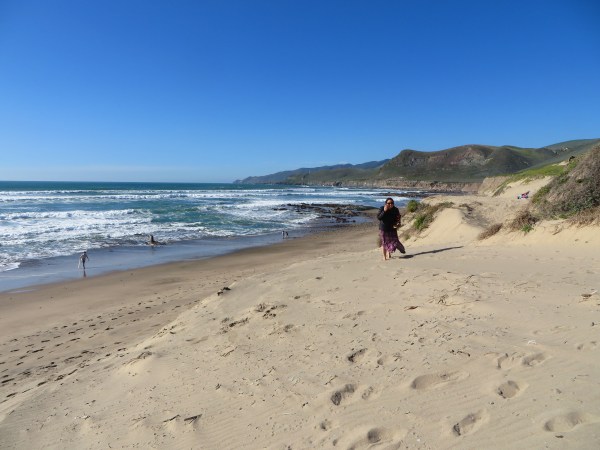
I knew the wild, remote beauty of Minuteman Beach, but just the same, I had forgotten it.
Vandenberg Space Force Base, California, February 2024
“Creativity is paradoxical. To create, a person must have knowledge but forget the knowledge, must see unexpected connections in things but not have a mental disorder, must work hard but spend time doing nothing as information incubates, must create many ideas yet most of them are useless, must look at the same thing as everyone else, yet see something different, must desire success but embrace failure, must be persistent but not stubborn, and must listen to experts but know how to disregard them.”
— Michael Michalko
Maybe it’s because I’m in the middle of working on an especially difficult paper for school, but when I read this quote, I felt it captured a good bit about the challenge of any creative pursuit. I don’t know anyone who creates anything worthwhile out of occasional whims from some imaginary muse. It’s hard work, and there’s nothing glamorous about the process. And most of us who try to write, or paint, or make music, or engage in any sort of artistic process must go into it knowing that failure will be far more likely than success, at least in terms of monetary reward or widespread recognition.
For me, and I suspect for most others who try to create anything, the work is its own reward. That’s not to say that sometimes we won’t have to force ourselves to do it, whether we’re in the mood for it or not. But as Michalko says, I know so much that I have forgotten. I find connections between seemingly unrelated things, but have never (as of yet) been diagnosed with any sort of psychosis or mental lapse. I have more ideas than I know what to do with, and I’ve never found anyone who sees the world exactly as I do. And of course, I often fail, and though I respect “expert” information, I don’t feel bound by it.
What else is there for me to do, but keep writing?
Singularly moved

Not beloved by many, but lovely nonetheless.
Photo by Steve Halama via Unsplash
I, singularly moved
To love the lovely that are not beloved,
Of all the seasons most
Love winter.
– Coventry Patmore
If you read the comments section, you may recall that I mentioned this verse to Marlene when she said she loved winter. This is the post I told her I would write for her.
I can’t say I most love winter, but I do enjoy many aspects of it. However, the line of Patmore’s verse that captured my imagination was “the lovely that are not beloved.” There are all sorts of things that can fit that category, winter among them, and I wonder what else he might have had in mind when he described himself as having an affinity for what is disregarded by others.
Have you ever found yourself protesting, “Oh, but I love _____” (fill in something everyone else is criticizing). In that category, I think first of certain animals– crickets, or lizards, or mice, or squirrels– creatures others might see as pests, but ones I see as more cute than irritating. Or it could be dandelions, or radishes, or other plants nobody seems to appreciate. Maybe you actually like to eat liver or zucchini. You might like a book or movie others found boring. Maybe you secretly appreciated a school teacher that everyone else hated, or thought that oddball classmate was interesting because he was different. Did you feel strange because you liked something others denigrated? Or were you happy that you found joy where others could not?
I think if we keep an eye out for beauty with the awareness that it may be hidden, we will find it in unlikely places. And we might discover that others share our enjoyment of something most people miss completely. Do you have any tips for us about where you’ve found examples of “the lovely that are not beloved?”
Ray Stevens is known mostly for his funny songs, but if you’re old enough, you might remember his 1970 Grammy-winning song that wasn’t joking when it declared “everything is beautiful in its own way.” Despite the arguments against this philosophy, if you’re feeling irritable enough to make Grumpy Cat look like an optimist, zoom back to the groovy year of 1970 and enjoy a much-younger Ray Stevens singing his song. I bet it will make you smile.
This post was first published seven years ago. In re-reading it before I scheduled it to be posted again, I did take a few minutes to enjoy the lovely Ray Stevens song, and found myself (like the audience) swaying side to side with its lovely, happy message– a message needed now more than ever.
The original post, comments and photo are linked, along with two other related posts, below. These links to related posts, and their thumbnail photos, do not appear in the blog feed; they are only visible when viewing the individual posts by clicking on each one. I have no idea why, nor do I know how they choose the related posts. That’s just the way WordPress does things.
Winter heals
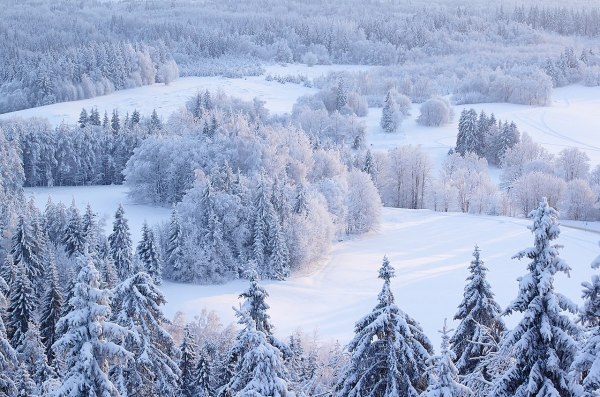
Haanja Upland seen from Suur Munamägi, the highest peak in Estonia.
Vaido Otsar, via Wikimedia Commons
“There’s relief in not having to be outside. No gardening, no mowing the lawn, no tyranny of long daylight hours to fill with productive activity. We rip through summer, burning the hours and tearing up the land. Then snow comes like a bandage, and winter heals the wounds.” ― Jerry Dennis
I don’t know whether it’s my imagination, or just wishful thinking, but I think I’ve experienced significant healing this winter. And I have to agree with Dennis– it seems to be at least partly related to the weather.
The last time we had a snowstorm here was just over three years ago, and my sister and her husband were visiting. Their return home was delayed, and there were all the usual hassles with transportation and cancelled flights. But also there was that excitement at the beauty snow brings, and as it softly yet furiously continued, the wonder at how very MUCH of it there was.
You’d think the memory of that last snowfall would have made the weather more emotionally difficult this year. And there was that pang of absence that is so familiar to anyone who has lost someone dear. But this year, the snow truly has felt like a bandage, covering my hurt and ordering me to be still and cease the endless drive to get things done. I have taken solace, as always, in tea, books, school, correspondence and spending time with Matthew. But this year, all these things had a feeling of special benediction, a willful slowing down and acceptance that this chapter in my life will bring new and different rhythms that will be exactly what I need right now.
People of faith– and I count myself among them– see Divine wisdom in the cycle of the seasons that seem, despite occasional inconvenience and even hazard, to be uniquely suitable for the regulation of human activity that sometimes goes too far, too fast.
So I’m taking the return to regular activity more slowly than usual. There’s still lots of snow on the ground, but I’m able to safely take my walks each day. And next week promises warming temperatures that will at least climb high enough above freezing to eliminate that last bit of ice on the sidewalks. The days grow gradually longer, and springtime calls me. I’ll answer gladly– but perhaps I’ll take a wistful glance back over my shoulder at the cozy psychological cocoon in which I’ve so happily spent the past few weeks.
How about you? Are you enjoying the winter? Remember, our Club Verandah is open all year, and Sheila and I never run out of hot beverages and conversation. Sit a spell and take your shoes off – we’ll leave the verandah to the critters and stay by the fireside looking out through the windows. If you forgot your slippers, no worries– we keep fluffy warm footies on hand.


 Defeat Despair