A powerful solace
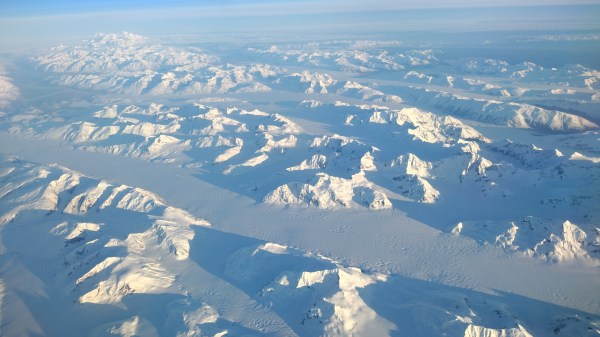
This was either Alaska or Canada. In the sky, boundaries disappear. May 2024.
“Mountains seem to answer an increasing imaginative need in the West. More and more people are discovering a desire for them, and a powerful solace in them. At bottom, mountains, like all wildernesses, challenge our complacent conviction – so easy to lapse into – that the world has been made for humans by humans. Most of us exist for most of the time in worlds which are humanly arranged, themed and controlled. One forgets that there are environments which do not respond to the flick of a switch or the twist of a dial, and which have their own rhythms and orders of existence. Mountains correct this amnesia. By speaking of greater forces than we can possibly invoke, and by confronting us with greater spans of time than we can possibly envisage, mountains refute our excessive trust in the man-made. They pose profound questions about our durability and the importance of our schemes. They induce…a modesty in us.” ― Robert Macfarlane
In the profound and continuing grief over the unexpected loss of my sister Carla, it’s easy to forget that many joyful things happened this past year. For example, Carla and I were able to take two of the trips together that I had booked for the year. I was able to attend my summer session at Oxford, and to visit my dearly loved friends on the central coast of California, and to return for the first time to Ohio, where Jeff and I lived with our baby sons during his first tour of duty in the Air Force. I was honored to enjoy a delicious luncheon hosted in the beautiful home of one of my church sisters, where I was surrounded by many other beloved sisters who have remained in my heart for nearly 40 years.
And I finally was able to do something I had planned to do at least two or three times, but somehow had always been forced to cancel: I visited my dear friend Jena at her home in Anchorage, Alaska, and met her husband Matthew for the first time, though I soon felt as if I had known him much longer. Jena and I became friends when she was still single, but the two of them are such a perfect match that now it’s hard to imagine her without him.
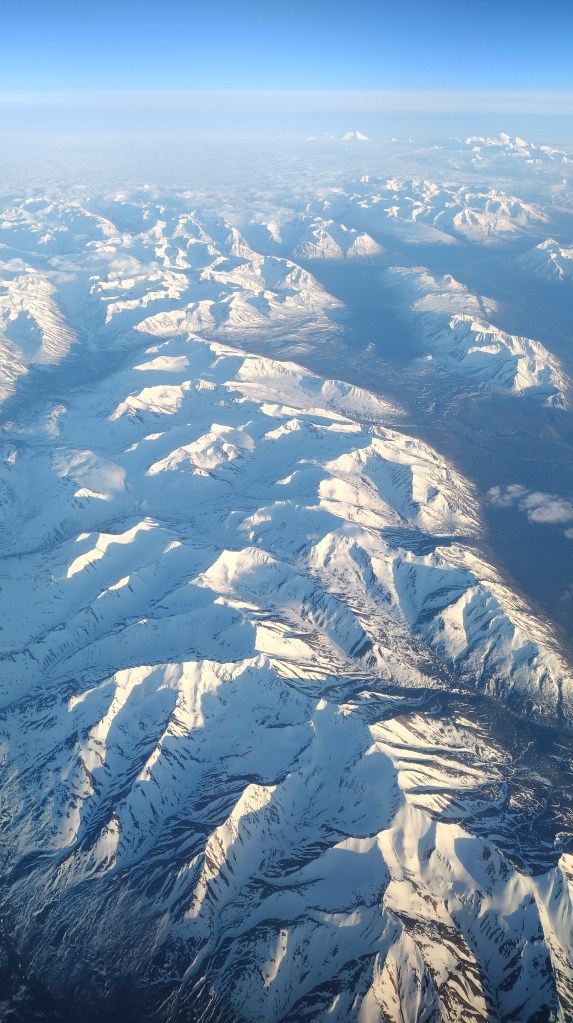
The week I spent with them was remarkable in many respects, and I might be blogging about that visit again in the coming year. But nothing prepared me for the amazing sights of the overnight flight back to the east coast. The photo above was taken at about ten p.m. This was in late May, when there are only a few hours of darkness each day in the far north. I had planned to sleep on the way home, and got a window seat, thinking it would be easier to sleep against the wall of the plane. But I spent at least the first hour mesmerized by the astoundingly close mountaintops and glaciers that I could never have seen from the ground. They were stunning, and seemed to go on and on.
At some point I realized that we could not possibly still be in Alaska, and were now flying over the Canadian Rockies. I took dozens of pictures; when I went to transfer them from my phone to my computer, I think the total was 83. Though my camera phone is inferior to the one I would have used if I’d had the sense to keep it in my carry on bag, it will give you an idea of the grandeur. The daylight, like the mountains, seemed to go on and on, stretching toward midnight.
As I gazed down in wonder, I had no idea of the grief that was in store during the coming year. But I do believe that in some way, the powerful solace Macfarlane describes has stayed with me since then, banked deep in my unconscious as a reminder that whatever is troubling or grieving me is only one tile in a beautiful mosaic. Those mountains, and the consolation of remembering them, are a fitting metaphor of my happy time with Jena and her husband Matthew. The gift of their friendship keeps on giving, sustaining me through the remainder of the year and continuing into the future.
This post is the first new one I’ve written in awhile. When I went to schedule the re-posts for January, I realized that 2018 was the year I dropped to posting just once a week (something I mentioned doing in the “About this blog” section). So I challenged myself to try to intersperse new posts in between the old ones, to keep the schedule to Wednesday and Saturday. I have no idea whether I’ll be able to keep doing it, but we’ll see how it goes. As always, thanks for being here!
- Posted in: Uncategorized
- Tagged: aerial view, Alaska, balance, Canada, consolation, contemplation, grief, humility, joy, mindfulness, mountains, perspective, quiet, serenity, solace, sorrow, worry


 Defeat Despair
Good morning, Julia!
I am delighted to see a new post! I’m so happy for you, that you’ve found the wherewithal to write anew. This is such a great post to start a new year; to remind us all that there’s something bigger than “just us”. I liked your analogy that our current situation is merely one tile in a beautiful mosaic of life.
Macfarlane said it well. Regardless of the setting, although the mountains are probably my favorite, the sheer grandeur is humbling, bringing us closer to the one Creator of it all.
Happy new year! May this year continue to bring you more peace, comfort and joy!
Thank you Chris! I hope this comment means that Jeanne is safely home now and doing better. I hope you have a wonderful year coming up!
Julia, So sorry to hear of Carla’s passing!
Mountains are magnificent to me, as well!
Still praying for you & Matthew.
Thank you, Mary Ann! We appreciated your kind card. I am STILL working on getting my cards done (now notes, since it’s too late for cards). I just didn’t have the heart for it this year, since Carla was my longtime “Christmas buddy” with whom I shared the joys of the season. Matthew and I did appreciate having a peaceful day together on Christmas. I’ll try to write soon! ❤
I’m so glad you were able to enjoy your visit. You are always welcome back for more solace. ❤️
Thank you Jena…and meanwhile, I’m visiting you in my imagination! ❤
Good morning, Julia!
I also spend a lot of time looking out the plane window when flying over mountains. Macfarlane describes the effect that they have on me so well, and your photos capture their glorious, solid statement. I may have flown over some of those same mountains on my flight from Chicago to Tokyo on my way to Thailand. I sure looked out as much as I dared but the cabin was darkened so passengers could sleep. I had one of those windows that darken electronically, rather than a shade, so there wasn’t much opportunity to peek out and I had to content myself with looking at the seatback monitor map. It was still too exciting to get much sleep!
Thank God for the many blessings of 2024!
Hi Susan, I’m glad you share my excitement about looking down on mountains from a view we can never get on the ground. Wow, would a flight from Chicago to Tokyo really fly NORTH? I don’t know much about flight patterns, but I didn’t envision them going over the “top” of the globe (as we think of it). I like the way modern planes allow you to follow the flight path on a screen at the seat, but I’ve never seen one divert that far out of the old “as the crow flies” pattern.
Hi Julia, I asked Chat GPT about this, and here is what I got:
“The most direct flight route from Minneapolis (MSP) to Tokyo (NRT or HND) follows a great-circle route, which is the shortest path between two points on a sphere. This route generally heads north-northwest over Canada, crosses over the Arctic region (though not directly over the North Pole), and then descends southward over Russia before reaching Japan.
Distance and Path Over the North Pole
The great-circle distance from Minneapolis to Tokyo is approximately 5,950 miles (9,575 km).
While this route passes over the Arctic region, it does not fly directly over the North Pole. Instead, it arcs over Canada, possibly passing near Alaska and Siberia, before heading south into Japan.
Comparison to a Predominantly Westward Route
If one were to travel in a predominantly westward direction rather than following the great-circle route:
The distance would be significantly longer because it wouldn’t take advantage of Earth’s curvature.
A westward flight over the Pacific Ocean without going north would cover around 7,500 miles (12,070 km) or more.
This is 1,500+ miles longer than the great-circle route, making it much less efficient.
Why Airlines Use the Polar Route
Fuel efficiency: Shorter distance means less fuel consumption.
Wind patterns: They often take advantage of favorable jet streams.
Flight time: Direct polar routes typically take about 12 hours, whereas a westward route would take significantly longer.
Would you like specific airline route details or flight durations for different airlines operating this route?”
OOOH, I had to think about this one…robots are the only ones NOT welcome here in the comments section. But since you introduced it, I’ll allow it…just this once! 🙂 Seriously, I could have looked it up myself. But as a librarian, I’d avoid AI in favor of human intelligence. The singularity may be near (or maybe not) but it’s not here yet. And I will always prefer humans to machines, though more and more people are forgetting how to interact with other humans…
I couldn’t remember how to describe that shortest path between two points on a sphere, so the question i asked was so convoluted that it would have been difficult to just look it up. I should review spherical geometry terms, I suppose!
I’ve been told that using AI uses copious amounts of energy and is therefore bad for the planet (this nugget of info came from my handpan-playing son-in-law). So I am unlikely to use it often.
Eventually it will evolve to being useful AND earth-friendly, but I’m not holding my breath on that. Meanwhile, I avoid it as much as I can (though it’s already embedded into so many of our daily activities without our knowing it). The other day, I read a comment from someone rhapsodizing about GROK-3 and I had no idea what it was, but as I first suspected, it turns out to be another iteration of AI. We can’t escape it! (Does that sound like a Sci-Fi horror film or what?)