The maxim of the British
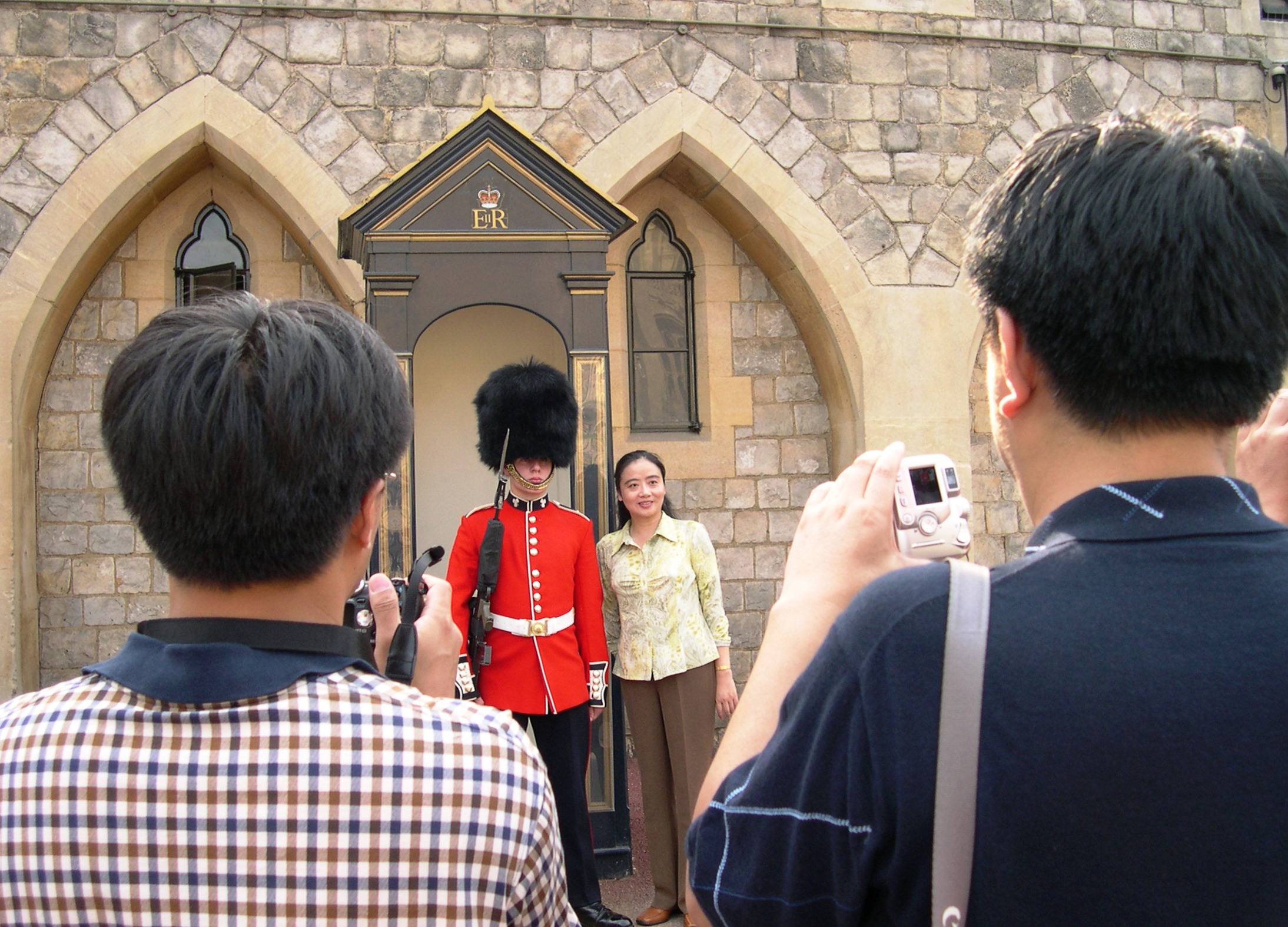
One of many tourists who pose with the Queen’s Guard. Windsor Castle, August 2005
“The maxim of the British people is ‘Business as usual.'” — Winston Churchill
This quote, and the photo posted above, capture one reason why I love being in England. I must not be the only one, because the now-ubiquitous, quintessentially British wartime quote “Keep Calm and Carry On” has been revived and printed on all sorts of items. It’s now also cleverly parodied by more than one producer of novelties. The legendary “stiff upper lip” is admirable to many of us, it seems.
Contrary to what some believe, the Queen’s Guard (one of whom is involuntarily posing with a tourist in the photo above) are not just a ceremonial detail, but are fully operational soldiers. When I saw the tourists taking turns posing beside the guards, I thought it was funny and decided to give it a try. I thought better when I got a bit closer and saw the razor edge of the bayonet and the barely noticeable tightening of the soldier’s hand on his rifle as I approached. I felt a bit disrespectful, and more than a little edgy. So the only photo we have of me with this same solder shows me standing a few feet off, looking ready to run, with a sheepishly undecided grin on my face.
Can you imagine what it must be like to stand silently and endure the constant stream of tourists for hours on end? These men are fully armed and responsible for the safety of a castle full of people (to say nothing of being a potential target for some deranged attacker), yet they are expected never to move and supposedly never to crack a smile. What if that huge hat gets unbearably itchy underneath? What if he had too much tea and needs to go to the loo? What if he has to sneeze? Business as usual, which for the Queen’s Guard, means keeping a poker face and standing firm in all sorts of irritating circumstances.
I over-react far too often, so this trait is something I need to cultivate, and I have had a great example in the past year. It’s been amazing to see how Jeff has taken the “business as usual” maxim as his approach to life with stage IV cancer. Almost every day that he has not been in the hospital or at a treatment appointment, he’s been busy working at the clinic by day and at home by night, going about his routines as if none of this nightmare had ever hit us. He manages to restrict how much we discuss it or even mention it, far from the obsessive worrying that I tend to do. It must be his British ancestry coming out.
In any case, the next time you are dealing with unforeseen and unpleasant surprises, or maybe just the annoying presence of distracting people, remember the stony endurance of the Queen’s Guard. Business as usual. Keep calm and carry on!
ADDENDUM 10-23-13:
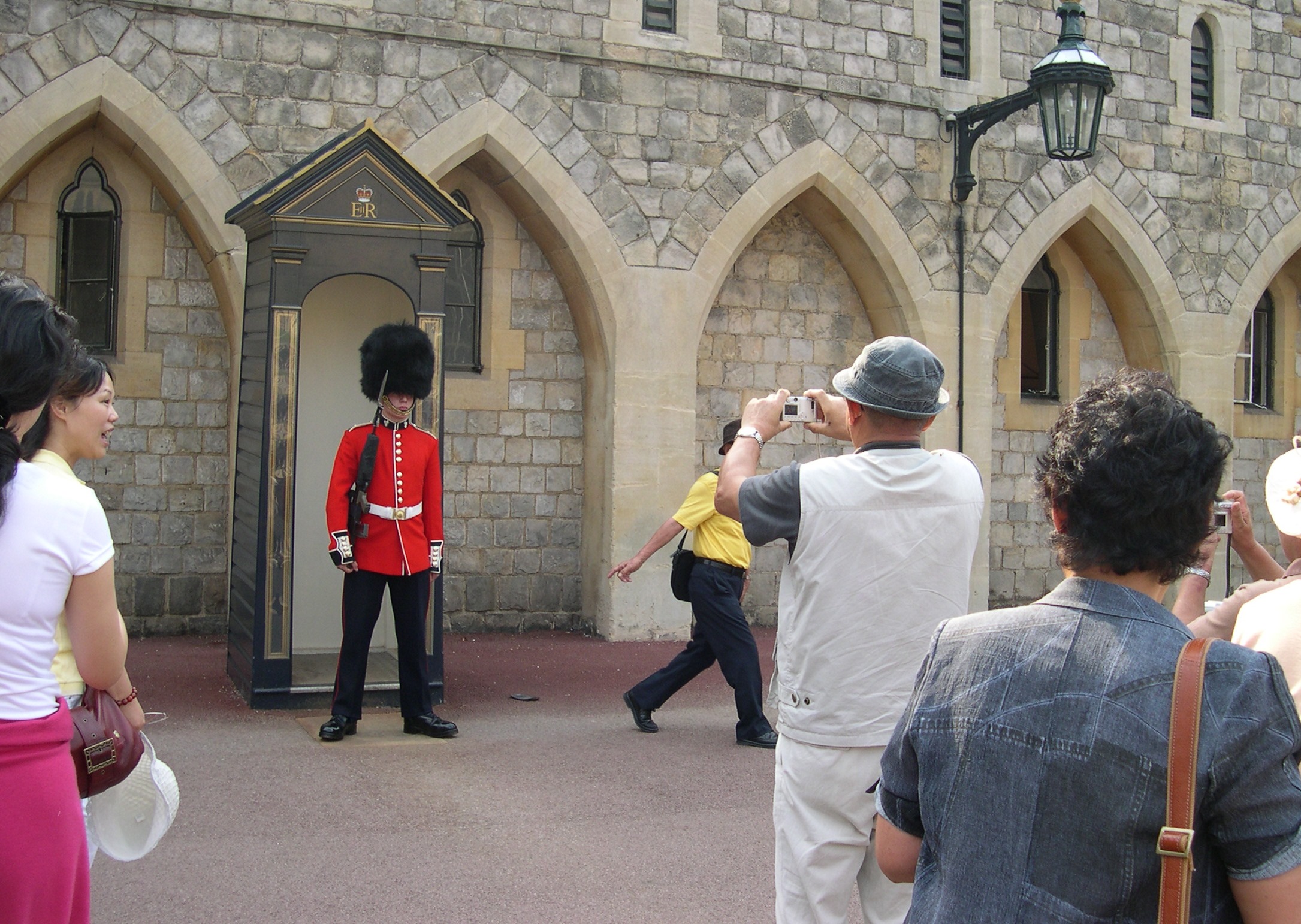
OK, by popular demand (meaning at the requests of people who are popular with me), here is the photo of me with the sheepish grin. In posting this photo I am breaking two blog standards: 1. use only photos that are focused and attractive; and 2. if I am in the photo, it has to make me look better than I actually look in real life.
Without further ado, see the following three photos:

Do I appear to be gritting my teeth here? Well, this couple seemed to share my hesitation:

But this guy in the yellow shirt seemed to have the best idea:
This post was first published seven years ago today. The original post, comments and photo are linked, along with two other related posts, below. These links to related posts, and their thumbnail photos, do not appear in the blog feed; they are only visible when viewing the individual posts by clicking on each one. I have no idea why, nor do I know how they choose the related posts. That’s just the way WordPress does things.
Let us love

One of countless love notes from God, this one at the Montreal Botanical Garden, May 2009
“Dear friends, let us love one another, for love comes from God. Everyone who loves has been born of God and knows God. Whoever does not love does not know God, because God is love.” — John, apostle of Jesus (I John 4:7-8, NIV)
In a chapter that opens with ominous warnings about false teachers, John gives us these beautiful words, along with many others that describe love as the way to know God. For all the beauty of these words, though, they set the bar quite high. Love is not an easy task, particularly when it is commanded without conditions. We are not told to love only those who are worthy of love, nor even to love only those we know. “One another,” “everyone” and “whoever” are fairly all-encompassing terms.
Taken in the context of the entire Bible, this description becomes all the more daunting. It becomes quite clear that love is not seen as a limited or qualified thing. How could it be limited, if the surpassingly infinite being of God is love? When we read the command to love our enemies, we tend to come up with internal, possibly unconscious parameters: “Yes, but that doesn’t mean…” or “I can love someone and still…” or even “Well, that sounds good, but nobody I know can really pull it off.”
The words themselves are simple, but not easy. We are the ones who turn it into something complex, mostly as a way of dodging the frightful implications of putting the needs of others before our own desires. Some people say “all love begins with loving oneself,” and while this may be true, John pointedly says nothing here about self love. I can’t think of a time when Jesus did, either.
What’s ultimately comforting about this passage is the confident declaration that God is love. When we focus on that, we tap into the energy and power to do what seems impossible. Every day, in countless ways, the love of God is poured out through the beauty of creation and the blessings that come from the hands of creative, competent and compassionate people. When we immerse ourselves in all the manifestations of what is true, just and lovely, we naturally want to become part of that loving force.
It’s a pretty safe bet that this very day, as all others, you will be called upon to love someone else, through some big or small task, or perhaps only through patience and kind words. In fact, chances are you will be in a position to show love to more than one person, through more than one opportunity. If it seems hard, just look around you for examples. God sends us love notes on a continual basis, and if we look closely, we can learn from them. How will we be asked to love one another today? How will we respond?
This post was first published seven years ago today. The original post, comments and photo are linked, along with two other related posts, below. These links to related posts, and their thumbnail photos, do not appear in the blog feed; they are only visible when viewing the individual posts by clicking on each one. I have no idea why, nor do I know how they choose the related posts. That’s just the way WordPress does things.
Drinking in the surroundings
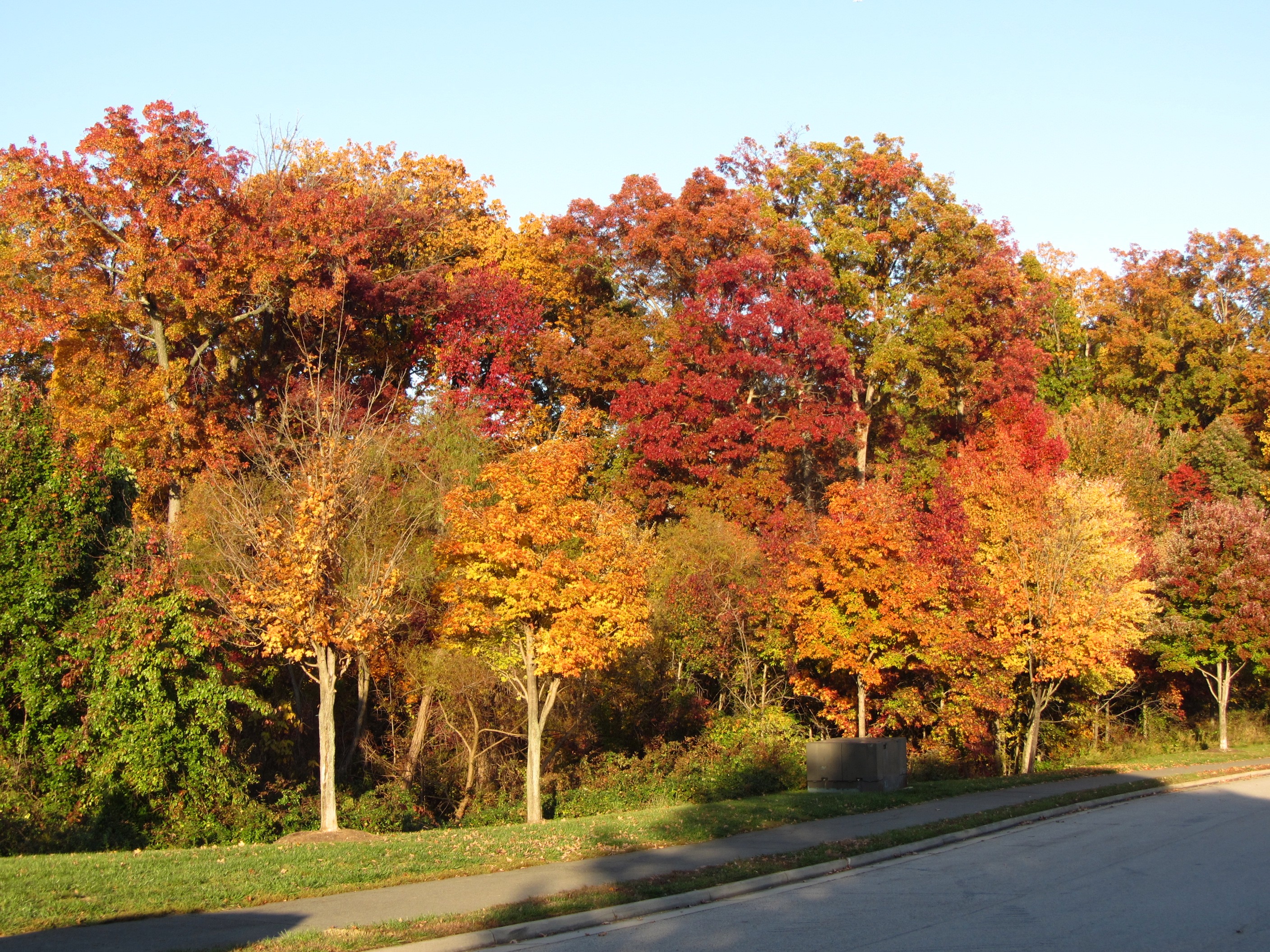
I snapped this photo just behind our townhome in Alexandria, November 2011.
“I was drinking in the surroundings: air so crisp you could snap it with your fingers and greens in every lush shade imaginable offset by autumnal flashes of red and yellow.”
― Wendy Delsol
I had never heard of Wendy Delsol until I came across this quote, but she described exactly what I was doing the day I took this photo. I’ve written a lot about our York home and our beloved little patch of woods there, but our Alexandria townhome also has a lovely view from the back deck, or the patio below it, of the woods you see in this picture.
With surroundings like these, along with unlimited digital recorded books from my local library to keep me company, how could I NOT love to walk? Some of the best things in life really are free. It’s often hard to carve out the time to put in my two or three daily miles, but I’ve learned to make it a priority. I hope this photo may inspire you to do the same, even if your walks are much shorter. You might not have fall foliage where you are, but you surely have something else beautiful, interesting or stimulating to enjoy. Go out and drink in the surroundings — and then come back and tell us about it here!
This post was first published seven years ago today. The original post, comments and photo are linked, along with two other related posts, below. These links to related posts, and their thumbnail photos, do not appear in the blog feed; they are only visible when viewing the individual posts by clicking on each one. I have no idea why, nor do I know how they choose the related posts. That’s just the way WordPress does things.
So many stupid remarks

As usual, Jeff and Matt heard more than they said. At the Louvre, Paris, September 2005
“Surely nothing has to listen to so many stupid remarks as a painting in a museum.”
— Edmond & Jules de Goncourt
When I read this quote, I laughed. Then I wanted to talk back to it. “Oh yeah? Try being a parent at an IEP meeting.” But I realize that’s a fairly esoteric thing to say. So I thought of other examples. What about:
- a gorilla at the zoo?
- a judge at traffic court?
- a middle school vice principal in charge of student conduct?
- a mother with a screaming toddler?
- anyone listening to a sports event’s “color commentator?” (You know, the ones who make immortal observations such as “this is a situation where they really need a hit” with the score tied and bases loaded in the bottom of the ninth.)
Admittedly, the Goncourt brothers came up with an interesting angle here, but let’s have fun with it. We all have to put up with stupid remarks occasionally, and sometimes we make them ourselves. Who (or what) do you suppose draws the most stupid comments? What are some classics you’ve heard (or said)? Sometimes, the best way to defeat despair is to shrug your shoulders, shake your head and laugh!
This post was first published seven years ago today. The original post, comments and photo are linked, along with two other related posts, below. These links to related posts, and their thumbnail photos, do not appear in the blog feed; they are only visible when viewing the individual posts by clicking on each one. I have no idea why, nor do I know how they choose the related posts. That’s just the way WordPress does things.
Not just a noun
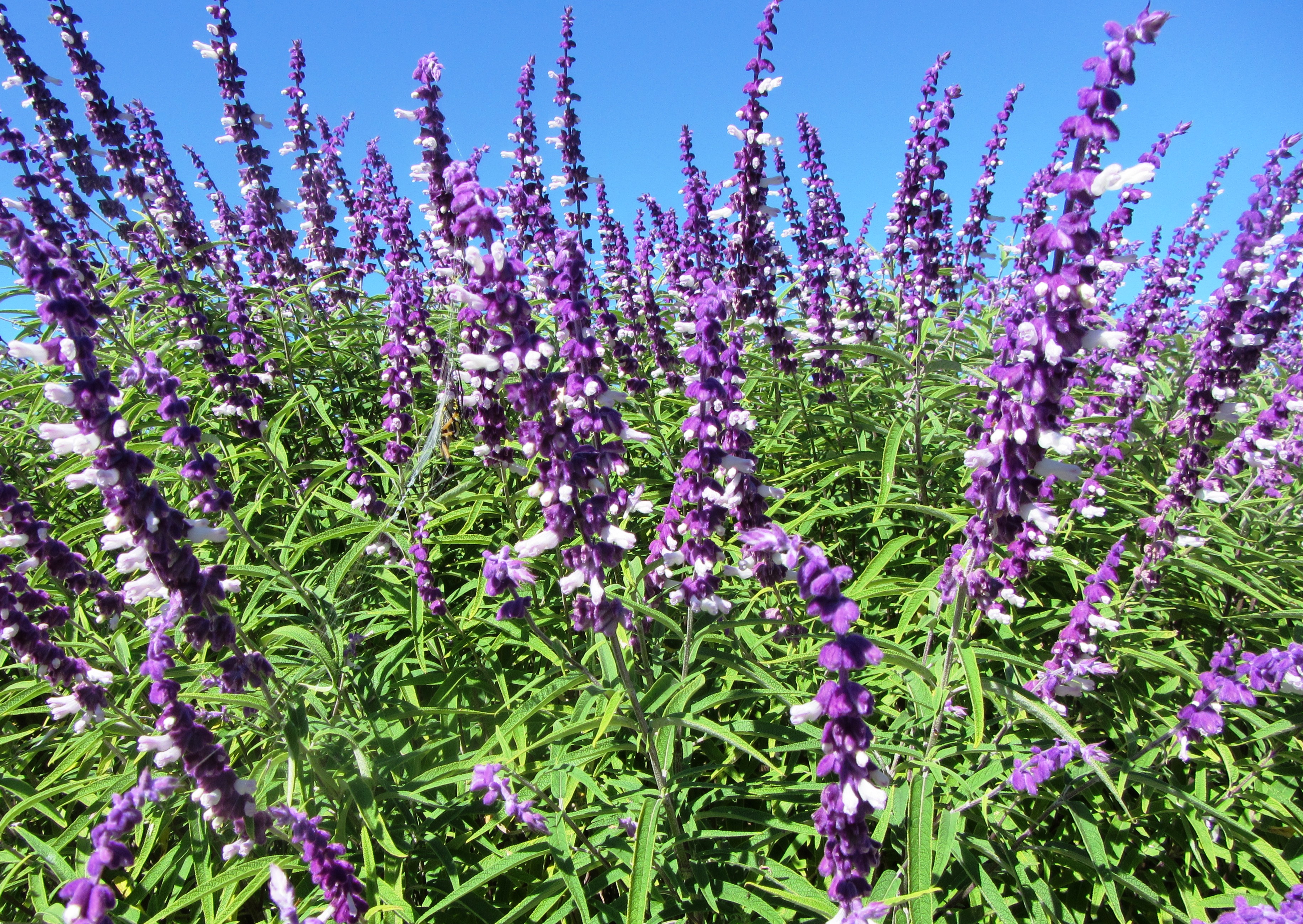
This beautiful shrub almost leaped out at us. Corolla, North Carolina, September 2013
“All the other colors are just colors, but purple seems to have a soul. Purple is not just a noun and an adjective but also a verb – when you look at it, it’s looking back at you.” — Uniek Swain*
I’m tempted to begin with Alice Walker’s well known quote about the color purple, but let us just say that I agree with those who think purple a remarkable color. I feel the same about most colors (I would never classify the others as “just colors”), but this never detracts from the singular beauty of the hue that happens to be in front of my eyes at the moment.
We came upon this enormous, lovely shrub in the historic village of Corolla, North Carolina, near Currituck Lighthouse. I could not remember ever seeing anything like it before, nor could Jeff. Can someone tell us what it is? Mike, perhaps you know? I asked the other visitors around us if any of them knew what it was, and none did, though all agreed it was remarkable. I’ve seen smaller versions of it before, but this one was taller than we are.
In any case, this plant stood out among many other varieties in a very lovely setting. As with some irises, the vivid purple and arresting form set it apart. It may not literally have been looking back at us, but its size and color did give it an animated feeling, as if it was there to greet us. I wouldn’t exactly say that the color purple seems to have a soul, but I confess to being something of a synesthete who experiences a kind of character or personality to colors, and purple seems active rather than passive; almost a verb.
What are your favorite colors? Do any of them seem to you to have personalities? Or do you scratch your head and wonder about the sanity of those who think that numerals, letters, automobiles and other abstract or inanimate objects have qualities that connect to animate traits in our minds? Either way, I hope these purple blooms brighten your day!
-
- (*This quote is widely attributed to Uniek Swain throughout cyberspace, but I have been unable to find anything about this person other than quote attributions. Readers are invited to enlighten me on this, too.)
This post was first published seven years ago today. The original post, comments and photo are linked, along with two other related posts, below. These links to related posts, and their thumbnail photos, do not appear in the blog feed; they are only visible when viewing the individual posts by clicking on each one. I have no idea why, nor do I know how they choose the related posts. That’s just the way WordPress does things.
We must free ourselves

A sailboat off the coast of Barbados, March 2010
“We must free ourselves of the hope that the sea will ever rest. We must learn to sail in high winds.” — Aristotle Onassis
Whatever else might be said of Aristotle Onassis, he certainly learned to make the most of adverse circumstances. His family’s experiences could have led him into poverty. Instead he became one of the world’s wealthiest men, though the details of his biography suggest his ethics were not equal to his determination.
Ethical questions aside, I appreciate his words quoted above, because I have found them to be true again and again. It might seem strange that a blog called “Defeat Despair” would highlight a quote about freeing ourselves from hope. But freedom from false hope can actually be an important part of overcoming setbacks. It allows us to adjust to misfortune or grief rather than denying it with wishful thinking.
When Jeff was first diagnosed with stage IV adenocarcinoma, we read up and immediately came face to face with the bluntly unfavorable prognosis that was confirmed by his doctors. A blessing we did not expect was the upbeat attitude of those who have provided his treatments. They are candid in discussing the battle he faces, but many of them have encouraged us to look at cancer as a chronic condition rather than a death sentence; to resolve to live with cancer rather than focusing on dying from it. To the extent that we have done this, we have been more able to weather the many difficult days, and cherish the relatively easy or peaceful ones, no matter how few and far between.
The next time you find yourself using the words “if only” or “I can’t wait until” or “when things calm down a bit,” remember the words of the Greek shipping magnate who harnessed the power of the unruly seas to bring himself legendary fortune. Don’t wish for easier circumstances that may never arrive. Learn to sail in the high winds. It will be good experience — and perhaps it will be unexpectedly invigorating.
This post was first published seven years ago today. The ideas expressed herein among those most relevant to how the past four years have unfolded in my life. I’ve been freed from whatever hopes I had left for my life, and I’m learning to focus (at least for now) on harnessing the winds, or in some cases, simply staying afloat.
The original post, comments and photo are linked, along with two other related posts, below. These links to related posts, and their thumbnail photos, do not appear in the blog feed; they are only visible when viewing the individual posts by clicking on each one. I have no idea why, nor do I know how they choose the related posts. That’s just the way WordPress does things.
Eyes turned skyward

A US Airways jet approaches DCA in FAA-choreographed precision.
Taken from the Arlington Memorial Bridge, April 2013
“When once you have tasted flight, you will forever walk the earth with your eyes turned skyward, for there you have been, and there you will always long to return.”
— Leonardo da Vinci
I’ve written here before about having grown up in an airline family, surrounded by relatives and friends who were pilots, and hearing endless talk of flight from my earliest memory. In those days, few of my friends had flown (except for the many who, like me, grew up with airline employees in their families, of which there were plenty in Atlanta). But I can remember flying before the days of jet engines, when even the major airlines flew propeller planes. In just my lifetime, aviation has changed tremendously, and not all of the changes have been for the better.
I don’t know how Leonardo da Vinci nailed it so well without having tasted flight himself, but he’s right. My experiences growing up with airplanes, and later my years working for US Airways, have meant that I pretty much walk with my eyes turned skyward, figuratively if not literally.
If you had told me when I was a child that there would come a day when flying was almost as common as riding a bus, and people would talk of it with contempt and even disgust, I would never have believed you. When airline deregulation passed, my father predicted just such a scenario, but even then I could not imagine it. And still, when I’m flying on a sunny day and happen to be near enough to a window to glimpse the brightly-lit clouds below, all the magic comes back. I just don’t understand how we came to take such a phenomenal experience for granted.
On a recent trip into DC, I decided to get off at the Arlington Cemetery metro stop and walk into the city across the Arlington Memorial Bridge. There were several sights I planned to take in, but my timing was such that when I crossed the bridge it was a very busy time for air traffic, and I ended up spending much of my time there with eyes literally turned skyward. I watched in fascination, snapping away with my camera as plane after plane shot staggered approaches into Reagan National Airport, just seconds apart. The risk and precision of it amazed me, although it was nothing I had not heard of hundreds of times before.
A few weeks later my brother, a retired Northwest Airlines pilot, accompanied us into DC for Matt’s arm surgery. As we came into the city, he remarked that he couldn’t cross those bridges over the Potomac without feeling an anxiety-related adrenaline rush conditioned by years of shooting harrowing approaches to the short runways of DCA. Again I thought of how much we take for granted about flying, and how ungrateful we usually are for the relative safety and convenience of modern air travel.
I stay so busy that I don’t have much time to miss my years at USAir and the wonderful flying privileges I grew up with and later enjoyed as an airline employee. But just as Leonardo said, there I have been, and there some part of me will always long to return.
Do you like to fly? Or has the negative press related to delays and fare increases, scary (though relatively rare) fatalities, and hassles of security searches ruined it for you? Notwithstanding all of the aforementioned drawbacks, can you at least enjoy the occasional glimpse out the window that shows you a different view of our world, one Leonardo would have given so much to experience even one time?
This post was first published seven years ago today. The original post, comments and photo are linked, along with two other related posts, below. These links to related posts, and their thumbnail photos, do not appear in the blog feed; they are only visible when viewing the individual posts by clicking on each one. I have no idea why, nor do I know how they choose the related posts. That’s just the way WordPress does things.
All the beasts

I photographed this elephant at Disney’s Animal Kingdom, August 2003.
“If all the beasts were gone, men would die from a great loneliness of spirit…”
— attributed to Chief Seattle
The oft-quoted words above were purportedly from a letter written by Chief Seattle to President Franklin Pierce. At least one historian has researched and dismissed the authenticity of this claim, and his arguments against its supposed provenance are rather convincing.
However, the quote lives on because the beauty of the words have the ring of truth to many of us. Animals are not only an adornment to our world; they are essential for its survival. With photo and video technology, we have a front-row seat for viewing the diversity of the animal kingdom. The stunning variety of their appearance, behaviors and habits are a never-ending source of fascination for those of us who enjoy watching creatures who share this planet with us.
Just as the fictional wizard Merlin taught the young Arthur about life by turning him into various animals, so we too have much to learn from the beasts. I’m thankful I’ve been able to watch all sorts of animals wherever I’ve lived and traveled, and while films will never replace the thrill of seeing them face to face, I’m grateful for digital glimpses of the inhabitants of regions all over the world. Cheers for the marvelous photography and painstaking research of humans who dedicate their lives to learning more about our animal friends.
A link to the video below was sent to me by one of the readers in this online community. When I watched it, I thought of the quote above, because I did feel less lonely in spirit as I watched the movements and expressions of the video’s stars. Many of them are not the first animals we think of when we talk about the delights of “critters,” but this clip captures the amazingly wide array of life on earth by focusing in closely on just a few examples, and each is beautiful in its unique way.
Today, I hope this video will spark fond memories of animals you’ve seen or loved, and gratitude for their presence with us here on earth, sharing and dispelling the loneliness of existence.
This post was first published seven years ago today. The original post, comments and photo are linked, along with two other related posts, below. These links to related posts, and their thumbnail photos, do not appear in the blog feed; they are only visible when viewing the individual posts by clicking on each one. I have no idea why, nor do I know how they choose the related posts. That’s just the way WordPress does things.
A daybreak that’s wondrously clear
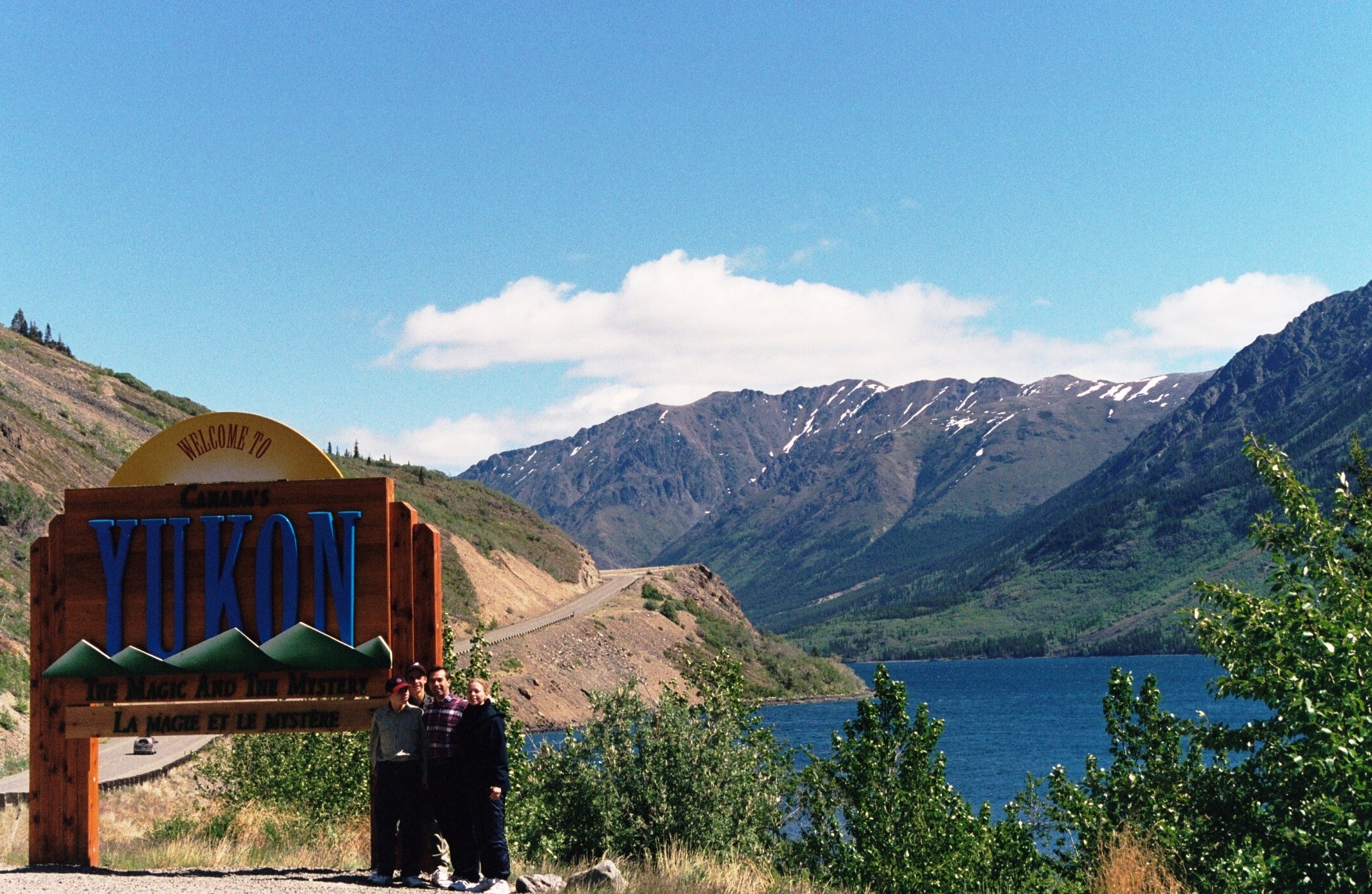
Just enough clouds to break the monotonous blue. The Yukon Territory, June 2000
Leaving behind nights of terror and fear
I rise
Into a daybreak that’s wondrously clear
I rise
Bringing the gifts that my ancestors gave,
I am the dream and the hope of the slave.
I rise
I rise
I rise.
— Maya Angelou
I join millions in saying “Thank you, thank you, thank you, Maya Angelou, for these ever-inspiring words, that light up the darkness for so many of us!” I’ve often said that Angelou’s writing does for my spirit what spinach did for Popeye. She has a gift for empowering others through what she writes.
To be extra-candid here, I’ve always had the feeling that some of my friends don’t understand my abiding interest in black history. It’s not that they say so in words; they don’t have to. And I’ve never felt the need to explain.
Still, it’s like the elephant in the living room. Sooner or later, anyone who knows me well, knows that I feel a deep unspoken connection with the African-American details of U.S. history. It’s partly that I’m from the South, where both transracial unity and lingering racism continue to flourish. Jeff often remarks, in some northern places we visit, how strange it seems to see that there are so few black people around. Both of us feel more at home when we’re not in an all-Caucasian crowd. Both of us have been most happy in churches where everyone belongs, regardless of age, ethnicity, disability or good old-fashioned eccentricity. It might seem odd or pretentious to admit that, but that’s just how it is.
But I can’t pretend to have the slightest idea what it’s like to be an African American today, much less twenty or fifty or two hundred years ago. I have, however, learned a few things I never wanted to know.
I’ve learned that invisible chains can be almost as restrictive and damaging as literal ones, and far more insidious.
I’ve learned that prejudice is something one can often sense and pick up on inner radar…and that such radar is sometimes inaccurate, skewed unfairly by past outrageous injustices.
I’ve learned that many cruelties and hurts are perpetrated by people who mean well, and have not the slightest intention of hurting someone else…and who sometimes are unwilling to see their own guilt in the matter, even if it is pointed out.
Most importantly, though, I have been blessed to know so many African American people who have lived out before my eyes the daily tasks I find so difficult: forgiveness, patience, fortitude, courage, humor, humility and never, ever giving up.
All of us struggle, of course. African-Americans have no corner on the suffering market; indeed, as Angelou herself points out in the clip below, no minority or majority does. Life is mostly a tremendous struggle, and ultimately, none of us gets out of this world alive.
Which brings me to another reason I love black history: its unmistakable link between faith and endurance; hope in God and trust in people, no matter how many times people may fail us and disappoint us, and no matter how hard it may be to see God pulling for us, working for our good in the harshest circumstances.
The gift Angelou refers to, the one her ancestors gave, is not just for black people or other minorities. It’s for all of us. The dream of the slave is the dream of us all: freedom from the pain and suffering and injustice of this world. Her final words in this poem, meaningful to all of humanity, have a special resonance for those of us who are Christians, because intentionally or not, they echo for us the theme that is at the heart of our faith, the greatest story ever told: that the victory of Jesus is our victory as well. We rise!
This post was first published seven years ago today. The original post, comments and photo are linked, along with two other related posts, below. These links to related posts, and their thumbnail photos, do not appear in the blog feed; they are only visible when viewing the individual posts by clicking on each one. I have no idea why, nor do I know how they choose the related posts. That’s just the way WordPress does things.
Bright and intense and beautiful

Taken on my daily walk in our York neighborhood, November 2008
“Fall colors are funny. They’re so bright and intense and beautiful. It’s like nature is trying to fill you up with color, to saturate you so you can stockpile it before winter turns everything muted and dreary.” ― Siobhan Vivian
That’s what I do on my walks; stockpile the colors and images and cool, smoke-scented air. No matter how often I see the autumn foliage, it always dazzles me. No matter how many photos I take, I always want to take more. I keep all these lovely digital and mental photos and sounds and scents in my mind as a sort of second line of defense against the sad and scary thoughts that keep getting past my psychological fortress. I can’t use the coming winter as an excuse for stockpiling, though, because I do the same with spring flowers. I replenish and tap into my stockpiles of cheer, serenity and joy all year long.
Still, I think the fall holidays have grown ever more festive because they ease us into the coming months of cold weather and short, gloomy daylight. I love the way the winter solstice sneaks in there right before Christmas, when merriment and frantic busyness are at a fever pitch. By the time the celebrations of the season have passed, we can perk ourselves up with the thought that the darkest day has come and gone, and every day that passes brings a longer time between sunup and sundown.
Meanwhile, though, we still have a few weeks to go before December. Grab every clear day you can, and make some mental and digital photos of the way the sunlight electrifies the vivid fall palette. Which colors are your favorite mood-booster?
This post was first published seven years ago today. The original post, comments and photo are linked, along with two other related posts, below. These links to related posts, and their thumbnail photos, do not appear in the blog feed; they are only visible when viewing the individual posts by clicking on each one. I have no idea why, nor do I know how they choose the related posts. That’s just the way WordPress does things.
Thy medicine

Even in December (2005), this shop in rue Cler, Paris, had abundant healthy choices.
“Let food be thy medicine…” — Hippocrates
You really don’t want to get me started on this topic, so I’ll try to keep it relatively brief. I think one of the best ways to keep our minds and bodies fit and healthy is to take care what we feed them. This applies to thoughts and images, of course, which is why I started this blog. But it also applies to food — and mental and physical health are inextricably linked.
I’m lucky that my mother taught me years ago not to believe everything I hear from the FDA about what is safe or healthy. Some of what she was saying 30 years ago was scorned and laughed at (such as “margarine is worse for you than butter” and “refined carbohydrates are empty calories” and “artificial sweeteners are harmful”). Now, of course, she has the last laugh, as do many of the nutritionists who were once dismissed as kooks.
Pharmaceuticals have their place, of course, but as Dr. Santos Rodriguez told me recently, “a great many diseases are basically the result of malnutrition.” As a remarkably fit physician in his 90’s, he has a lot of credibility in my book. No matter what may ail your spirit or your body, a good diet can be the start of your journey toward wellness and peace of mind.
As winter approaches, I hope you will enjoy the benefit of fruits and vegetables, now available year round thanks to the advances in shipping that allow us to enjoy produce from other regions when we are unable to access food that is grown locally. Years of experience have taught me that eating lots of fruit and vegetables in fall and winter translates to fewer colds and viruses. If you’ve never tested this idea, give it a try this year. Indulge in your favorites, even if they cost a bit more in the off-season. It will be an investment in your health and enjoyment that will pay dividends!
This post was first published seven years ago today. The original post, comments and photo are linked, along with two other related posts, below. These links to related posts, and their thumbnail photos, do not appear in the blog feed; they are only visible when viewing the individual posts by clicking on each one. I have no idea why, nor do I know how they choose the related posts. That’s just the way WordPress does things.
The inspiring force

This monument honors Martin Luther and other leaders of the Protestant Reformation.
Worms, Germany, August 2005
“I was carried beyond myself by the inspiring force of urgent necessity.”
— Antoine de Saint-Exupéry
If you’ve been through anything especially difficult, harrowing or protracted and exhausting, chances are you’ve heard well-meaning people say “I don’t know how you do it” or “I could never do what you are doing.” It’s natural for them to feel that way, but of course, those of us who are enduring great trials or facing seemingly impossible tasks usually do so because we feel we have no other choice.
Sometimes, great and monumental changes are started by people who have no idea where their acts of courage or resistance will lead. Martin Luther wasn’t planning to leave, let alone divide, the Roman Catholic Church when he penned his 95 Theses. Rosa Parks may have simply been too tired and fed up with unequal treatment to move to the back of the bus. I think it’s safe to say that neither of them imagined what would come of their defiance. Nevertheless, their individual actions sparked events that changed the course of human history.
Yet far more often– every day, in fact– people all over the world are similarly carried beyond themselves in ways that are largely unknown and unheeded. Millions of humans struggling with countless challenges somehow manage to keep going beyond what they might have believed they could endure. Some manage tasks that seem almost impossible under stress. Others quietly bear up under years of chronic pain, or take care of loved ones for years on end, or live with the limitations of physical or mental illness, or press on through repeated failures until success is achieved. A few of these stories make the news, and inspire us. But the vast majority of heroes will never be known to us.
What is it that gives us the strength to survive, or even prevail? Based on what I’ve seen, experienced and observed, I think usually it’s simply that we have no other choice. No matter how tired or inadequate we may feel, we carry within us the ability to rise above far more challenges than we dream ourselves capable of overcoming.
This post was first published seven years ago today. The original post, comments and photo are linked, along with two other related posts, below. These links to related posts, and their thumbnail photos, do not appear in the blog feed; they are only visible when viewing the individual posts by clicking on each one. I have no idea why, nor do I know how they choose the related posts. That’s just the way WordPress does things.
The simplest toy
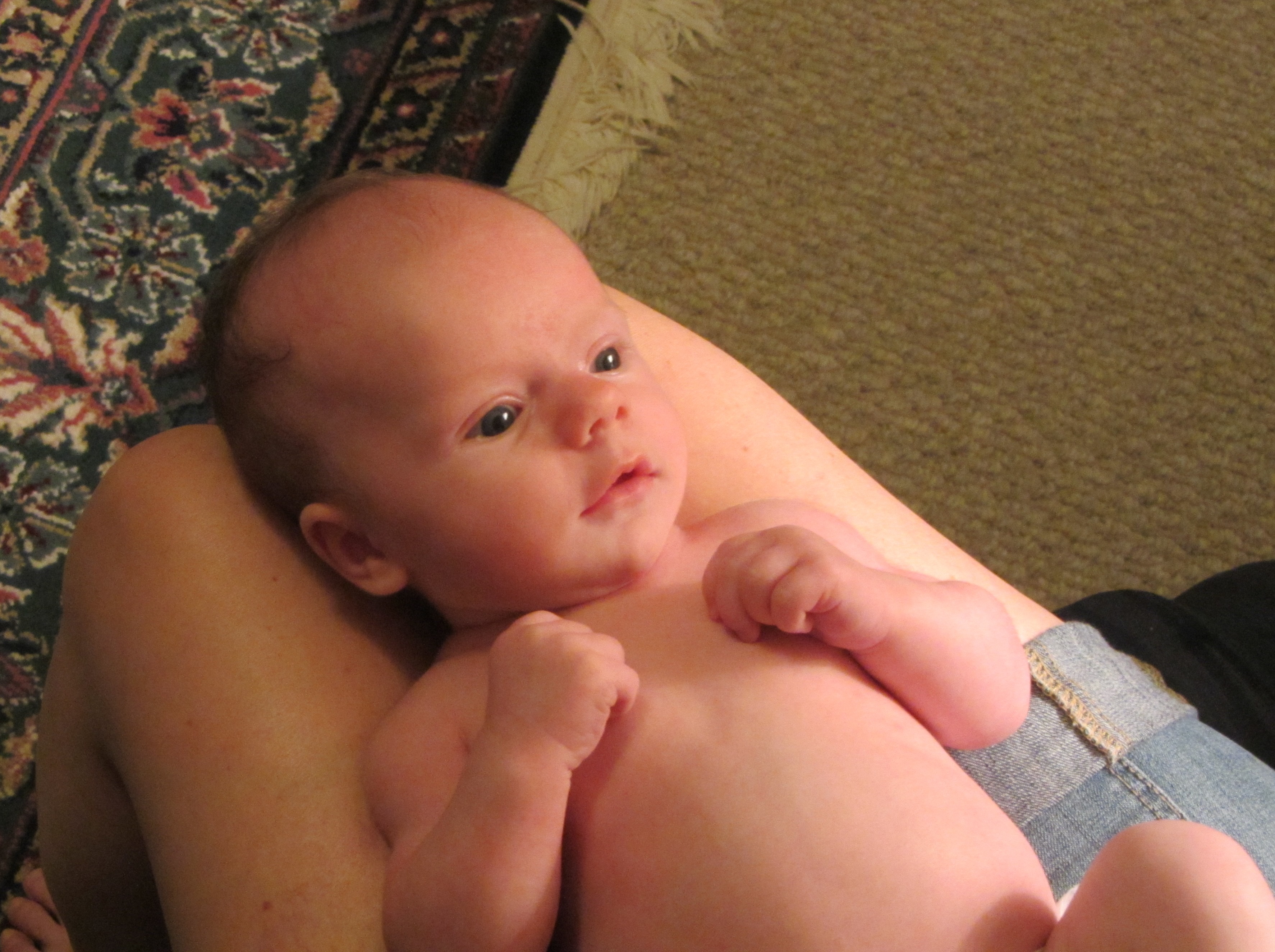
Our first grandchild, Grady, figured out how to work this toy right away.
I snapped this photo of him on my lap in September, 2013
“The simplest toy, one which even the youngest child can operate, is called a grandparent.” — Sam Levenson
There are colorful toys, singing toys, funny toys, educational toys, old-fashioned toys, and toys that wear out quickly. Grandparents are all of the above. Every child should have at least one or two – hopefully more! If your child doesn’t have any, don’t fret – as with all well-loved toys, you can borrow someone else’s.
Today I wish you many happy thoughts of your grandparents, grandchildren, or both!
This post was first published seven years ago today. The original post, comments and photo are linked, along with two other related posts, below. These links to related posts, and their thumbnail photos, do not appear in the blog feed; they are only visible when viewing the individual posts by clicking on each one. I have no idea why, nor do I know how they choose the related posts. That’s just the way WordPress does things.
Let us begin

Fall is the time to plant bulbs and prepare for a beautiful spring lawn!
Keukenhof, the Netherlands, April 2007
“All this will not be finished in the first one hundred days. Nor will it be finished in the first one thousand days . . .nor even perhaps in our lifetime on this planet. But let us begin.”
― John F. Kennedy
One thing that bothers me most about contemporary culture is our collective impatience to see everything done quickly. There are quite a few things we can mass-produce rather than lovingly craft, and “that takes too much time” is a common indictment of all sorts of bygone skills and nearly forgotten ways of life.
But some things cannot be rushed, and some things require advance planning and organization. An elaborate holiday feast for family, a handmade gift for a special friend, the training of a new puppy or kitten; all take time that yields a rich return for our patience.
Don’t you love colorful spring flowers? Now is the time to plant some bulbs! I remember the first year I ever bought a lot of daffodil bulbs. During the hard work of planting them, I became irritated with myself for having bought so many bulbs in my enthusiasm. In the chilly fall I dug and dug until my hands were sore, but now, nearly ten years later, I still enjoy seeing my favorite flowers in the very early spring. Some of them have spread beyond the initial planting. It took time, but it was worth it.
A lovely lawn or garden; a well-behaved child; a uniquely hand-crafted furnishing or decoration — all these and more will make the world more beautiful for all of us. It’s hard work, and we won’t see the results immediately…but let us begin!
This post was first published seven years ago today. The original post, comments and photo are linked, along with two other related posts, below. These links to related posts, and their thumbnail photos, do not appear in the blog feed; they are only visible when viewing the individual posts by clicking on each one. I have no idea why, nor do I know how they choose the related posts. That’s just the way WordPress does things.
If you look
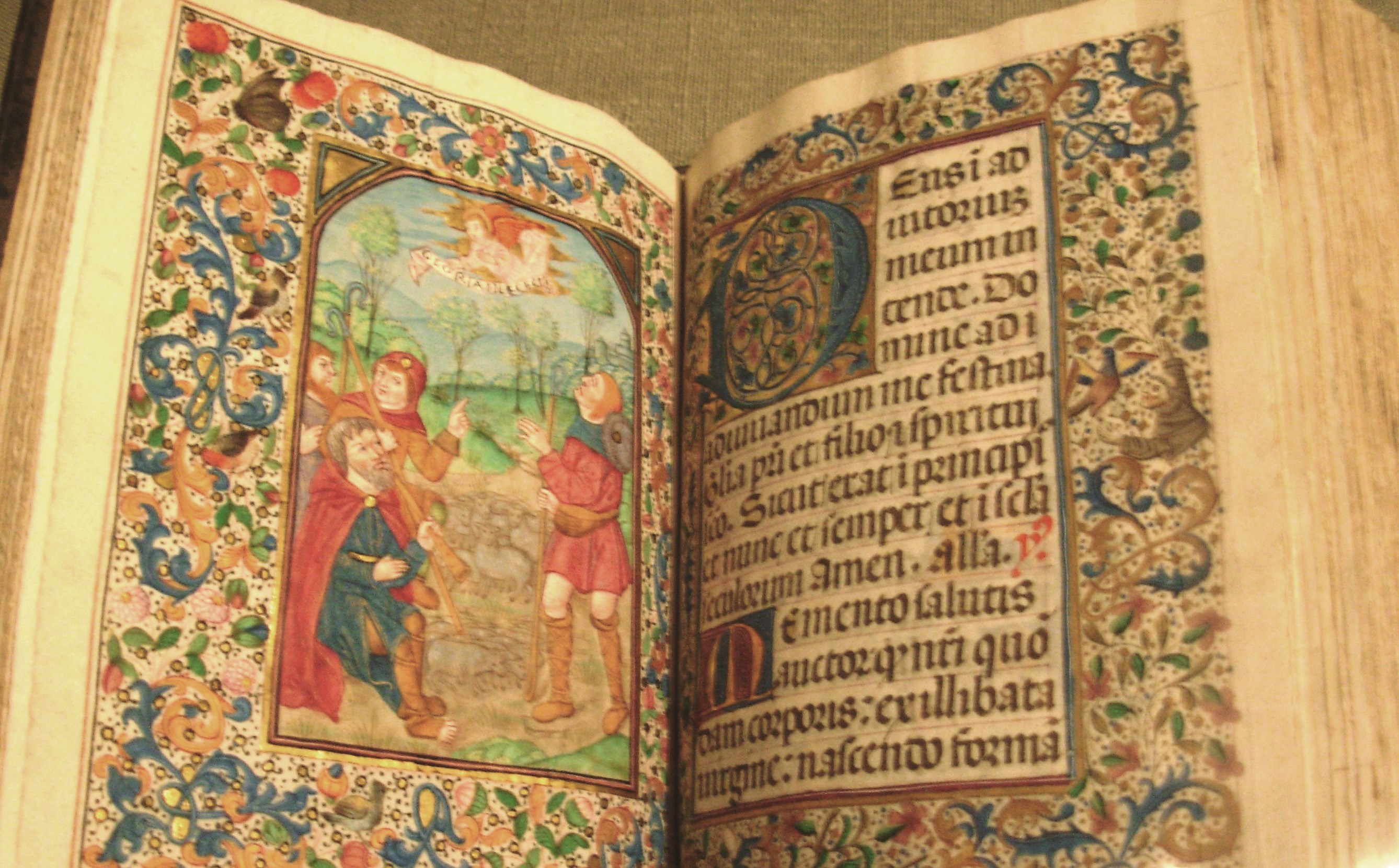
A medieval illuminated manuscript at the Philadelphia Museum of Art, July 2007
“If you look at an illuminated manuscript, even today, it just blows your mind. For them, without all the clutter and inputs that we have, it must have been even more extraordinary.” — Geraldine Brooks
I started reading aloud to our sons when they were babies, and kept it up nightly until they were in middle school. Over the years I marveled at the multitude of gorgeous picture books that were available in full, vibrant colors. When I was a child, picture books were fewer in number, and many of them had only two or three colors. In fact, some of the Caldecott Medal winners such as Make Way for Ducklings were muted in appearance compared to the bright hues that decorated even the least expensive picture books our sons enjoyed. I wondered if they had any idea how lucky they were, having hundreds of visually appealing titles available at any public library or bookstore.
Of course, our children could say something similar about the greater benefits available to young readers today, who have animated eBooks with motion, sound, and interactive features available at the click of a key. For all the talk about reading being an endangered pastime, the various formats of literary offerings seem to become ever more plentiful, accessible and diverse. Imagine, then, how a medieval reader (or nonreader, as the vast majority were) would react to the literary wealth of our era.
But even centuries ago, there were picture books. Before the printing press ushered in a renaissance that was as far-reaching as our digital revolution of today, books had to be copied by hand. Countless monks and scribes literally gave their entire lives (and sometimes their eyesight) carefully duplicating texts that had slim chances of surviving the ravages of uncontrolled climate, hungry insects and pillaging or censoring conquerors. It’s a bit amazing that any of these treasures survived.
Some did, though, and among the most amazing are the illuminated manuscripts, with elaborate border decorations and richly detailed illustrations. The intricate patterns and calligraphy tell an unwritten story that goes beyond the diligently copied text, reminding us that books have been vital to humanity for as long as history has been recorded. The countless hours spent preparing, recording and preserving the written word testify to the respect, even reverence, that books have always commanded from those who appreciate them.
It’s fun to wonder whether much of the deluge of writing now available online will live through as many centuries as the handwritten texts have survived. Does the ease of writing (and deleting), the abundance of lovely photos and artwork so easily viewed on any computer, and the common expectation of widespread literacy, cause us to devalue one of the greatest blessings people have ever been granted? Are we treating words and illustrations carelessly, flinging them about with the contempt that often accompanies any easily available, seemingly boundless resource?
Perhaps some of us are, at least now and then. But I’d like to think that a great many of us — particularly those who are reading and writing words right now, rather than passively taking in television re-runs — comprehend the surpassing importance and responsibility attached to literacy. There’s a popular bumper sticker that says, “If you can read this, thank a teacher.” Perhaps there should be one that says, “If you can read this, BE a teacher — and a learner!”
Whatever you are doing today, you’ll be in contact with written words more often than you’re even aware of them. I hope you’ll take a moment to be thankful for this gift of literacy, which binds us to people centuries removed from us. They’ve left us richly illustrated reminders that words can be, and often are, extraordinarily beautiful.
For a look at picture books of bygone days, see Elephant’s Picture Book, a fun and interesting blog!
This post was first published seven years ago today. The original post, comments and photo are linked, along with two other related posts, below. These links to related posts, and their thumbnail photos, do not appear in the blog feed; they are only visible when viewing the individual posts by clicking on each one. I have no idea why, nor do I know how they choose the related posts. That’s just the way WordPress does things.
Your message

Even when it’s very, very dark, there’s a light shining somewhere.
Here’s the full moon, shining on Dam Neck, Virginia, September 2013
“If you want to get your message across, shut up.” — Mardy Grothe
I don’t take this advice nearly as often as I ought to, but today, I get it. I schedule these posts about two weeks in advance, so I have no idea how I’ll be feeling when this post is published. But right now, as I am writing it, I am just treading water. Maybe my wonderful and funny and highly intelligent readers can help write this post for me. Got any sunny, happy or at least wise thoughts to share? Today, I am attempting to Defeat Despair by keeping my mouth shut!
Wish me luck.
This post was first published seven years ago today. How ironic that it should re-post on the fourth anniversary of Jeff’s death. Appropriate, I guess, because for all of my writing and talking, there are still no words to communicate the unsurpassed loss.
The original post, comments and photo are linked, along with two other related posts, below. These links to related posts, and their thumbnail photos, do not appear in the blog feed; they are only visible when viewing the individual posts by clicking on each one. I have no idea why, nor do I know how they choose the related posts. That’s just the way WordPress does things.
Wild with leaves
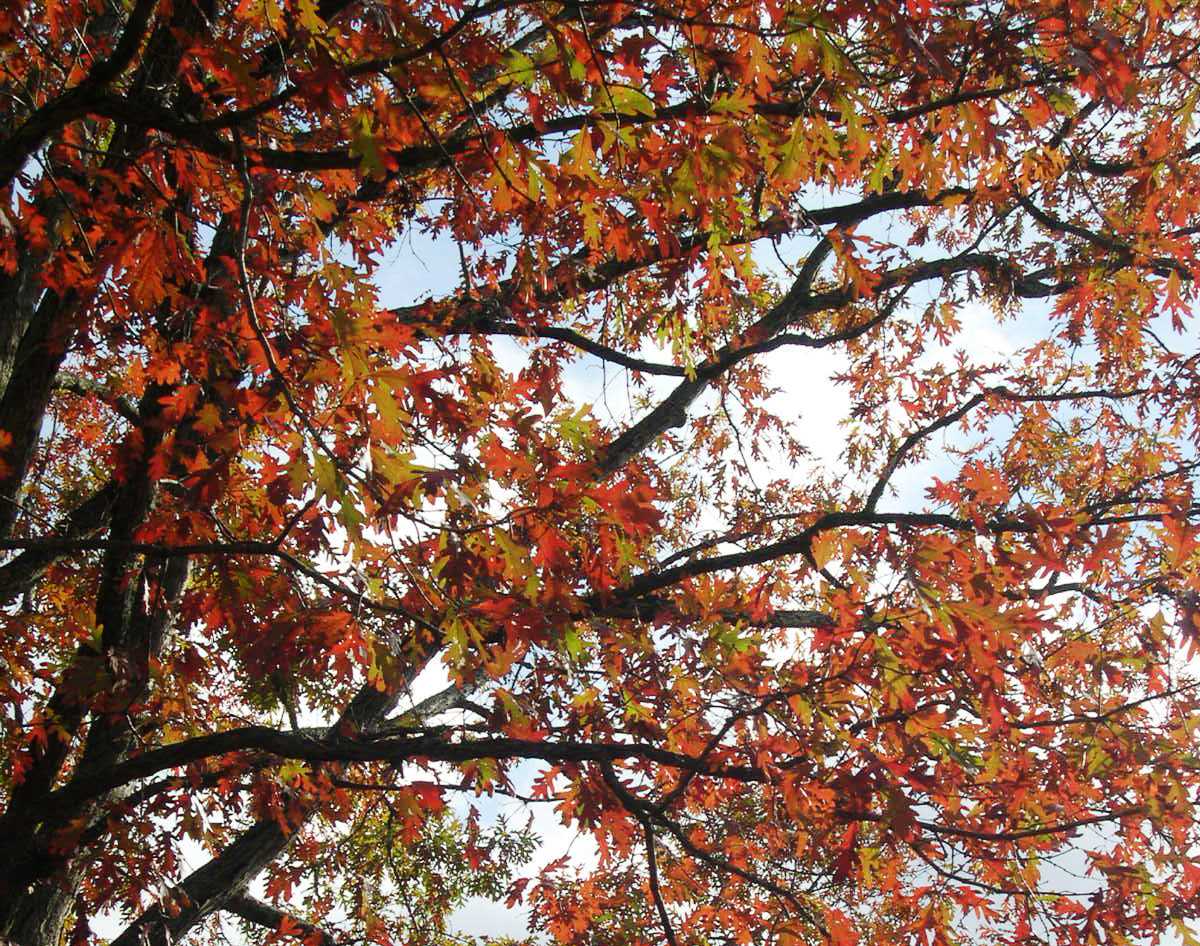
Autumn leaves at Colonial Williamsburg remind me of all that I love about the season. November, 2004
“Listen! The wind is rising, and the air is wild with leaves,
We have had our summer evenings, now for October eves!”
― Humbert Wolfe
The photo above was taken just a few months after we moved to Virginia, having lived in northern California for the past five years. I was almost unbearably homesick for the west coast. The heat, humidity, unpredictable thunderstorms and hungry mosquitoes had been a real adjustment. But when fall rolled around, it brought back distant memories that refocused my perceptions.
For the first several years here in Virginia, we had season passes to nearby Colonial Williamsburg. After the crowds of tourists thinned out in the autumn, it was magical to walk the dirt roads there at dusk. Fire torches and flickering candles provided light as the darkness fell, and the colors of autumn seemed a fitting complement to the carefully re-created historic atmosphere. My rediscovery of the joys of the season was the beginning of my love for the Commonwealth of Virginia.
In our other homes far west of here, we had seemingly endless warm days and mild evenings, year round (or nearly so) and dearly loved. Yet four distinct seasons provide a different kind of enjoyment, and I feel grateful to be back in the climate I loved in childhood.
What are your favorite memories of this season? Wherever you live, I wish you October eves rich with autumn’s unique enchantment!
This post was first published seven years ago today. The original post, comments and photo are linked, along with two other related posts, below. These links to related posts, and their thumbnail photos, do not appear in the blog feed; they are only visible when viewing the individual posts by clicking on each one. I have no idea why, nor do I know how they choose the related posts. That’s just the way WordPress does things.
Do not wait

Matt with “Ms. Darla,” who has opened so many doors for him. February 2012
“Do not wait for leaders; do it alone, person to person.” — Mother Teresa
If I’ve learned anything at all since Matt was born, I’ve learned this: no government or agency can match the power of one dedicated and compassionate person to improve the life of another.
Agencies, laws and governments are necessary, but to the extent that we come to rely on them for needs that can never be answered except by the presence of another human, they can work against us. Indeed, we can excuse ourselves from difficult or uncomfortable work by telling ourselves that “agencies” or “the state” or “the church” can take care of the problem. This is an illusion, and a dangerous one.
When I look back on Matt’s life, it’s always the individuals who made a difference for our family. The perceptive fourth grade teacher who saw past the disabilities to the intelligence that was not always obvious. The occupational therapist who patiently helped me understand what Matt’s challenges are, and how we can do little things daily to help him overcome them. Above all, the friends who simply loved us, letting their hearts lead the way and doing naturally the things that others, afraid of making mistakes, were too hesitant to do.
The remarkable lady pictured above with Matt has helped him, and many others with or without disabilities, in countless ways during the years — almost a decade now — that we have had the gift of her friendship. Her considerable skills and experience make her a candidate for more lucrative and prestigious careers, but she chooses to dedicate herself to her community and its people, volunteering in various ways that bring her into contact with those who need her.
Most importantly, she does all these things with a joy and enthusiasm that could never be matched by a salaried person sitting behind a counter or desk. In serving others face to face, person to person, she changes many lives. While she is one of the few people who have ever been willing to join me in my political activism (we spent a marvelous day in Richmond at the capital, meeting with our elected representatives and their staff), she never waits for leaders to do things that need to be done. How different our world would be if there were more people with her energy and dedication!
You may not see yourself as having abilities unavailable to powerful or well-known leaders, but in reality, you have opportunities that they will never know about. In your own family, church, community, school — really anywhere you go — big and little doors are open to you, chances to act in small ways that cumulatively bring about great change. It starts with a smile, a kind word, a human touch that no organization or legislature can produce. When you step out as one person to make a change in your world, you really aren’t alone; you’ll become part of an unknown army of others like you, who make the world a better place every day.
This post was first published seven years ago today. The original post, comments and photo are linked, along with two other related posts, below. These links to related posts, and their thumbnail photos, do not appear in the blog feed; they are only visible when viewing the individual posts by clicking on each one. I have no idea why, nor do I know how they choose the related posts. That’s just the way WordPress does things.
Not a child

Amy’s dog is one hundred percent adorable. Manassas, Virginia, July 2013
“My dog is not a child substitute, according to its pediatrician.” — Rita Rudner
On a recent weekend visit, Drew and Megan were laughing about their having unintentionally referred to Grady as “Pasha” a couple of times. I laughed too, but before the weekend was over, I had done it myself. It’s an easy mistake to make. They’re about the same size, not too much difference in the weight, same sort of addictive cuteness that elicits an irresistible urge to talk in silly voices.
Most of us who have animals in our homes probably never realized that adopting a pet would bring out behaviors to which we once thought ourselves immune. You may have even said at some point (as I did, more than once) “I would never, ever act as foolish over a dog (or cat or bird or whatever) as they do — you would think that was a child.”
The interesting thing is, once you lose that particular illusion, you’re in. You get it. And you will usually find yourself much more enamored of animals in general. Some of my best friends are my best friends’ dogs. Take the sweetheart pictured above. He (yes, it’s a HE, and no sexist remarks about the doll please) is one of the most loveable cuties I’ve ever seen. Good thing he’s too big for me to hold on my lap.
If you are lucky enough to have an animal in your household, take it from one parent to another: Enjoy these years. They go by much too fast!
This post was first published seven years ago today. The original post, comments and photo are linked, along with two other related posts, below. These links to related posts, and their thumbnail photos, do not appear in the blog feed; they are only visible when viewing the individual posts by clicking on each one. I have no idea why, nor do I know how they choose the related posts. That’s just the way WordPress does things.
Alterations

Early American style displayed at the dressmaker’s shop, Colonial Williamsburg, Virginia, November 2004
“Time is a dressmaker specializing in alterations.” — Faith Baldwin
I imagine most of you remember Scarlett O’Hara’s reinvention of her parlor curtains, as well as Carol Burnett’s hilarious parody of it. I admired Scarlett’s ability to work with whatever she had, which often wasn’t very much. In our era, when new clothing is relatively easy to obtain, we scarcely ever re-fit or repurpose garments, but time’s alterations continue unabated.
As Jeff and I have aged, I have reached the conclusion that no trait is more necessary for thriving in late life as the ability to adapt to change. For some of us, change is exciting in certain situations, but the types of changes that go along with getting older are not all of the stimulating, desirable kind. Research tells us that even positive change is stressful. How to cope, then?
Perhaps Baldwin’s analogy is helpful. Start with a lovely, flattering dress that has gone out of style, or no longer fits. A clever seamstress can refashion the cut and details to accommodate the new circumstances, keeping the classic features of the original while adding touches here and there that disguise and decorate. And a really talented seamstress can do this more than once with the same gown. Maybe we can do something similar with our daily lives.
I’ve grudgingly made some adjustments to what I expect my body to do now. I cannot tolerate the same amount of eating, exercise or excitement I relished when I was younger. I’ve added some interesting details, though, that weren’t part of my life thirty years ago. Focusing on the wealth of experiences, memories and relationships that have deepened over time keeps me from wallowing in regret over what now belongs to the past, or what never was.
Have you been busy with time’s alterations? Have you a new lace collar, some eye-catching buttons or different hemline to share with us? Give us some hints on re-inventing! And enjoy your new look – on you it’s fabulous!
This post was first published seven years ago today. The original post, comments and photo are linked, along with two other related posts, below. These links to related posts, and their thumbnail photos, do not appear in the blog feed; they are only visible when viewing the individual posts by clicking on each one. I have no idea why, nor do I know how they choose the related posts. That’s just the way WordPress does things.
Stories to tell

Fort Raleigh National Historic Site is rich with imaginary echoes of the Lost Colony.
Roanoke Island, North Carolina, September 2013
“With thousands of years of human habitation, this land surely has stories to tell. The trees rustle with whispers of those who have come and gone.” — from a display at the Visitor’s Center at Fort Raleigh National Historic Site
Recently Jeff and I visited beautiful Roanoke Island, North Carolina, the site of the mysterious “Lost Colony.” Encountering such unanswered questions of history, it’s easy to let imagination take flight as surely as the Wright brothers’ plane did at nearby Kill Devil Hills. The sylvan enchantment of the grounds around Fort Raleigh are especially captivating for those of us who are inclined to create mental pictures to fill in the gaps left by the information engraved on historic markers.
Have you ever visited a place rich with history and felt some intangible sense of what happened there in years past? Do you love to read historical novels that take up where the often debatable “facts” of history leave off? Touring a spot that has stories to tell, whether it’s a modest home built centuries ago or the ruins of an ancient city, helps me step out of my own circumstances and breathe in the richly textured nuances left behind in whatever remains or has been re-created. As with all forms of travel, visiting another era gives me perspective on my own struggles, helping me see my life with newly appreciative eyes.
If traveling to a geographically distant place is not possible for you anytime soon, try taking a vacation to a bygone era. No matter where you live, you will be close enough to such a place to make a daytime visit there and be back in our own time by evening. You won’t need to pack anything except maybe a camera, but do bring along your imagination. Those of you who are experienced time travelers, share some of your flights of fancy with us!
This post was first published seven years ago today. The original post, comments and photo are linked, along with two other related posts, below. These links to related posts, and their thumbnail photos, do not appear in the blog feed; they are only visible when viewing the individual posts by clicking on each one. I have no idea why, nor do I know how they choose the related posts. That’s just the way WordPress does things.
Autumnal sunshine
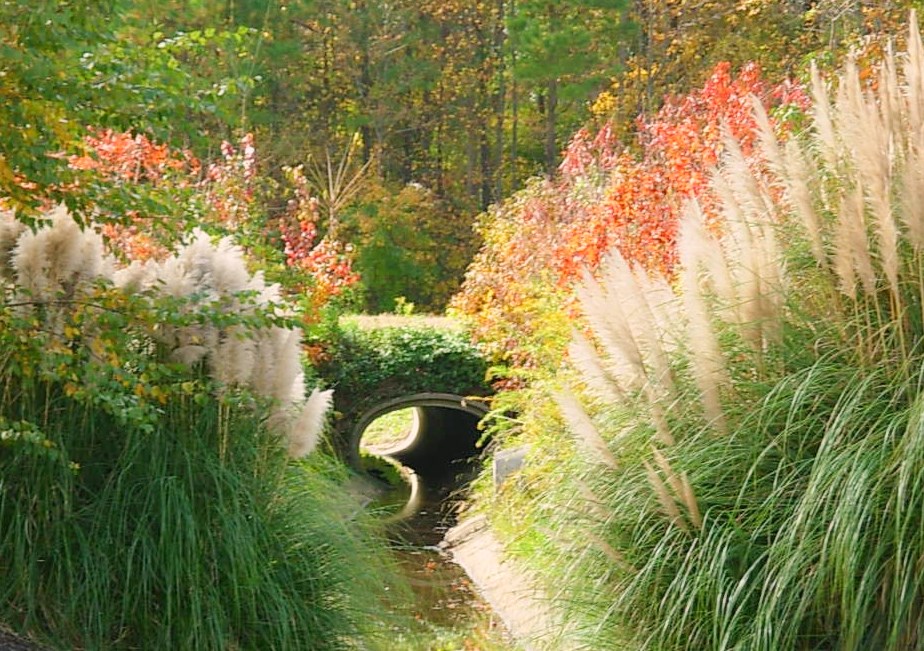
Gather the golden moments of autumn, with a camera or just in memories. Yorktown, 2008
“I cannot endure to waste anything so precious as autumnal sunshine by staying in the house.” — Nathaniel Hawthorne
“In autumn, don’t go to jewelers to see gold; go to the parks!” — Mehmet Murat ildan
As our President would say, let me be clear. Yesterday’s post was about rainy weather. On a gloriously bright fall day, we simply MUST find the time to go outdoors for at least a little while. No other time of year features the combination of visual opulence, agreeable temperatures, and sunshine that electrifies the foliage and flowers. Spring’s loveliest weather tends to come before the trees are at their fullest or flowers are at peak bloom. In the fall, before the leaves drop and the flowers fade away, there is a rich abundance suggestive of the festivities to come.
Let’s heed the words of two writers who come from very different locations and eras. As their tributes to autumn suggest, some pleasures are universal and unchanging. If you have any fine weather this week, don’t let it go to waste! Go out and gather beautiful images, scents and sounds to treasure through the winter.
This post was first published seven years ago today. The original post, comments and photo are linked, along with two other related posts, below. These links to related posts, and their thumbnail photos, do not appear in the blog feed; they are only visible when viewing the individual posts by clicking on each one. I have no idea why, nor do I know how they choose the related posts. That’s just the way WordPress does things.
What to do
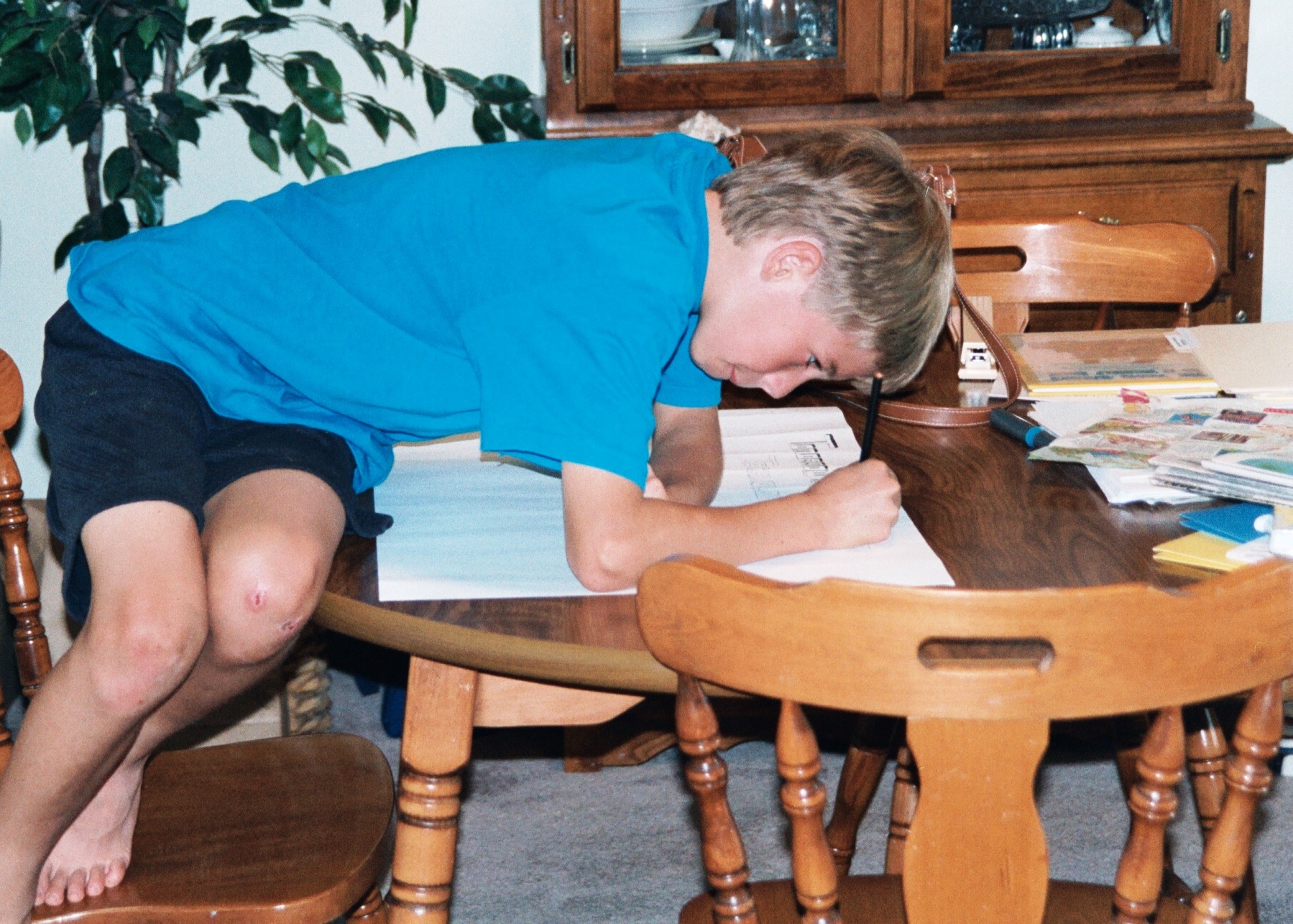
Even in Hawaii, Drew had no regrets about spending some time indoors. Honolulu, 1995
“Millions long for immortality who do not know what to do with themselves on a rainy Sunday afternoon.” – Susan Ertz
As the warm weather fades and the cold or rainy season moves in, we’ll all be indoors more, whether we like or not. I like it.
I relish the chance to spend hours at home, puttering around indoors, despite my great love of long walks and trees and flowers. There are so many things I enjoy that make engaging indoor pursuits. As my books, magazines, craft supplies and well-stocked tea cabinet suggest, I am about as prepared for rainy days as one can be.
Drew has always loved rainy weather, and while he likes actually being outside in it, getting wet and soaking up the pervasive atmosphere that goes along with a stormy day, I suspect part of his love for gloomy weather is rooted in so many of the pastimes he loves. When he was a child, I never had to entertain him. He made his own fun, and could find ways to keep his busy mind occupied no matter where he found himself.
That’s actually a great talent, I think. Most people who read blogs have lively minds that are interested in a variety of topics, but I wonder how well we would function if the computer, smart phones and tablets suddenly went unavailable for long stretches of time. I’d like to think that I have enough reading, crafting, baking and homemaking projects to keep me happy through a lifetime of long winters.
Whether or not this Sunday afternoon is a rainy one for you, I hope it’s a peaceful one, with time for prayer, meditation, quiet conversation and any number of indoor pleasures. It’s much easier to face the coming of winter when our homes are stocked with happy hobbies and plentiful projects. Have a comfy-cozy afternoon!
This post was first published seven years ago today. The ability to be happy indoors has taken on a whole new dimension of importance in the post-COVID world, and I hope we’ve all honed that trait in the past months.
The original post, comments and photo are linked, along with two other related posts, below. These links to related posts, and their thumbnail photos, do not appear in the blog feed; they are only visible when viewing the individual posts by clicking on each one. I have no idea why, nor do I know how they choose the related posts. That’s just the way WordPress does things.
A moveable feast

They talk of Paris in the spring, but it’s also beautiful in autumn. September, 2005
“If you are lucky enough to have lived in Paris as a young man, then wherever you go for the rest of your life, it stays with you, for Paris is a moveable feast.”
― Ernest Hemingway
I haven’t even been lucky enough to visit Paris more than twice, let alone live there, but for me it was love at first sight. Those visits will stay with me the rest of my life, so I can easily imagine the truth behind Hemingway’s apt and much-quoted description.
That description isn’t true only of Paris, however. As we enter the season most associated with feasts of various kinds, let’s think about the places we have been, and how our souls have feasted on the beautiful, unique, stimulating or relaxing qualities of this astoundingly diverse and breathtakingly gorgeous planet. I am guessing that most of you, like me, have many places you carry around in your heart, moveable feasts that will stay with you forever.
I started this blog, in part, as a way to document and celebrate such joys I’ve experienced, but I have only seen a small fraction of all the earth has to offer. What are some of your moveable feasts? Share your thoughts, links, or photos below, and let’s have a banquet today!
This post was first published seven years ago today. The original post, comments and photo are linked, along with two other related posts, below. These links to related posts, and their thumbnail photos, do not appear in the blog feed; they are only visible when viewing the individual posts by clicking on each one. I have no idea why, nor do I know how they choose the related posts. That’s just the way WordPress does things.
Its own season
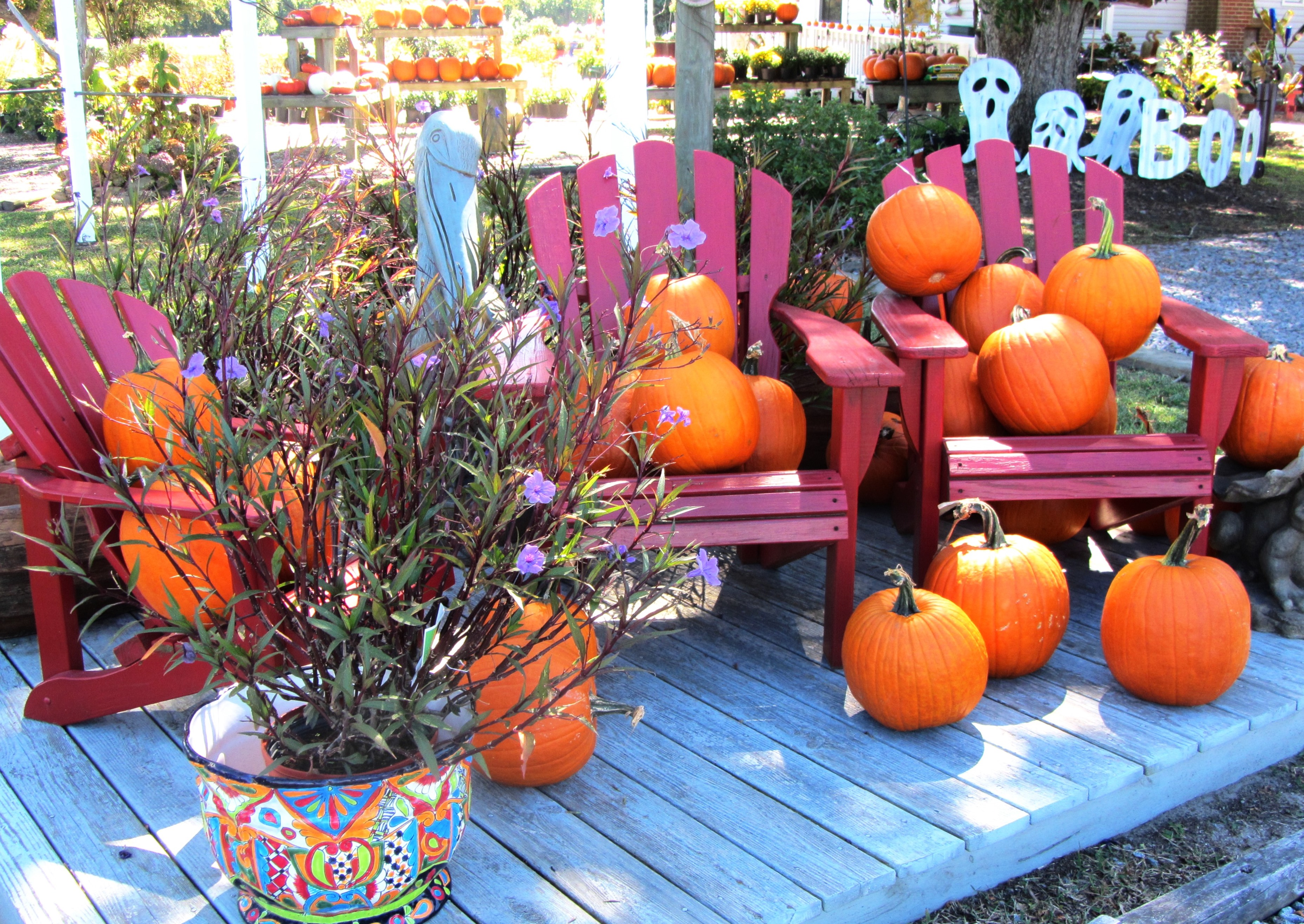
Pumpkins were plentiful at this shop near the Outer Banks, North Carolina, September 2013
“Oh how we love pumpkin season. You did know this gourd-ish squash has its own season, right? Winter, Spring, Summer, Pumpkin…. We anxiously anticipate it every year.” ~Trader Joe’s Fearless Flyer
Full disclosure: I don’t care for eating anything pumpkin-flavored. I know many people who do, however, and I love the scents and sights related to this gorgeous gourd. So I felt it would be appropriate to post a paean to the pumpkin.
If you’re lucky enough to live near a Trader Joe’s (and btw, I told Jeff that a non-negotiable consideration in choosing a place to retire is whether there is a Trader Joe’s nearby) you know that TJ’s loves pumpkins as much as they describe in the quote above. You can get endless pumpkin-flavored treats there: pies, pancake mixes, cakes, cookies, coffee, even the unadorned pumpkins themselves, in a variety of styles and sizes.
But, luckily for the world, pumpkins (which are thought to be native to North America) are easy to grow, and are now found almost everywhere except Antarctica. Mma Ramotswe, the charming and indefatigable protagonist of Alexander McCall Smith’s delightful series, waxes eloquent about the joys and comforts of pumpkins in her home country of Botswana. A visit with Mma Ramotswe is almost enough to convince me to try eating pumpkin once in awhile, since I trust her judgment; she also has a tremendous appreciation of TEA!
Anyway, my point (and I do have one) is that pumpkin popularity is widespread and here to stay. Chances are you have at least one thing that is pumpkin-related in your home every fall. For me, it’s pumpkin scented hand soaps from Bath and Body Works, and pumpkin-flavored coffees and treats for those in our family who love them.
How about you? Are you a pumpkin lover? Do you enjoy them in various forms during the October, November and December holidays? Share your favorites and traditions– even recipes, if you like. The pumpkin lovers among us will thank you!
This post was first published seven years ago today. The original post, comments and photo are linked, along with two other related posts, below. These links to related posts, and their thumbnail photos, do not appear in the blog feed; they are only visible when viewing the individual posts by clicking on each one. I have no idea why, nor do I know how they choose the related posts. That’s just the way WordPress does things.


 Defeat Despair