The patient seamstress
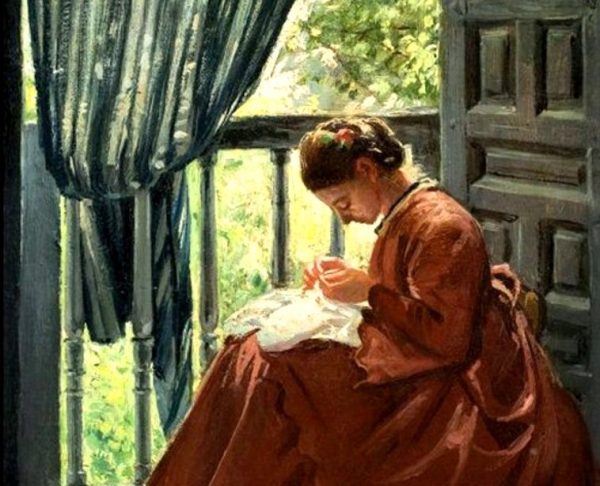
Detail of “Seamstress” by Manuel Gómez-Moreno González
Public domain, via Wikimedia Commons
“Faith is the patient seamstress
who mends our torn belief,
who sews the hem of childhood trust
and clips the threads of grief.”
— Joan Walsh Anglund
I think this poem captures the essence of how faith operates in most lives. Some claim to have had dramatic revelations or sudden moments of truth, but for most of us, faith is a less flashy force. All of us have times when our beliefs are torn, our childhood dreams unravel and our thoughts seem a messy tangle of confusion. Faith works to hold things together, patiently reinforcing what remains of the thinning fabric of our existence.
And speaking of childhood, I wrote a post awhile back in which I quoted a different poem by Anglund from memory, having first read it in my youth. Since I wrote that post, there have been a few postscripts to add. As it turns out, I quoted it fairly accurately, although the volume in which I remembered seeing the poem, A Cup of Sun, (copyright 1967) was not the actual source.

Instead, I found that it came from a companion book published three years afterward, A Slice of Snow, (copyright 1970) which– this is the funniest part– I actually had sitting on my own bookshelf in York County, all along. I didn’t need to quote it from memory after all, but as this photo shows, I did get pretty close to remembering the text without knowing where to look for it. I had looked online, unsuccessfully, for quite a long time, hoping to verify what I was writing. I had totally forgotten that A Slice of Snow, which I knew I had, was the book from which the poem I remembered had come.
The most fun part was how I discovered this mistake. A blog reader in a distant state, who read the original post linked above, was kind enough to locate a copy of A Cup of Sun and send it to me. What a joy! I re-discovered many other poems that will probably end up being posted here eventually, along the one quoted above. I don’t know whether the person who sent me the book noticed that it was NOT the source of the poem I quoted; if so, it was tactfully not mentioned.
Now both books sit side-by-side on one of my bookshelves in Alexandria, since this is where I write most of the posts.

So here is a case of old meeting new. On a blog that appears in a format I could scarcely have dreamed of when I first read the poem, I shared it and then received back another forgotten bit of my own past. It came from someone many miles away, with whom I am in touch through the present wonders of technology, shining brightly on a past interwoven tightly with the present to create a unique gift for me here and now.
I think that’s magical. It makes me believe that the increasingly tattered, faded cloth of my life, mended slowly and patiently by faith again and again, still has a place in the vast gallery of the shiny new turbo-charged world where almost everyone is younger and stronger than I am, and much of what I value is deemed useless by the cold-blooded calculation of modernity.
If you have needed a good bit of mending in your own life from time to time, you probably will understand. And if you have yet to reach that stage, know that when you do, the patient seamstress will be awaiting you.
Geniuses

Owen tries hard to say hello, July 2, 2016.
“A certain group of geniuses can easily learn even the world’s most difficult languages: they’re called babies.” — Ashleigh Brilliant
Are you bilingual, or (even more impressive) do you speak several languages fluently? If so, I envy you. I’ve always wished that I could communicate in many different languages. I suppose it’s because I like to talk, and I like to travel, and I like to learn more about other countries and cultures. Learning a language is great for all three.
I remember being fascinated with the language skills of some of the kids who came to the programs we hosted at the small town library in California, where I was the youth services librarian. These students grew up speaking Spanish at home, but spoke mostly English at school and in other settings. They had not a trace of an accent in English, and I’m guessing they didn’t have one in Spanish either. They were quite helpful in translating for me when an adult who spoke only Spanish needed to ask me something. They were polite and never laughed at me or acted superior, despite leaving me with the idea that, in at least one respect, they certainly were.
I’ve heard people suggest that babies and children can learn language so easily because their brains are not “cluttered up” with other superfluous content. Others have said maybe young brains are just wired to learn more quickly, as they simply must. In any case, I find language acquisition fascinating to watch and contemplate.
When we met Owen for the first time ever, early in July, he was almost six weeks old. I loved looking into his face and watching him watch me talk. It often seemed he was attempting to mimic my actions, moving his lips and tongue around, and cooing in response as if he was trying to tell me something. Of course, I can be written off as a silly grandmother, but still, I think those face-to-face contacts are the beginning of learning to speak for most babies. Isn’t it wonderful to think about the way children typically learn such complex skills in such a natural way– almost teaching themselves?
When you get the chance to spend time with infants, try looking right into their eyes and speaking to them so they can watch you. Don’t feel silly if you instinctively use a high-pitched voice; apparently, research indicates babies respond to that. In any case, whether the baby picks up any new skills or not, I imagine it will put a smile on your face and brighten your day. Though these little geniuses can be noisy and inconvenient at times, they definitely make the world a much happier place.
Just outside the gate
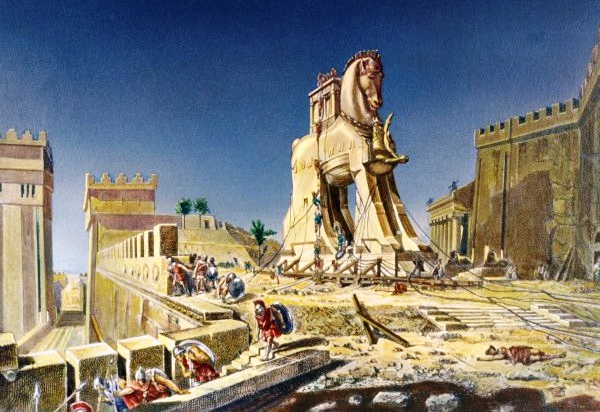
Anonymous drawing based on an oil painting by Henri Motte,
public domain, via Wikimedia Commons
“A Trojan Horse sits just outside the gate of your heart. Its name is bitterness. It is a monument to every attack you have endured from your fellow human beings. It is a gift left by the people who have wronged you…It is rightfully yours. But to accept the gift is to invite ruin into your life.” – Andy Stanley
Whoa. I don’t know about you, but that hits me hard. What jumps out most at me is the sentence “It is rightfully yours.” How often do we hang onto hurts and resentment simply because they are understandable, even justified?
If you think Stanley is wrong in warning that bitterness leads to ruin, I challenge you to watch the news and ask yourself how many of the stories of mayhem and violence have their roots in bitterness. Then think of some of the most inspiring, uplifting tales you have heard. Chances are, many feature a huge dose of forgiveness, understanding or willingness to move beyond hurt.
In today’s world, the Trojan Horse evokes thoughts of computer viruses that sneak onto hard drives and work widespread damage. It’s not a bad metaphor for the malevolent influence of resentment in our hearts. It sneaks into areas where it has no relevance, tainting what once was helpful, destroying any chance of happiness, new friendships and future success.
We cannot afford to accept this treacherous gift, no matter how appealing it may seem. It may have a sinister, seductive beauty about it. It may be large, and hard to get rid of. We may need outside help to deal with it safely. But we cannot afford to keep it.
Is there a Trojan Horse outside your gate? I’m working on dismantling mine. If you have one, I hope you’ll join me in neutralizing the evil influence of bitterness. It’s not easy, but the alternative is ultimately much worse.
A clover, any time

One of many clover bouquets I’ve picked while strolling. May 2016
The pedigree of honey
Does not concern the bee;
A clover, any time, to him
Is aristocracy.
— Emily Dickinson
I am a person of simple tastes. During our lean years, I supposed this was because we couldn’t afford grand things. But the passing decades have taught me that it’s a deep-down unchanging part of who I am. It simply doesn’t take very much to impress or delight me.
A lot of people might think that’s mildly pathetic, and maybe they feel sorry for me. I don’t mind. I think it’s an incredibly lucky trait to have; it makes life fun and relatively inexpensive.
On my evening walks in Alexandria, I sometimes stroll past neglected medians and roadside fields of grass sprinkled with clover. I find the flowers so beautiful that I can hardly resist picking them and bringing them home to display in a pretty Limonata bottle. See what I mean? I honestly prefer a recycled bottle to a vase.
The great thing is, I need never worry that someone will get mad at me for picking clover blooms. I just have to be careful not to anger a bee who was there first. The blooms last a long time, and bring me joy every time I see them.
Are there any simple, humble things that you enjoy? If so, count yourself fortunate. I wish you a summer full of easily-quenched thirsts, modest treats and unpretentious pleasures.
A thin stream of fear

Trafalgar Falls, Dominica, March 2010
“Anxiety is a thin stream of fear trickling through the mind. If encouraged, it cuts a channel into which all other thoughts are drained.” — Arthur Somers Roche
Waterfalls start out a lot smaller and more quiet than they end up. If you’ve ever stood at the foot of a fairly large waterfall, you know the kind of power it can generate as the water flows along, accumulating volume before taking that steep downward plunge.
You’ve probably noticed that I love metaphors. I think Roche came up with a vivid image that illustrates what anxiety can do to us. It’s impossible to keep worrisome thoughts totally out of our minds, but if we allow them to meander here and there, they will pick up momentum and strength as they go along. Soon the objects of our worry multiply. We can even end up worrying too much about worrying too much. Then, if we’re not careful, the cumulative anxiety can take on a force of its own, destructive and impossible to stop.
A bit of anxiety can be useful, if we transform it into a healthy degree of caution. But reining it in can be a real challenge. I’ve been dealing with all kinds of anxiety lately, much of it justified, and I’ve had to evolve ever-increasing coping strategies for keeping it at bay. Reading, prayer, music, singing, writing, walking and working outdoors are all formidable defenses for me. What works best for you?
The stormy present

This poster once hung on the hospital door of a young man wounded in Iraq.
It was framed and now hangs on the Wounded Warrior floor
at Walter Reed National Military Medical Center in Bethesda.
I photographed it in May, 2013, and again in April 2016.
“The dogmas of the quiet past are inadequate to the stormy present. The occasion is piled high with difficulty, and we must rise with the occasion. As our case is new, so we must think anew and act anew.” –– Abraham Lincoln, Second Annual Message to Congress, December 1, 1862
In the years I’ve been writing and posting at this site, it seems that our family’s trials and challenges have paralleled the larger and more widespread difficulties facing the USA and the entire world. I withdrew from paying much attention to the news after Jeff’s diagnosis hit us in 2012, knowing I had to conserve my energy and stay as grounded in hope as I possibly could. But there is no way to isolate oneself from the calamities of the past few years.
These last twelve months have been especially fraught with personal crises for me, with Daddy’s death, Mama’s decline in health, Jeff’s brain tumor and subsequent treatments, and the overall worsening of his health as the cancer seems impossible to stop for very long.
Likewise, our country and world have been dealing with political turmoil, global terrorism, civil unrest (or outright warfare and genocide in some areas of the world) and the unceasing threats of disease and disaster. In the face of such oppressive realities, is it any wonder so many of us fall prey to despair?
As I’ve written again and again, maintaining faith and nourishing hope do not imply a withdrawal from reality, or a denial of profound sorrow. Grief and pain are inescapable, and we help no one if we try to wish or drink or argue it away.
Instead, we defeat despair when we comfort one another with support and understanding, resolving together that we can and will rise to the occasion. Sometimes, as Lincoln pointed out, this will mean thinking and acting in new ways, moving beyond habits of mind that are no longer useful to anyone, least of all ourselves.
The photo above depicts a framed poster that hangs in the hallway of the Wound Warrior floor at Walter Reed National Military Medical Center in Bethesda, Maryland. It’s just a few doors down from the room where Jeff spent so many weeks in 2013. The poster was created by a U.S. Navy Seal who was gravely wounded in Iraq in 2007. It hung on the door to his room before eventually being framed with medals and photos of him after he recovered many months later.
During the countless times I walked past it during our long, often discouraging weeks at Walter Reed, I often stopped to read it and reflect on the courage of the young man who first wrote those words when facing perhaps the greatest uphill battle of his life. No matter what else was going on, I always felt encouraged by reading it. I know it must have inspired so many others over the years, including the President, whose signature you may recognize near the bottom of the poster.
Maybe you are among those of us who have found many of the recent news stories distressing and depressing. Perhaps you are battling personal challenges too, leaving you drained and exhausted. If so, I can identify. Life seems increasingly piled high with difficulty. Nevertheless, I want to keep alive the spirit of “fun, optimism and intense rapid regrowth” that this Navy Seal pledged to uphold through his lengthy recovery.
I hope we can take heart from the words of our esteemed President Lincoln, and from many others who have given us an example of how to rise above trouble. I am encouraged by your presence here!
Company enough
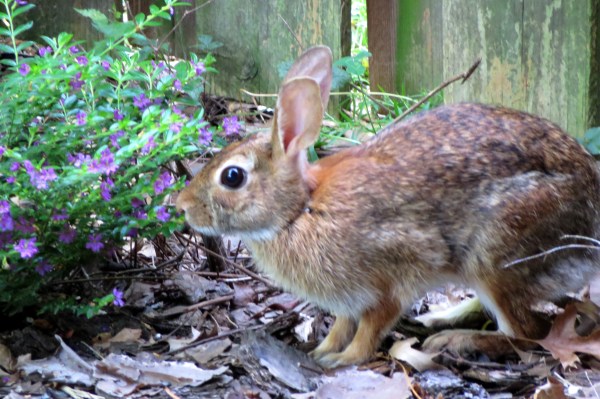
This sweet bunny came to visit and stayed awhile. July 2016
“I can enjoy society in a room; but out of doors, nature is company enough for me.” — William Hazlitt
I think many of us can identify with Hazlitt. It’s almost impossible to feel lonely when the birds are chirping, the squirrels are scampering around and the rabbits hop silently from place to place. Even the flowers and trees are good company. Add a book and a cup of tea, and what more could anyone want?
The other day I was chatting by telephone with Mama, from her room in the rehabilitation facility where she is staying temporarily. I was happy because she sounded as if she was doing well. As usual, she had only cheerful things to say about how kind everyone there was treating her. She tends to put a positive spin on things, but she really did sound pretty good, much better than she had the last time we talked.
So I already was smiling when I glanced out to the porch and saw this adorable little visitor, who seemed not to mind my opening the door to get a better photo. My smile became a big grin because I never tire of these surprise visitors. No matter how many times I see them, each one seems special. I just had to snap a photo to share with you. As a bonus, a virtual visit means this critter will not eat up anything you are trying to grow.
I think I’ll go sit outside and read for awhile. Want to join me? It’s perfect weather for spending a late afternoon keeping company with nature. If it’s chilly or raining where you are, maybe you can open a window just enough to hear the sound of the raindrops on the trees or roof. If it’s hot, perhaps you can take some iced tea or lemonade outside and sip while you enjoy the view. What will you see and hear that you might have missed?
I wish you natural sights and sounds to put a smile on your face today!
Like the sun
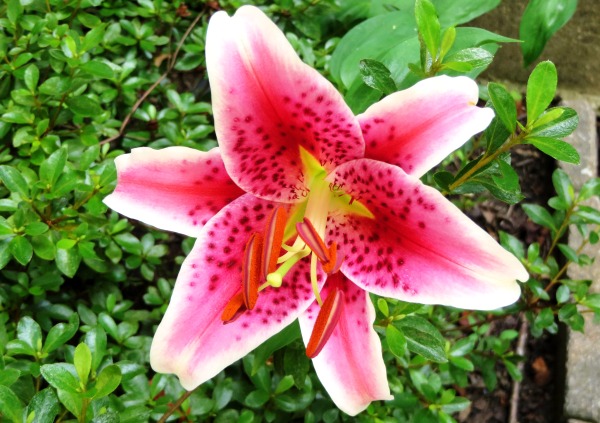
Here’s what happens when a flower reaches for the sun. July 2016
“They can be like the sun, words. They can do for the heart what light can for a field.”
― San Juan de la Cruz (St. John of the Cross)
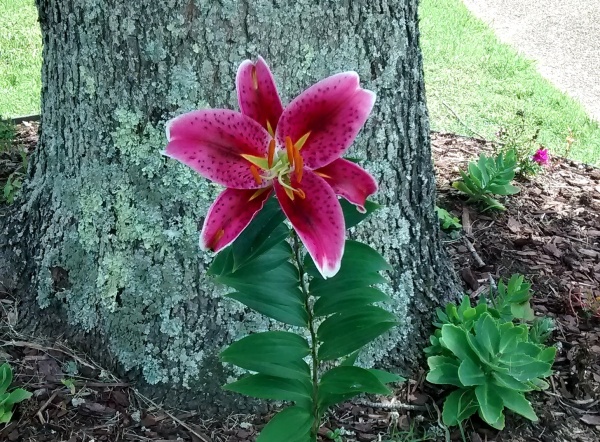
Two years ago I planted a couple of Asiatic lilies in front of our Alexandria porch. I read that they could tolerate partial shade, so I thought the dappled afternoon exposure would be perfect for them. But they clearly have other ideas.
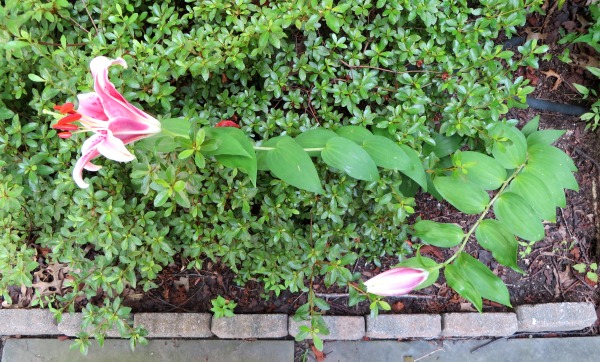
See how they lean in toward the brightest area of sunlight? I wondered whether this might be caused at least partly by the weight of the huge flower at the end of the slender stem, but a bulb from the same lot that I planted in bright sunshine at our York home has no such tendencies. It stands straight and tall. These flowers simply long for the sun, and grow accordingly.
I thought of that when I read San Juan’s thoughts about the power of words. Language is a powerful thing, and how carelessly we use it! Yet what beautiful things we might accomplish with words, if we understood their lingering ability to infiltrate the heart and soul. Words can crush, damage, hurt, anger, ruin. But they also can heal, bless and shine like the sun into the darkness of sorrow and loneliness.
Here’s a video I love, in which Dr. Maya Angelou eloquently reminds us that words are things, and have lasting and profound influence, not only on those who hear them, but perhaps more so on those who say them. I especially like what she says at the close of this clip. I invite you to watch this brief gem of wisdom, and join me in resolving anew to be mindful of the formidable power of our words.
More important

Grady proudly displays his home-grown vegetables, June 2016.
“It’s bizarre that the produce manager is more important to my children’s health than the pediatrician.” — Meryl Streep
“Eat your vegetables. They’re good for you.” — almost every mother who ever lived
Pediatricians are important in fighting children’s diseases, to be sure, but it might be even more bizarre that we somehow generalize their crucial responsibility to the far more complex business of nurturing health in our kids. Wellness is much bigger than being free from illness. To rear happy, hardy youngsters, it really does take a village, and the produce managers are among a large cast of players– but parents usually have the all-important roles of directors.
That said, kudos to Streep for promoting organic gardening long before it was as widespread as it is today. For children lucky enough to take part in growing at least a bit of what they eat, it’s a wonderful experience on many levels, as Grady can tell you. I imagine that particular squash and that cucumber tasted better to him than they would have if he didn’t watch them grow and then participate in the joy of picking them off the vines.
Of course, those healthy eating habits may not last (I’m told I used to love freshly-caught fish when I was a toddler and we lived in Hialeah, Florida) but surely kids are more likely to keep eating what they learn to enjoy at a very young age. And it’s never to late for us to acquire a taste for nutritious food. Or so I tell myself every time I munch on raw cauliflower.
Do you like vegetables? Which ones are your favorites? If you have any secrets for healthy seasonings, please share them for those of us who are still working on loving veggies. And even if you’re past the stage of spending time with the pediatrician, it might be wise to make friends with your local produce manager. It couldn’t hurt.
Webbed and sustained

The flag flies at a home in Yorktown, Virginia, May 2013.
“Liberty is as relevant to modern Americans as it was to the men and women of 1776. We live in a world webbed and sustained by the liberties they won at terrific cost in an agonizing eight-year ordeal. The freedom to speak our minds, to worship in the churches of our faith, to vote for the political leaders of our choice, to pursue our careers, to manage our individual lives in a hundred different ways, depends on American liberty as it was enunciated and defined in the crisis years of the Revolution.” — Thomas Fleming
Happy 240th Birthday to the United States of America! May our great collective experiment in democracy continue to endure amid the crises and changes of an unpredictable world. I invite you to join millions of Americans who will be celebrating today, looking back with gratitude and forward with hope.
A fountain of gladness

I enjoyed this fountain on my walks at Regent University, Virginia Beach, June 2016.
“A kind heart is a fountain of gladness, making everything in its vicinity freshen into smiles.” — Washington Irving
During my days on campus this past month, there were some long hot lunchtime walks between the communications building (where I had classes) and the library. Fortunately the campus is gorgeous and well shaded with countless trees, but on sunny days I still got a bit warm, especially if I was carrying an armful of books.
Halfway down the walkway between those two buildings, there’s a beautiful fountain. Usually I did not take the time to venture up to enjoy it at close range, though it was tempting to do so. But even from a distance, it was refreshing to see. Such spots of beauty set into lovely park-like surroundings really do lift the spirit and relax an overwhelmed mind.
I think Irving picked a perfect analogy in likening a kind heart to a fountain. Have you ever noticed that someone’s kindness can make a moment or hour sparkle with refreshing joy? Like water on a wilting plant, kindness can fortify and calm us with a renewed sense of worth and strength. A kind heart radiates support and welcome to all who come near.
Today, I wish you many encounters with kindness, whether as the source, or the recipient, or both. The world needs more gladness; let’s get out there and make a splash!
Something worth more
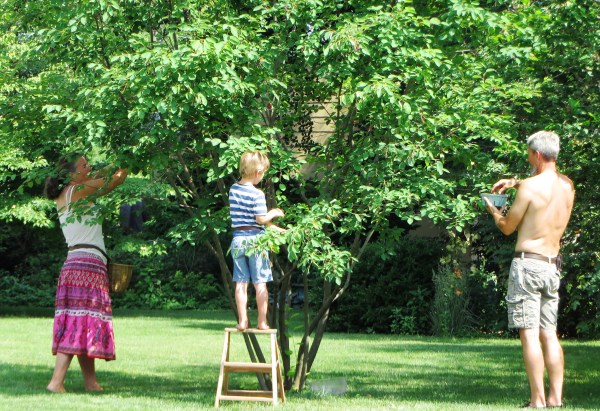
Backyard fruit pickers in Lancaster County, Pennsylvania, June 2015
“I work hard in the orchard, not for the money anymore, but for something I can’t explain. Something worth more than money.”― Steven Herrick
I have only faint childhood memories of occasionally picking fruit. I recall muscadines and plums, and the blackberries that grew in the wild bushes surrounding the pond behind our home. One year my mother planted strawberries, but we didn’t grow enough of them to keep up with my appetite. I had fantasies about growing watermelons.
I read stories in children’s novels about people who picked all sorts of tasty fruits– apples and cherries and peaches and citrus. My parents talked of our home in the Texas border town where I had been born, and how they could pick grapefruit right off the tree. I wondered with envy what it must be like to have such bounty close at hand, free for the taking.
It would be more than forty years before I found out. In northern California our next door neighbor had nearly a dozen fruit trees, including pomegranates, mandarins, and Sorrento lemons. He told us to pick all we wanted, because he did not eat any of the fruit. The more we picked them, the more they grew.
We had fresh lemonade about ten months of the year every year, because Jeff liked making it and got very good at adding just enough sugar to take the edge of the tart flavor. It was a couple of years before I realized I had experienced the first winters in my memory without catching a single cold. Of all the things I miss about California, I think those sunny fresh lemons are near the top of my list.
Do you have fruit trees nearby, or orchards where you love to go and pick fresh fruit? If so, send us some delicious details so we can enjoy a virtual treat. It might even inspire us to visit the grocery store for a less-tasty substitute. For those of you who are able to pick fresh fruits and berries, enjoy them! I agree with Herrick; they are worth more than money.
Cares seem small
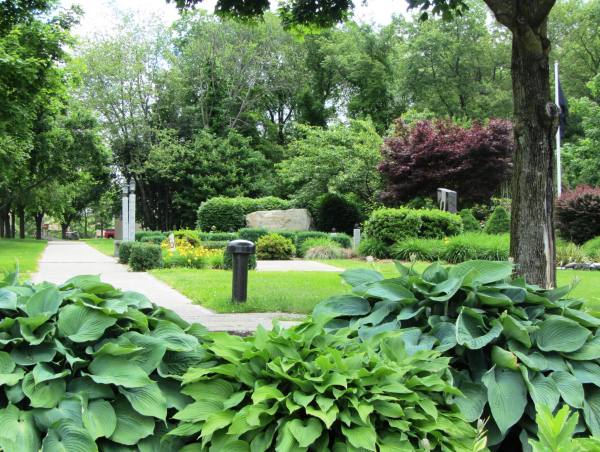
Summer splendor near Concord, Massachusetts, June 2012
…what though we suffer? Sun and skies
And green trees’ beauty make our cares seem small;
Boon that no Esau sells, or Crœsus buys,
The golden summer-time, is over all.
— Percy Reeve
It has been a tough summer already, but not without happiness. There’s a joy in the season that can’t be totally quenched even when the afternoon is dreary with rain.
One thing I so love about Jeff, something we have always shared, is his ability to take great delight in nature. We’ve had less time to enjoy the outdoors together than I had hoped we would have this year. But what little time we’ve had has been sweet, looking out the glass doors early in the day, watching the mourning dove hopping around our back porch, watering the flowering shrubs, and enjoying the cardinals who lately seem determined to take over the longtime dominance of robins in our back yard.
The days are at their longest this week. Already we are starting the slow slide into autumn. Why not take an early morning stroll or twilight walk? Take along a camera, or save memories simply by looking a bit longer than usual at whatever seasonal sight most captures your imagination.
I hope you will find time to savor every moment of sunlight, basking in the vibrant green trees and blue skies that make our cares seem suddenly lighter.
Where there is joy

Owen Ramon Denton, one of our latest and greatest joys. Four days old, May 2016
“Find a place where there is joy, and the joy will burn out the pain.” — Joseph Campbell
What brings you joy? For most of us, there are many answers to that question, and some of us are fortunate enough to discover new joys daily. Perhaps the surest way to survive despair is to grasp these joys and hold them close no matter what else is going on.
Wherever you are today, and whatever you have planned, your day might contain any number of blessings that will bring happiness if you stop to reflect on them. A flower, a song, an expansive sky or sheltering tree; a baby, a child, a friend, a new acquaintance with a warm smile and winsome personality; a savory snack or relaxing cup of your favorite tea or coffee; all these things, and many more, are out in the world awaiting us, countless gifts with our names lovingly inscribed on them in invisible strokes.
Today, I wish you joy to burn out the pain.
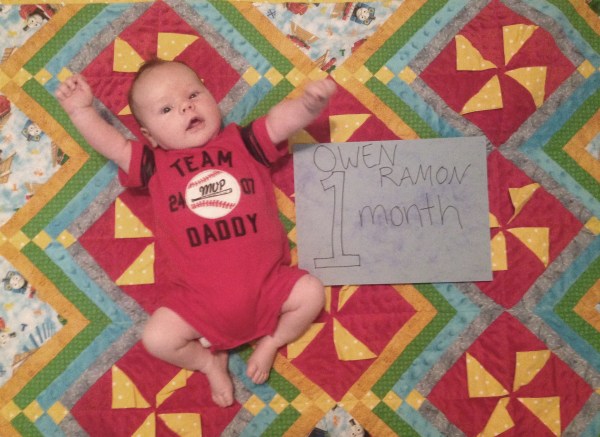
Owen, wearing the same outfit Grady wore in his 4-month photo. June, 2016
Our old home life

Not the Bagots’ hallway, but perhaps not so very different.
Bar Harbor, Maine, June 2012
“I was never before so eager to cling to every bit of our old home life and to see you…Come and see me, I am homesick…” — C. S. Lewis
Today is my 900th regular post, so I hope you will bear with me as I try something a little bit different. I’m bringing you a snippet of fiction, but first I will lead in with a quote as usual. The quote above is from a letter to his father that Lewis wrote as he was in a London hospital recovering from a battle injury during World War I. Though his relationship with his father was difficult at best (and his mother had died when he was young) there was still a deeply felt bond that tugged at him during his recovery from the horrors of a war that took the life of every one of his classmates who served alongside him.
As with Lewis, most of us have mixed memories of our early homes. Yet even if we do not remember our childhood days as consistently happy, there is still a strong foundation that we rest on, often without knowing it. I thought of that again recently as I was listening to Maeve Brennan’s beautiful story “Christmas Eve” which is one of several she wrote about the Bagot family of Ireland. I listened to the story via the New Yorker podcast as I was driving to school through the thick traffic that always gathers at the approach to the Hampton Roads Bridge Tunnel, and what might have been a stressful time was instead a pleasant journey, brightened by flawless storytelling.
The passage below was so lovely that I decided to share it with you, without further comment. I hope it will evoke a warm sense of connection for you, as it did for me.
The hall was quite narrow, and was covered with linoleum, and it served its purpose very well, both as an entrance to the house and as a vantage point from which the house could be viewed and seen for what it was – a small, plain, family place that had a compartmented look now in winter because of all the doors being closed to keep whatever heat there was inside the rooms. In the hall there was a rack with hooks on it for coats, and there was an umbrella stand, and a chair nobody ever sat on. Nobody ever sat on the chair and nobody ever stood long in the hall. It was a passageway – not to fame and not to fortune but only to the common practices of family life, those practices, habits, and ordinary customs that are the only true realities most of us ever know, and that in some of us form a memory strong enough to give us something to hold onto to the end of our days. It is a matter of love, and whether the love finds daily, hourly expression in warm embraces, and in the instinctive kind of attentiveness animals give to their young, or whether it is largely unexpressed, as it was among the Bagots, does not really matter very much in the very long run. It is the solid existence of love that gives life and strength to memory, and if in some cases childhood memories lack the soft and tender colors given by demonstrativeness, the child grown old and in the dark knows only that what is under his hand is a rock that will never give way.
On foot
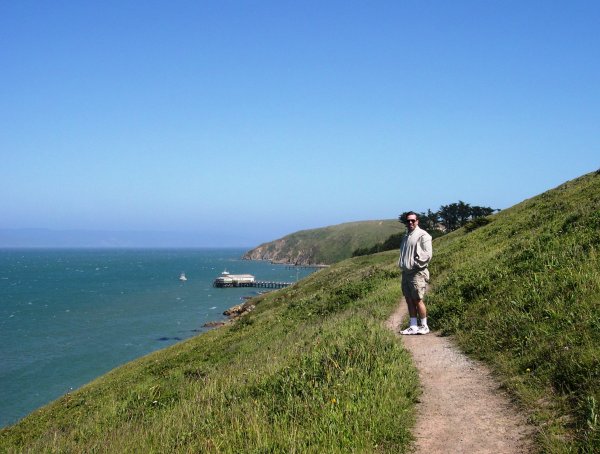
Walking toward wellness: Jeff stored up health that helped him survive ten years later.
Point Reyes National Seashore, California, May 2003.
“Sickness comes on horseback, but goes away on foot.” — William Carew Hazlitt
Seemingly out of nowhere, it hits– the devastating diagnosis, or the catastrophic accident, or the debilitating chronic pain– shattering the life of a loved one, or self. Life changes– sometimes forever. We feel blindsided, helpless, resentful, afraid. But somehow, we keep going.
The horse that arrived so suddenly may have been heading for us quite some time, although we did not know it. A sudden reversal of health carries with it the shock of surprise, but in most cases, it was building gradually to a tipping point where it became too obvious to ignore. Occasionally we can send it away with almost as much speed as it arrived; the quick, successful surgery or “miracle” drug that carries a swift cure. But even then, complete healing will take time.
Likely, the recovery will seem even slower than it is, because when we travel on foot, we notice almost everything. This may seem a curse at first, but in reality it’s also a blessing. Gradually we come to realize that the tiny details that fill our newly-slower days are the true substance of the life we crave. We recognize the value of this altered life, and resolve not to take for granted a single minute of enjoyment, laughter, or freedom from pain.
Even if we have never been sidelined with illness, our wellness has always traveled on foot. It cannot be rushed or wished into existence. It is made of clear, cool water, sipped serenely on a warm day; of morning breezes that visit us carrying birdsong; of real, unadulterated food eaten with joyful gratitude, of quiet moments spent reading or praying or meditating; of comforting words or companionable silence with someone we enjoy.
If the illness comes back, we will bear it patiently, knowing that we will return to our walk toward health again. Perhaps the pace will be slower, with longer breaks that must be taken more frequently, but we walk in the direction of well-being, whether mental, physical, or both, and we are surrounded with the solace of fellow travelers who know the way, and understand. It’s a lovely road, and the weather is often breathtakingly beautiful. If you should happen to meet us along the path, let’s walk awhile together.
Slowing down
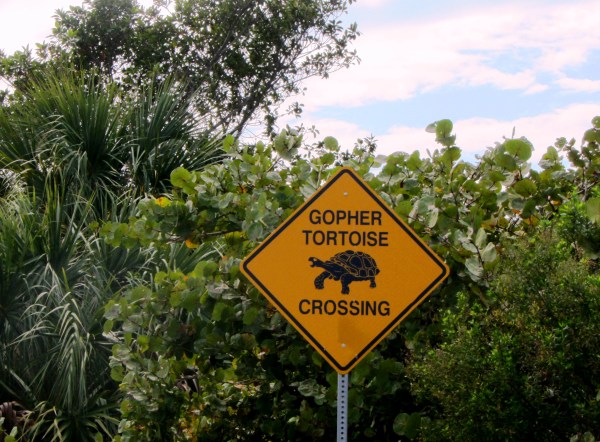
Take a lesson from the Captiva tortoise, who lives on island time. January 2013
“…in a day when doing something as soon as possible is the standard response to perceived problems, slowing down may be the best way to move ahead.” — Mark A. Noll
Sometimes, action is urgently needed and haste is imperative. However, I suspect that most of the urgency we feel about everyday stresses and conflicts is unnecessary, even unwise.
There was a time, not so long ago, when few people other than physicians on emergency call wore beepers. And just a couple of decades before that, even physicians were not available at the touch of a few buttons. Now everybody is on call, all the time, to whomever has their cell phone number. How did life become so frantic?
In his illuminating book Traffic, Tom Vanderbilt speculates that the few minutes saved by chronic lane-changers will most likely take more time than that off the end of the hectic, rushed life. The same could be said about many other forms of rushing around. At some point, perhaps we should stop to ask what we are gaining by putting so much pressure on ourselves.
I’m not saying that deadlines don’t matter (in fact, I’m dealing with several big ones related to school, as I take a few minutes to write this). I’m only admitting that I almost never help myself when I try to go too quickly. Maybe it’s because the weather has finally turned hot, or maybe it’s age or exhaustion. But more and more, I find myself simply unable to speed through life.
That’s a good thing, I think. I like to take my time and enjoy the view. How about you? Take a few minutes to send me a description of some everyday sight you might not notice if you were hurrying to somewhere else. I’ll keep the tea warm for us to share. On second thought, maybe iced would be better about now?
Great acceptances
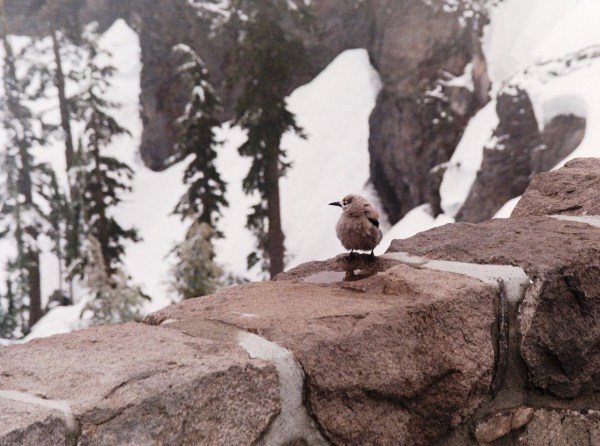
We don’t need to be big or strong or colorful to be beautiful.
I photographed this pretty little bird at Crater Lake, Oregon, June 2000.
“Contentment, and indeed usefulness, comes as the infallible result of great acceptances, great humilities—of not trying to make ourselves this or that, but of surrendering ourselves to the fullness of life—of letting life flow through us.”
— David Grayson
I couldn’t help but find some comic relief in what I learned when I looked up the author of this quote; I kept coming up with articles on some guy named Ray Stannard Baker. It took me a couple of false starts before I read on enough to find that David Grayson was a pen name. My first thought was “Hey, what happened to what you said about not trying to make ourselves this or that?” Okay, so I’ve always been a bit of a smart alec. Regardless, I like what he says here.
The word “great” isn’t usually paired with the word “acceptance,” but I do find the concept intriguing. The fullness of life includes a lot of things for which we might not have wished or planned– otherwise life wouldn’t truly be full– but once we get over the bumps, acceptance can indeed be a blessing. If we are to keep life flowing through us, that means being open to the new while not hanging on too tightly to the familiar and comfortable.
What are the great acceptances of your life? Whatever that phrase might bring to your mind, I hope you are happy and content to be who you are, and where you are. I know I’m happy you are here! As my hero Fred Rogers was so fond of saying, “There’s only one person in the world exactly like you, and people can like you just the way you are.”
The house shelters
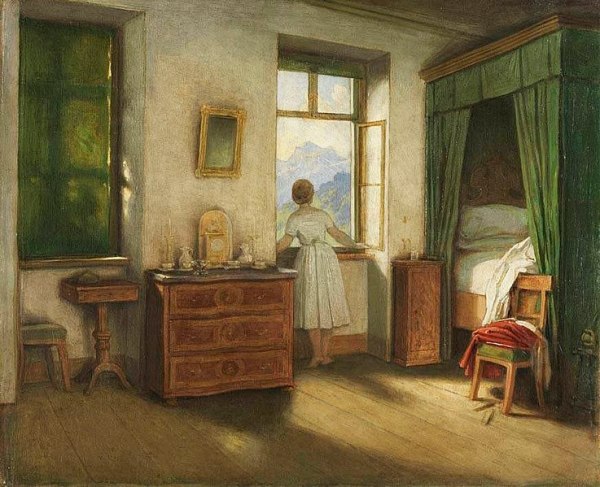
Early Morning by Moritz von Schwind (1858)
Public domain via Wikimedia Commons
“If I were asked to name the chief benefit of the house, I should say: the house shelters day-dreaming…the house allows one to dream in peace.” — Gaston Bachelard
I saw this quote from Bachelard on a Celestial Seasonings box of Sleepytime tea. I found it charming, and at first I agreed with it. Then I thought “Tell that to a busy mother…a house that allows one to dream in peace? Only if the kids are away at school!” Even if everyone is gone, our homes may continue to shout or nag at us, pointing out the paper piles, the dusty surfaces, the streaked windows.
But that doesn’t mean Bachelard is wrong about houses. The house can shelter daydreaming, if we allow it to do so. For some of us, this will mean putting the outward appearance to order with at least a bit of tidying up. For others of us, it will mean looking beyond the undone chores to see the beauty that always lies beneath, even if hidden.
And really, even the clutter can evoke reverie. The craft supplies and half-finished projects bring thoughts of anticipation at sharing our creativity with others. The dusty trinkets may bring back memories of an enchanting trip or a charming phase in a child’s life. Piles of old letters and photographs noiselessly sound the delightful din of loving voices surrounding our hearts with joy.
Most all of us agree there’s no place like home. When singing the praises of our dwelling places, we typically cite the solace of familiarity, the comfort of one’s own bed or sofa, and the pleasant busyness of self-chosen, self-directed projects in process. But perhaps Bachelard, in his wonder-filled wisdom, has seen something we may have missed. Maybe the sense of security that engulfs us when we return home is based, at least partly, on its being the haven for our daydreams; a safe cocoon where our hearts can bask in beautiful realities that are too fragile for the world outside.
Today, I hope you will take a few minutes to allow your home to be a sheltered place for daydreams.
Free and undivided
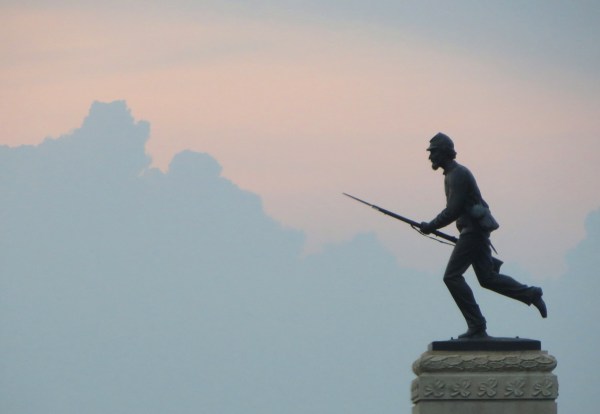
This Gettysburg monument honors the 262 troops of the 1st Minnesota Infantry,
who charged a force of 1600, buying time with an unprecedented 82% casualty rate.
“Let no vandalism of avarice or neglect, no ravages of time, testify to the present or to the coming generations, that we have forgotten, as a people, the cost of a free and undivided Republic.” — John A. Logan
Union General Logan was an important leader in the movement to recognize Memorial Day (then known as Decoration Day) as a national holiday. No doubt he carried a heavy burden of devastating memories, having seen first hand the tragedy of Americans taking up arms against each other.
Logan probably was not thinking of picnics and ball games and long weekends when he pushed for an official day of remembrance. But when I hear the words “Memorial Day,” those are the things I think of, along with hot dogs and warm weather and the resulting traffic nightmares as so many people hit the road to have fun.
Have we forgotten the cost that was (and is) paid to buy us our freedom? Sometimes it seems we have, and never more so than when our political discourse spirals downward into vulgar, often petty personal attacks. Are these sorts of controversies really worth squandering the unity that people died to save? Would our ancestors be ashamed of us?
Even today, it’s not hard to imagine that people who are facing genocide, epidemic disease, starvation and political oppression might see us as ignorant, or worse, decadent. Are we too distracted by diversions to care?
I’m not trying to rain on anyone’s holiday parade, but I hope that we will take a few moments today to reflect on the sacrifices of men and women whose lives were without the health, hope and happiness that we take for granted. Let’s honor them by remembering.
Quietly thrilling
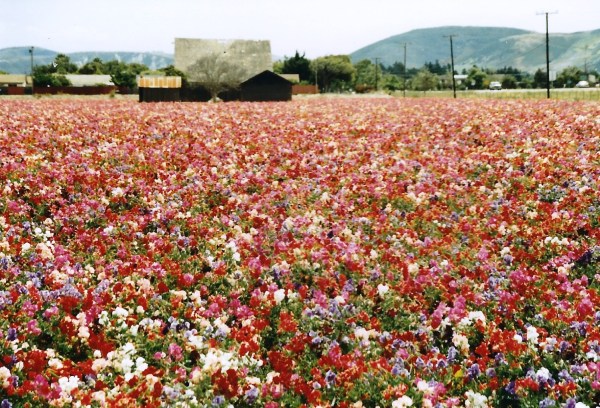
The flower seed companies created beauty as well as jobs. Lompoc, California, 1992
“It is always quietly thrilling to find yourself looking at a world you know well but have never seen from such an angle before.” ― Bill Bryson
When I read these words from Bryson, I realized why I love photography so much. Through the lens of my camera, I look at things from all sorts of angles, and see what I otherwise might have missed. And he’s right, it is a quiet kind of thrill, but a thrill no less. It inspires wonder and gratitude. It wakes the mind up.
The great thing about photography is that you can experience that quiet thrill again years later when you look through old pictures you haven’t seen in awhile. That’s how I felt recently when I saw the photo posted here. I know, of course, that my memories of our time on the central coast of California are among my happiest; that our years there had a magical quality about them. But I had forgotten the almost unreal beauty of those gorgeous flower fields, until I saw this photo again while I was putting together Jeff’s retirement scrapbook.
Wherever you are right now, whatever you’re doing, I hope you’ll make the time to experience as many quietly thrilling moments as you can. The loud thrills may get all the press coverage, but it’s the quiet ones that add up to a lifetime of happiness.
Opening the gates
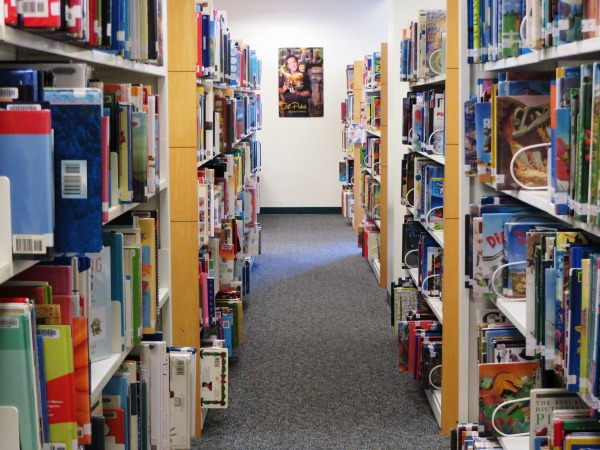
Step through the gates to exploration and discovery!
Poquoson Public Library, Virginia, March 2014
“Books. They are lined up on shelves or stacked on a table. There they are wrapped up in their jackets, lines of neat print on nicely bound pages. They look like such orderly, static things. Then you, the reader come along. You open the book jacket, and it can be like opening the gates to an unknown city, or opening the lid of a treasure chest. You read the first word and you’re off on a journey of exploration and discovery.”
— David Almond
Appearances can be misleading, can’t they? The static, orderly appearance of well-stocked libraries or neat home bookshelves give no hint of the endless adventures awaiting anyone who opens the gates to the wealth contained therein.
The joys of reading have withstood the tumultuous changes of century after century, binding us to each other across continents and eras. No matter our current circumstances, we can tap into this joy at little to no expense. What a perfect way to defeat despair!
Some of my favorite adventures have taken place entirely within my own mind, traveling as an invited guest to a front-row seat in worlds far removed from my own. And some of the most memorable characters I’ve ever had the pleasure to know are fictional; people whose virtues and faults are so familiar that they seem as true to life as any “real” person.
Today I invite you to step through those magical gates to discover people and places new to your life. Who knows what you might see along the way? Feel free to send us a few virtual post cards in the comments below.
The opposite of availability
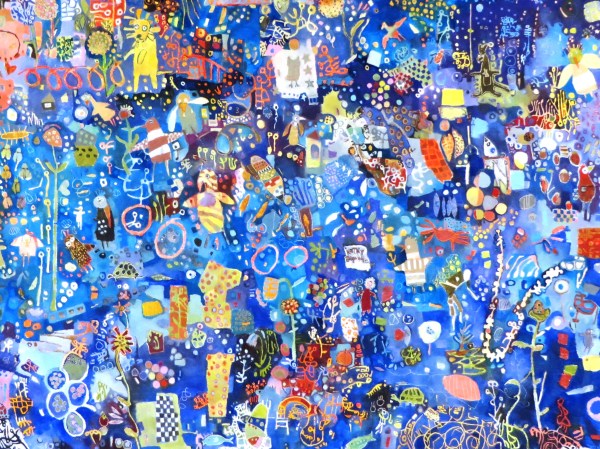
So many things compete for our attention!
Detail from artwork at Children’s National Medical Center,Washington, DC, March 2014
“The opposite of availability is not unavailability, but an overcrowded heart.”
— Sue Monk Kidd
Did any of you wince inwardly on reading these words? I know I did. It’s the sort of observation we know to be true even as we wish it wasn’t. So many of us have a hard time saying “no” to new opportunities, potential friendships, or additional experiences even though our lives are already filled to the brim with good things.
Choosing between good, better and best is no easy task. But on reflection, perhaps I don’t have to start there. Maybe there are a few not-so-great things taking up real estate in my overwhelmed brain. Is there any junk I can clear out of my home, heart and schedule? I must admit, there certainly is.
I don’t know what anyone else’s list might look like, but I can start with eliminating negative thoughts and worry, fretting over minor irritations, and berating myself (aloud or silently) for simple mistakes. The cumulative effects of these mental habits use up more energy than I might realize.
Moving on to more concrete items, I can easily live without glossy, attractive advertising for items I don’t need, or gossipy online “news” stories of dubious credibility. I can turn the telephone off for a few hours (or even days!) and check my phone messages once daily, or re-direct them to email, so as not to be sidetracked. I can take steps to minimize junk mail, junk TV, junk calls and texts, and junk food and drinks. These distractions consume countless small increments of time that add up to hours of life.
Once I eliminate all the things I will never miss, it might be easier to find time for what is really important to me. Sometimes this will mean decreasing the time allocated for certain activities, at least temporarily. Or it may mean learning to be comfortable with being totally unavailable for awhile, knowing that periodic unavailability for one opportunity opens doors to others.
Do you struggle with the conflicted emotions that go with having an overcrowded heart? What are some of your secrets for being available for the people and projects that matter most?
At this time and this place

Late spring is lovely here, as the cherry blossoms give way to azaleas. May 2016
“You get a strange feeling when you’re about to leave a place. Like you’ll not only miss the people you love but you’ll miss the person you are now at this time and this place, because you’ll never be this way ever again.” —Azar Nafisi
Now that Jeff is retired, we can sell our Alexandria townhome and take up a less peripatetic existence in York County. That’s what we plan to do, gradually, but letting go of our part-time home here is more difficult than we imagined it might be.
Strange, really. One could argue that we should be eager to leave. We’ve had the most difficult years of our lives here; one heartbreak after another, devastating news followed by medical trauma followed by losses of loved ones and shattered illusions of permanence and security.
Yet there has been so much beauty too, and even joy. Our two grandsons came to life during this time, as did this blog. We’ve somehow survived more than we dreamed was in store for us, and managed to salvage countless moments of light happiness and laughter tucked in between the dreary days, glowing like tiny lighthouses, showing us that there really was shelter in the storm.
We’ve been so grateful for our kind and considerate neighbors here, and their delightful children and precious dogs and cats, and the lovely cherry blossoms and blooming gardens that somehow flourish in the crowded residential areas so close to a huge city. We’re thankful, too, for the friendships that have blossomed amid the chaos, and the ties that have been formed or renewed as people who care about us have enclosed us in a cocoon of compassion, prayers, and warm expressions of support.
Just as one can never step in the same river twice, no person or place can stay the same. Change is inevitable. The best we can hope for is accompanying growth, fond memories and bright new opportunities. Whenever we look back on our time here, I know we might wonder how on earth we managed to endure much of what the years brought. But we’ll smile, too, thinking of all the blessings. Thanks to each of you for being among them!
Even when we are not planning an upcoming move from one location to another, all of us are continually leaving behind the past and moving into new phases of life. What will you miss about this time and place? What will you hold close in heart today, as you savor each moment?
Like my own heart
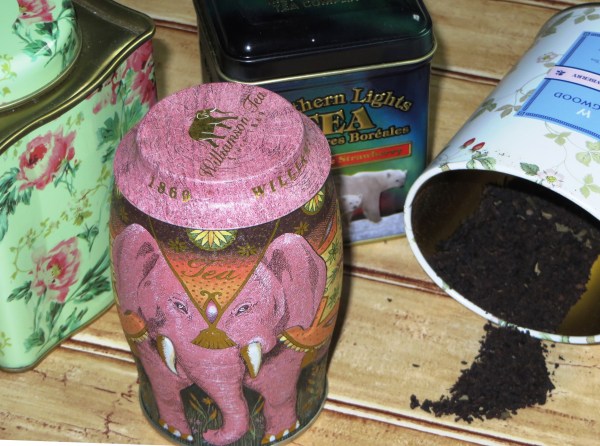
Fancy or plain, tin or paper, my tea boxes are full of treasure. May 2016
…box of tea,
like my
own heart
you arrived bearing
stories,
thrills,
eyes
that had held
fabulous petals in their gaze
and also, yes,
that
lost scent
of tea, of jasmine and of dreams,
that scent of wandering spring.
Ah, no wonder I love tea so much! Once again, the poet distills deep wells of emotion into a few well-chosen words. As we sip our tea (or coffee) today, let’s imagine the miles those leaves and beans traveled to reach us, and silently give thanks for the hands that harvested the bounty that brightens our mornings. Let’s savor the scents that linger, redolent of faraway lands and adventures we only dream of in our daily lives. I raise my cup with you in a virtual toast to refreshing moments that indulge the imagination as well as the senses. Santé!


 Defeat Despair