Even more beautiful
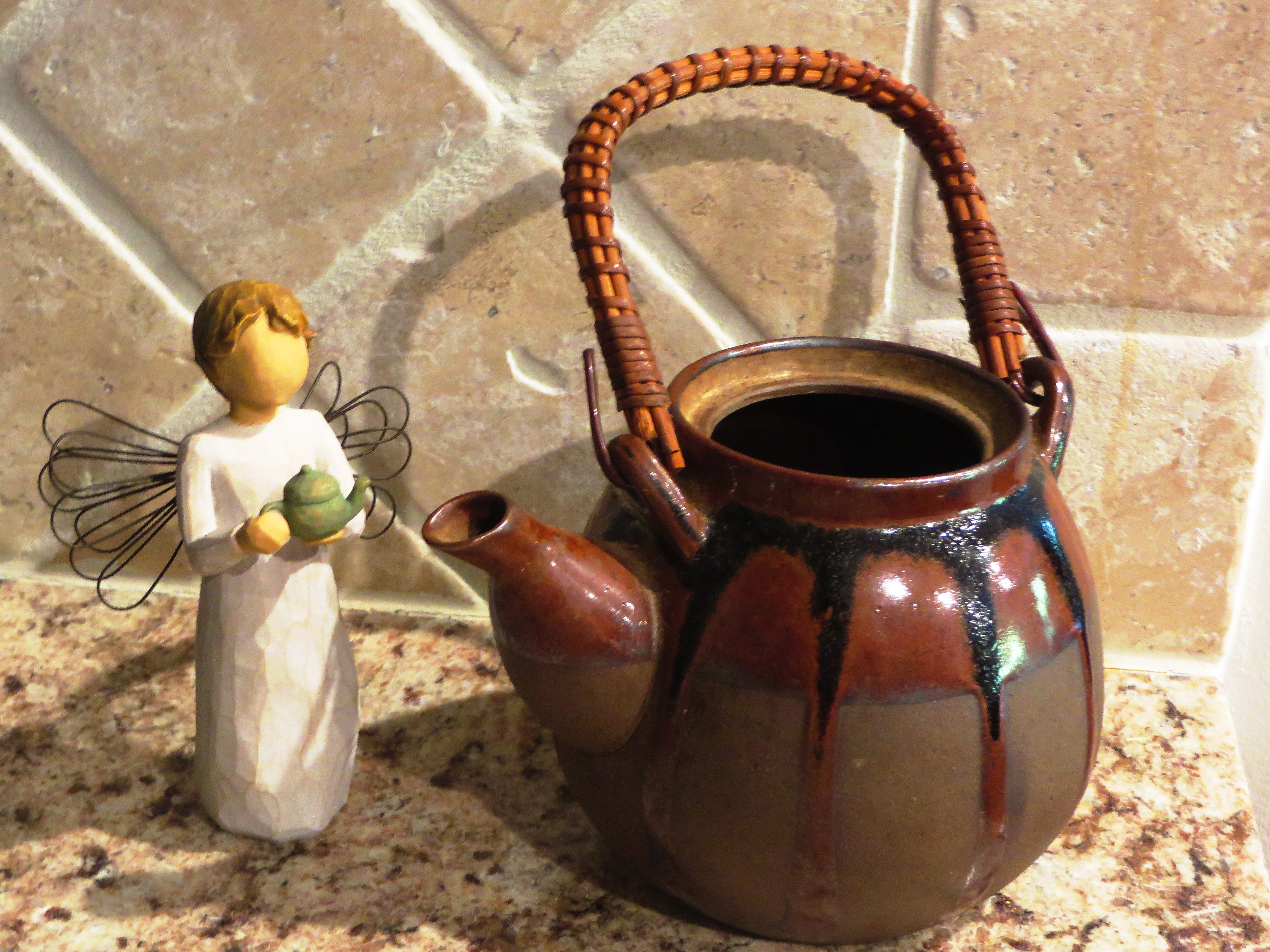
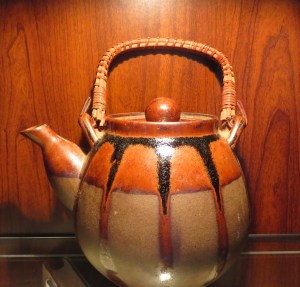
Pretty even without a lid, my antique Brown Betty in July 2019
“The point is that things can be repaired. That they are even more beautiful for having been repaired.” — Sonali Dev
I’ve read a few articles in recent years about “wabi sabi,” a term applied to a variety of philosophical contexts. The aspect of wabi sabi that first captured attention is the idea that flaws and imperfections can be viewed as contributing to the beauty of an object. For example, a vase that had been chipped or cracked might be considered more attractive than a brand new version of the same, because the older one has a history.
I thought of this recently while engaged in the seemingly endless task of sorting through a lifetime of accumulations. Often I will find myself setting an object aside because it’s just too hard to decide what to do with it. One such object I came across a couple of weeks ago is an antique “Brown Betty” teapot given to me as a wedding gift. The woman who gave it to me was an elderly retired teacher and school principal for whom I had great affection and respect. It had been part of her own teapot collection, one item of which she lovingly passed on to me.
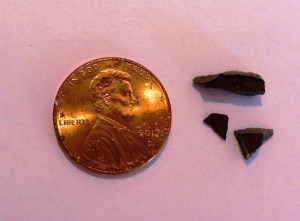
Though I would not become a tea drinker for many years, that teapot traveled with us through all the many moves associated with marriage, school and the career of a military officer’s family. It made the journey safely through every move except the final one to Virginia, during which the packers failed to wrap the lid separately and simply left it in place on the (inadequately) wrapped teapot, which was stuffed into a box. On arrival I discovered the lid inside the pot, shattered into a zillion pieces, of which 21 were large enough to see and count. Some of those 21 were tiny:
I remember being very sad about the breakage, but instead of doing anything immediate about it, I left the broken shards inside the pot and packed it away. Within a year or two of coming to Virginia, I started drinking tea regularly, but the pot was packed away and all but forgotten.
Fast forward 15 years to the present. I had unpacked the teapot almost a year ago, but set it aside, debating whether to keep the undamaged pot without its lid, or get rid of the entire thing. I searched on eBay and at other china replacement sites, hoping to find a lid I could purchase, but I came up empty. I did find several similar teapots without lids, but no lids without pots.
A couple of weeks ago, with the growing “now or never” determination to make some progress on clearing away the bittersweet relics of my past, I started to pitch the broken pieces and get rid of the pot. But something stopped me. I decided to bring it to my northern Virginia home where I took the time to examine the pieces with the wabi sabi intention of reassembling them. I knew the glue would never endure repeatedly being steamed by hot tea, but I reasoned that the pot was primarily a decorative object anyway, being smaller than the practical pots I use regularly.
I started by giving myself permission to pitch the project if it became too frustrating. I had done something like this only once before, when I re-assembled a Christmas ornament I had bought in Amsterdam, and I remember that I found the process absorbing and satisfying, with the result better than I had expected. The ornament has hung on my tree every year since, and I thought of it when I first read about wabi sabi some years ago.
It was much the same experience when I began to reassemble the lid. I found it to be a relaxing pastime not unlike working a jigsaw puzzle, as it required much of that same skill. In the process, the slow nature of the work turned it into a sort of meditative path, as the limitations of what could be done caused me to adjust and re-adjust what I planned to do. How like life, I thought.
I worked on it a few minutes and one or two pieces at a time. This was not just a way of forestalling frustration; it was necessary to be patient and allow each step of the repair to dry and hold strong before proceeding. It could not be rushed or everything I had accomplished might be undone. How like life, I thought.
When I got a little more than halfway through, I met an unforeseen problem. I had started with the largest pieces, which seemed logical. The outer ring of the lid had remained fairly intact though in 5 pieces, so I reassembled that first, then built from one edge to the center where the undamaged round ball created a place to hold the lid. So far, so good. But as I proceeded on, I found that I had failed to consider what should have been obvious: no matter how closely the pieces were reassembled, there would be just a tiny bit more space between them…which left not enough room to fit the smaller pieces into the newly glued repair.
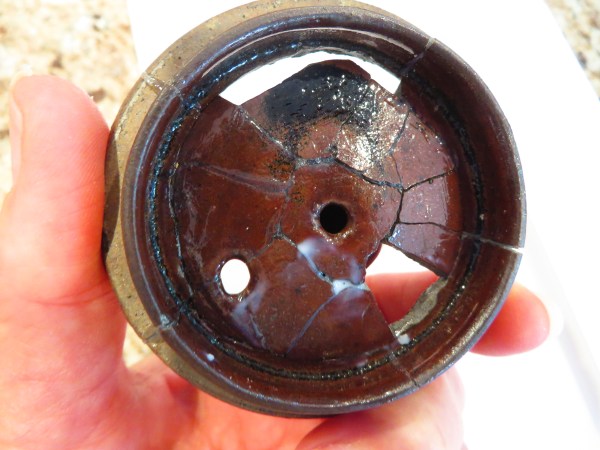
I didn’t know what to do at first, and thought of giving up and just leaving the remaining holes in the lid. But then, with a bit of practice, I found a way to hold the lid tightly in one hand to support the mended places enough to keep them intact, yet allow them to move slightly outward to make room for more. I gradually worked the new pieces in, one at a time. I could hear the grinding of tiny bits of ceramic powder being sanded off between the pieces as I wedged them in. When I was done, the cracks in the previously mended parts were much more pronounced due to the necessary expansion. Every other piece, especially the largest ones, had to “give” a little to allow the smaller bits to become part of the whole again.
How like life.
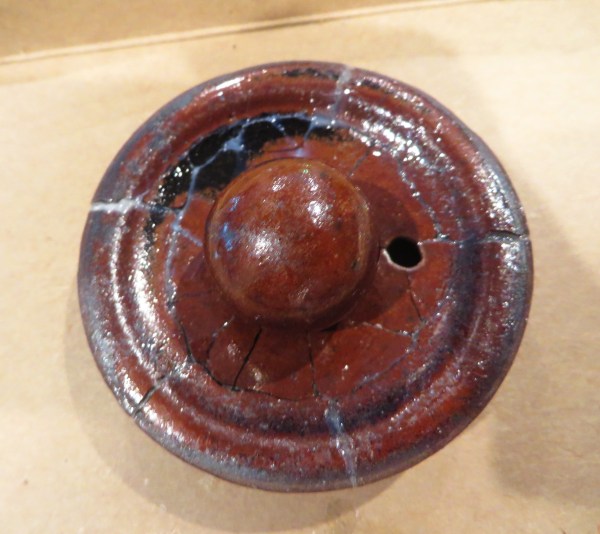
So here is the completed whole, including the original hole that was not breakage, but a steam vent. Better than the first photo, cracks notwithstanding? You be the judge.
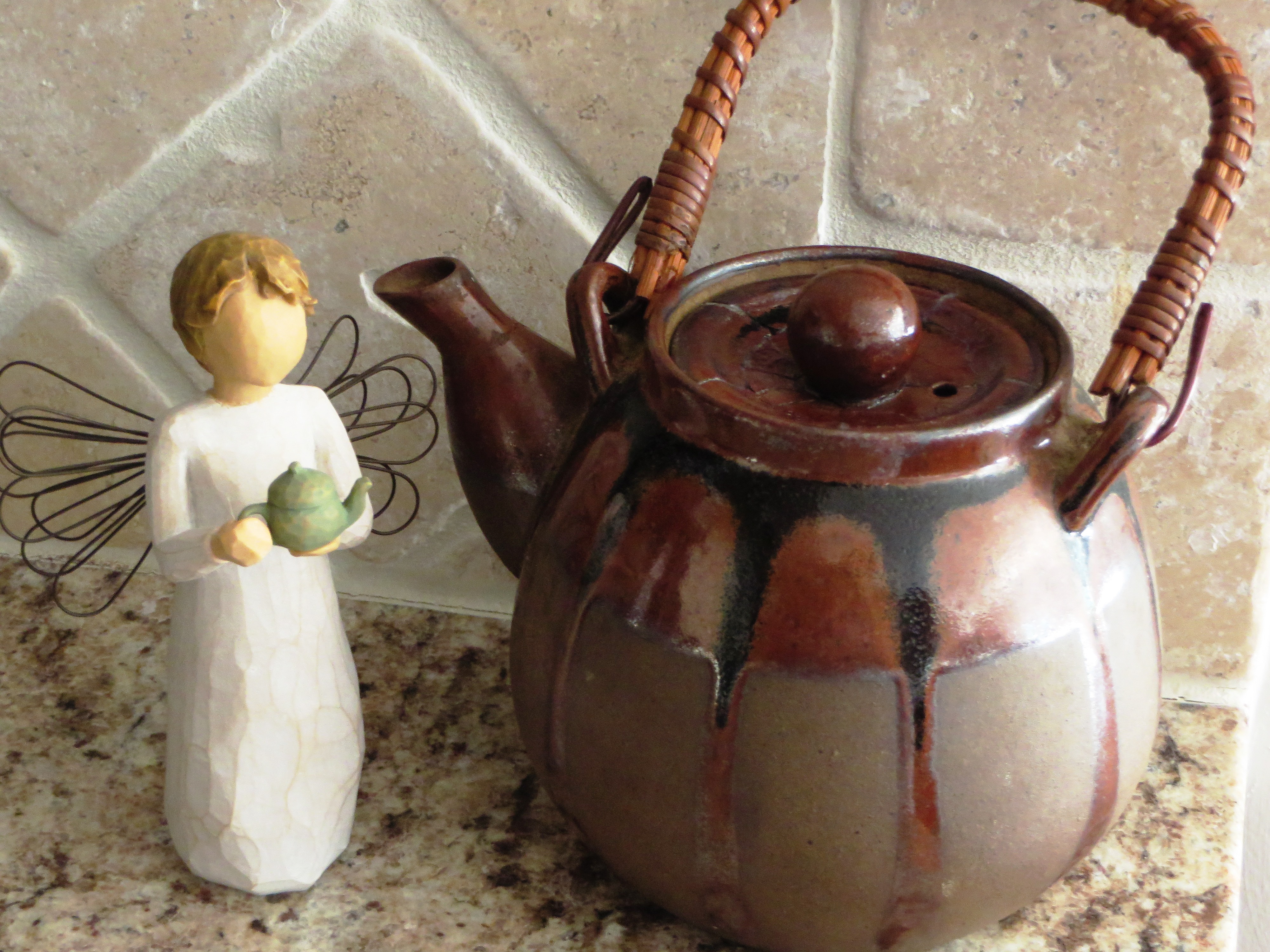
Even if I am blessed to live to advanced age, the time is coming in the not-too-distant future when someone will be going through my possessions, deciding what to do with them. Perhaps they will chuckle when they see the glued-together teapot lid. “Was she a cheapskate or what?” they might laugh. “She had at least half a dozen other teapots, yet she chose to glue this back together. Why on earth waste all that time?”
Or maybe they won’t even look at it closely enough to see the cracks. Maybe it will just be set aside with the 95% of everything else that will go to some thrift store or Goodwill donation center. Nobody will remember Ms. Violet Gilman, who owned the teapot before I did and made it so special for me, nor will anyone know why I repaired the lid, if they know me at all. But none of that matters. I have the teapot today, right now, and in my eyes, it’s even more beautiful than it was before.
Today, I hope you will find many things in your life that are more deeply valued for the history that only you can remember and understand.
Note: In a purely unintentional instance of wabi sabi, I accidentally dated this post incorrectly, so it published before I was finished writing. To those who saw it…this is the repaired version! 😀
This post was first published seven years ago today. The blog is not designed for viewing on cell phones, but you can get a less distorted version of the photos if you click on the “view on blog” link at the top right of the screen. The original post, comments and photo are linked, along with two other related posts, at the individual post views. These links to related posts, and their thumbnail photos, do not appear in the blog feed; they are only visible when viewing the individual posts by clicking on each one. I have no idea why, nor do I know how they choose the related posts. That’s just the way WordPress does things.
- Posted in: Uncategorized
- Tagged: broken, contemplation, meditation, memories, mended, new, old, process, repaired, subjective, teapots, value, wabi sabi


Beautiful repair, beautiful teapot.
So glad my maker thinks I am worth the repairing and takes the time.
Thank you, and welcome to the comments section! I agree with you; I’m grateful to the grace daily extended to me and all of us who make a good faith effort to do the right thing, however misguided we might be at times. When things go wrong, I remind myself “His grace is sufficient.”
Good morning, Julia!
Yesterday as I was pulling strands of creeping Charlie out of my lawn, I started to chastise myself for wasting time on such a ridiculous and hopeless activity. The creeping Charlie is clearly winning. Then I realized, as you did, that sometimes we just need to do something that’s not wildly productive. It is meditative. It’s quiet time that I don’t need to be critical of the quality of my work (as you have yourself permission to quit).
At least you have a fun remembrance for your efforts. (And I think it looks great! There is something to Wabi-Sabi, after all!)
We should raise a cup of tea to Ms. Violet Gilman!
Susan, if you had known this lovely lady personally, you’d definitely join me in raising a cup to her anytime! There’s no telling how many students were blessed by her patient guidance. As to the weeding, I too find it VERY therapeutic. Even if it’s too hot to do more than pull up a few sprigs here and there daily, I’d rather do that than spray toxic chemicals on them.