The noise is democracy
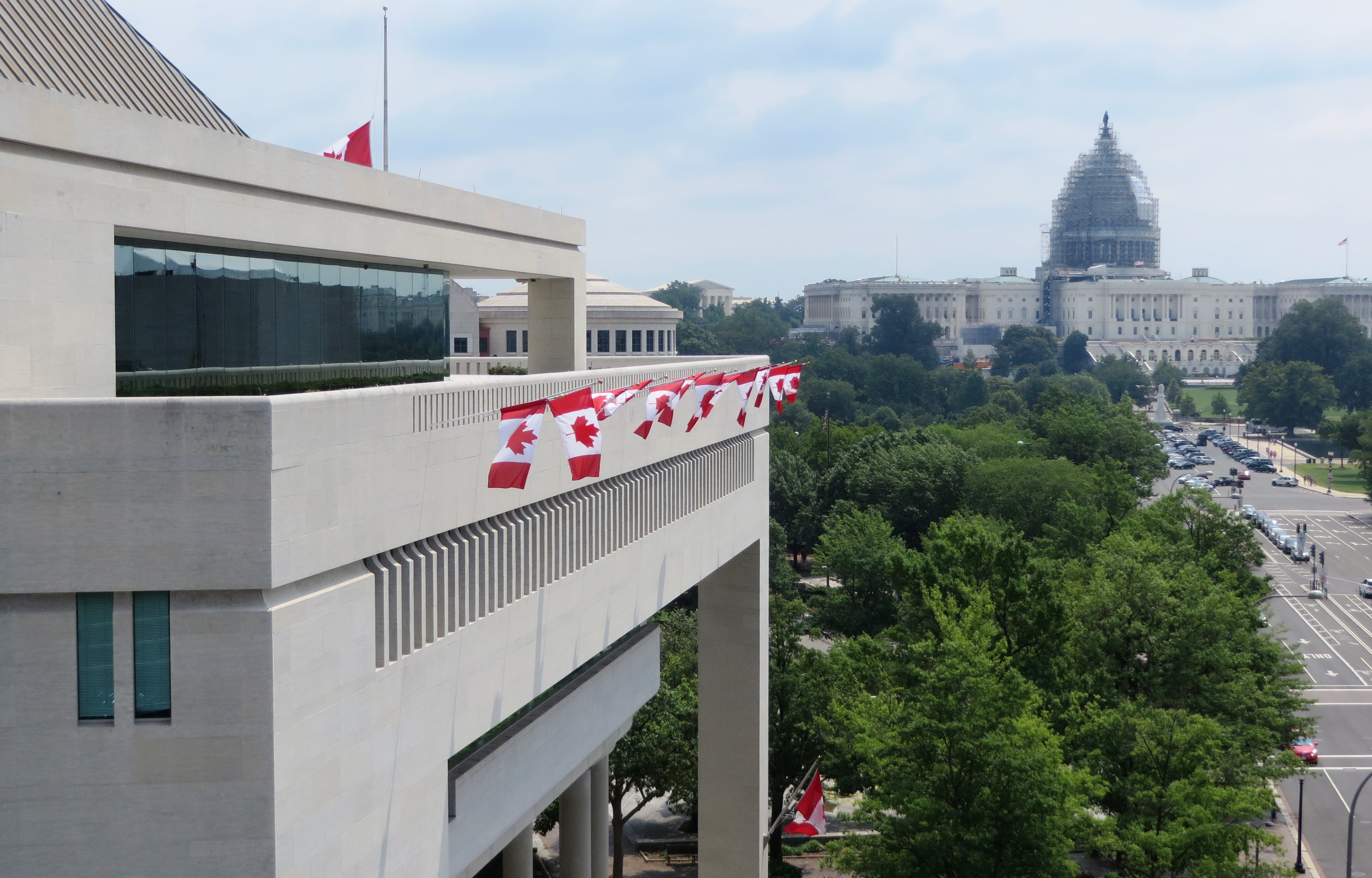
All that clanging requires diligent maintenance and occasional restoration.
The Canadian Embassy and the U. S. Capitol, seen from the Newseum
Washingon DC, July 2015
“Our political institutions work remarkably well. They are designed to clang against each other. The noise is democracy at work.” — Michael Novak
When I first read that quote by Novak, I couldn’t help wondering when he said it, and whether he still feels that way. Everywhere I turn, I hear people complaining about the government. There’s a diversity of opinion about where the blame lies, but there is clear consensus about one thing: a lot needs fixing. If only we could agree on what, and how, and when.
Ah, but that’s really the argument that Novak is making, isn’t it? If there is a great deal of vocal disagreement, maybe that’s an indication that democracy is working. That we feel not only the urge but the freedom to complain; that we examine our leaders again and again in the court of public opinion; that we elect all sorts of representatives who themselves have a hard time reaching agreement — maybe these are healthy signs of government that truly aspires to be “of, by and for” an increasingly diverse people?
I’m not saying it’s right to show disrespect toward our leaders, or toward anyone else whose opinions offend us. I abhor hateful name-calling and gratuitous insults. But constructive criticism, incisive commentary and hilarious satire are all necessary components of a society ruled by a Constitution and a Bill of Rights.
If I could, I would find a way to banish all trolls from the internet; they pollute thoughtful discussions with vicious and often illogical attacks, acting ugly seemingly for the sake of ugliness. It makes me tend to shy away from the comment sections following any news story, particularly if the topic is controversial. It also makes me angry that we allow the lowest common denominator to hijack reasonable argument. Polite disagreement may sound like an oxymoron, but I believe it’s possible.
Meanwhile, with election talk already beginning to dominate the airwaves, let’s brace ourselves and get ready to see this nonstop and often irritating chatter as an inevitable by-product of the incalculable blessing of living in a free country. I invite you to join me in resolving two things: one, I will not let all the complaining and whining and hand-wringing cause me to lose sight of how many reasons we have to feel thankful; and two, I will not become part of the problem by venting my (often reasonable) frustrations in inflammatory speech or over-reactive anger at anyone who happens to disagree with me.
Let the clanging begin!
This post was first published seven years ago today. To my knowledge, this is the first time an author of a quote I featured in a post died between the first and second publication of that post. Of course, many (maybe most) were long dead before I chose their words as the inspiration or theme of mine. But for some reason, it was a bit jarring when I checked the link to Novak’s name and found that he died in 2017. I wonder all the more whether he would still feel that way about democracy, with crime rampant and civil behavior increasingly rare, not only in government, but in the everyday settings in which we all witness rude or disrespectful words and actions. I renew the invitation to resolve the two intentions mentioned in this post. I think it’s even more important now than it was seven years ago.
The original post, comments and photo are linked, along with two other related posts, below. These links to related posts, and their thumbnail photos, do not appear in the blog feed; they are only visible when viewing the individual posts by clicking on each one. I have no idea why, nor do I know how they choose the related posts. That’s just the way WordPress does things.
To produce some good

Should I say something? Let me get back to you on that.
Self portrait, August 2015
“I am very little inclined on any occasion to say anything unless I hope to produce some good by it.” – Abraham Lincoln
To borrow some famous words of Yogi Berra, Lincoln really didn’t say everything he said, but apparently he really said this. And WOW, what a quote. Just think how much better the world would be if EVERYONE followed this rule.
Assuming one doesn’t quibble over the question “good for whom?” (which might be used to justify anything that generates publicity or commercial profit) I think it’s safe to say that a huge percentage of thoughtless and harmful chatter would be promptly eliminated if we took this idea to heart.
Can you imagine how talk radio and news commentary would be transformed by this principle? But closer to home, how might it change our everyday conversations? I like to think most of what I say is at least harmless, but I’m a long way from meeting this standard myself.
I invite you to join me in an experiment this week. I’m going to try being more aware of how much of what I say (or write) can pass Lincoln’s test. For some of us, this will mean saying less; for others of us, it might mean saying MORE, in the form of compliments to those who need them, encouraging words to people who are struggling, and being unafraid to share positive ideas for practical improvements in places where we tend to feel silent disapproval for how things are.
If you were to adopt Lincoln’s policy regarding your own speech, would you end up saying less? Or more? Or the same amount, with a different focus? Share your ideas in the comments, and let’s hope to produce some good with what we say here.
This post was first published seven years ago today. The original post, comments and photo are linked, along with two other related posts, below. These links to related posts, and their thumbnail photos, do not appear in the blog feed; they are only visible when viewing the individual posts by clicking on each one. I have no idea why, nor do I know how they choose the related posts. That’s just the way WordPress does things.
There are no words
2022 update: When I first decided to re-post everything I had written for the past seven years, I dreaded the heartache that would come when I had to re-live the most difficult times. This post marked the first of the great sorrows that changed me forever. Yet watching the video, I also feel blessed beyond measure that my siblings and I had such a wonderful, loving Daddy. I still miss him, each and every day. And often, I will listen for what I think he might have said to me if he was still here to advise, comfort, and amuse me with his wit and wisdom.
Dear blog readers, our wonderful Daddy passed from this life earlier today. Here is a video I made for him on Father’s Day 2014, just a token of the tremendous place he holds in the hearts of his four children. There will be no posts this week. Thanks for understanding.
Update, Monday 12:15 a.m. — Thanks to all for your kind thoughts, prayers and comforting comments. Please be assured I am reading the comments and will respond to each one as soon as time allows. Your friendship and support mean more than I can say. Please pray for our Mama who is having a very hard time after losing her husband of more than 66 years. She has depended on his loving support for so long.
This post was first published seven years ago today. The original post, comments and photo are linked, along with two other related posts, below. These links to related posts, and their thumbnail photos, do not appear in the blog feed; they are only visible when viewing the individual posts by clicking on each one. I have no idea why, nor do I know how they choose the related posts. That’s just the way WordPress does things.
I learn by going
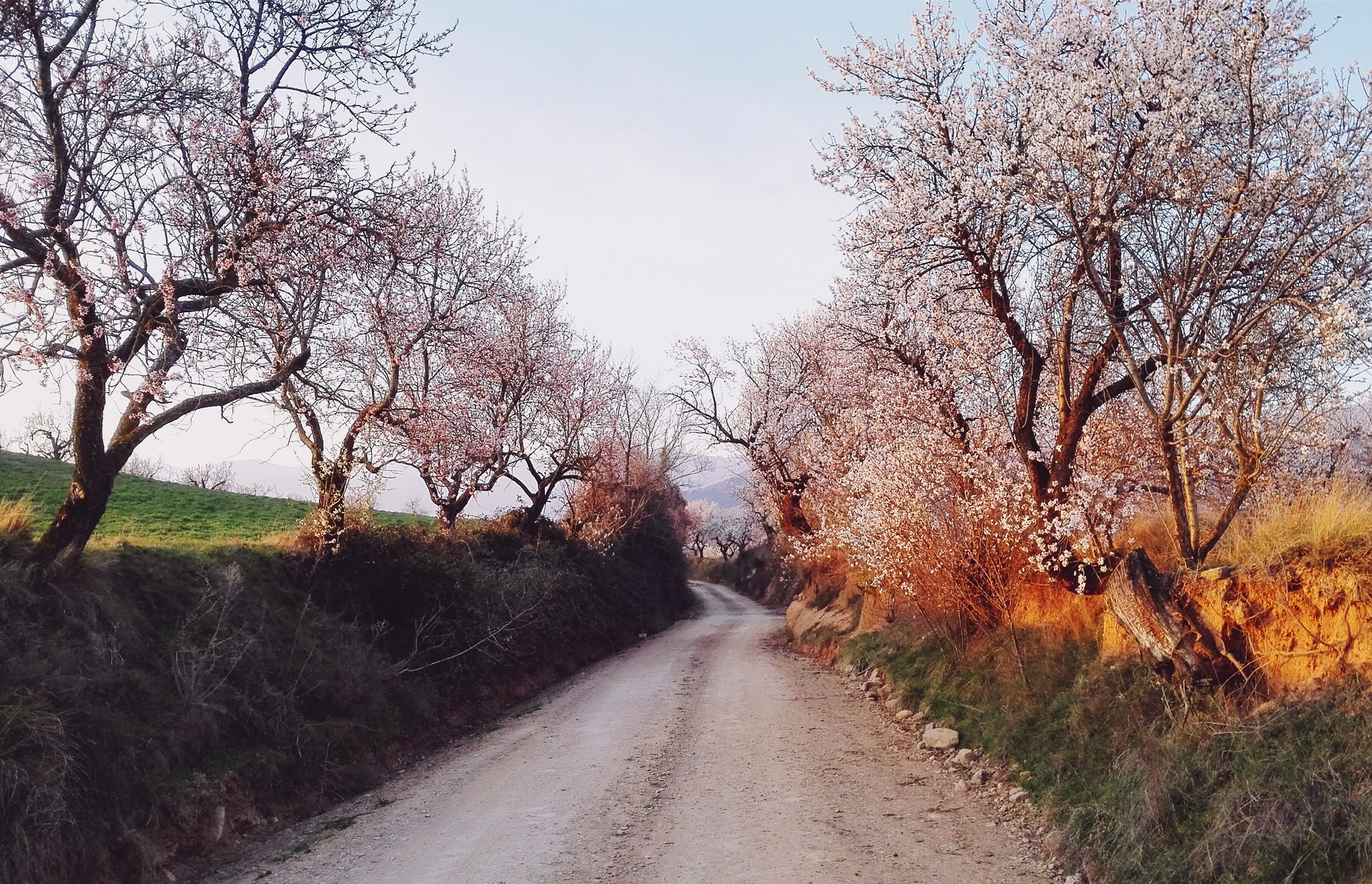
The road we travel is unknown to us, but it’s a beautiful and compelling journey.
Almendros en flor (cropped) by Gregorio Puga Bailón, CC by 2.0 via Flickr
I wake to sleep, and take my waking slow.
I learn by going where I have to go. — Theodore Roethke
I’ve never been fond of awakening from a nice dreamy sleep, and getting up (especially on cold, dark mornings) is not something I do well. I envy and wonder at Jeff’s ability to get up very early, usually without an alarm to wake him, and immediately start his day. Aside from his recent times in the hospital under sedation, I can’t remember a single time when he has shown any reluctance to get up in the morning.
This is the season when it starts to become most difficult, as the morning light wanes and we have to get up in the dark. When the cold sets in, it will be really brutal. But every day, along with millions of others who share my morning drowsiness, I somehow arise and go about my morning routine, my steps seemingly ahead of my brain much of the time.
Life is like that, isn’t it? A lot of what we learn, we learn simply by doing what we have to do and going where we must go, even if we start out in a bit of a fog. Whether we place ourselves in the hands of God, or look elsewhere for direction and reassurance, daily each of us must summon some measure of faith to keep moving into an uncertain future.
The present moment is deceptively familiar, yet totally unknown to us; our entire world can change in the blink of an eye. Little wonder the comforting nest of sleep is something many of us are slow to relinquish. But the day ahead calls to us, and we know it is often beautiful, sometimes amazingly so. With lingering yawns, we move forward.
As I reschedule this post, reading it again hits me with an almost cruel blow. I am struck by the strangeness of how prophetic that last paragraph was. Over the seven years to follow its publication, my life was to change in an instant, not just once or twice, but several times. Most recently, as many of you know, is the bizarre injury and facial trauma that has taken over my life for six painful months now, with another 8-12 months still ahead of me, with no guarantees as to outcome. Indeed, I have learned and continue to learn by going where I have to go, and I suppose I must be grateful that I had no idea what lay ahead of me during those 7 years– nor even the past six months. I could never have imagined any of it, and the unimaginable just keeps coming.
Enduring now what I could not have expected nor prepared for, I doggedly try to look to whatever future remains to me with optimism. It’s becoming harder and harder to do that, because all we have as an indicator is the past. For those of you who have noticed my lengthy absences from the comments section, I appreciate your patience as I do the best I can each day. I have not forgotten you.
This post was first published seven years ago today. The original post, comments and photo are linked, along with two other related posts, below. These links to related posts, and their thumbnail photos, do not appear in the blog feed; they are only visible when viewing the individual posts by clicking on each one. I have no idea why, nor do I know how they choose the related posts. That’s just the way WordPress does things.
Important decision

Contagious happiness: Carla took this photo of Ms. Ella, Raynard, Mary, Matt and me.
That’s a yummy chocolate cake in the tin on the table in front of me. But I digress…
Virginia Beach, July 2015
“The most important decision you make is to be in a good mood.”― Voltaire
In the grand scheme of things, it might seem that Voltaire is exaggerating to describe a mere mood as being so important. After all, there are plenty of huge and life-changing decisions that are far less transient than how we feel on any particular day. But when you think about it, our moods have such a pervasive effect that it might not be too much of a stretch to say they have the potential to change almost everything.
A good mood is, in most circumstances, a choice we make. While there are burdens and sorrows that are too heavy to allow us to just “snap out of it,” I think that most of our daily irritations are relatively minor. Have you ever known someone who seemed to take everything in stride, smiling even when things don’t go well? People like that serve society well, because a good attitude is contagious. How different would the world be if everyone managed to keep a positive and sunny spirit through everyday frustrations?
Looking at the picture above, you would never guess that Ms. Ella, Raynard and Mary had just spent most of their day sitting in horrible traffic. But that’s exactly what had happened. After several planned meet-ups that fell through for one reason or another, we had finally found a day when it seemed we would be able to get together in Virginia Beach. My sister was in town from Alabama, and I was taking her for a late breakfast at the Belvedere. We figured our friends would arrive around lunch time, and Raynard had promised to bring me a freshly-baked cake that would be one of the three choices I gave him (chocolate, chocolate or chocolate, or if none of those worked out, chocolate). We all looked forward to meeting face-to-face for the first time after years of online friendship at Upper Room and this blog.
Though it was a Saturday, none of us guessed that the beach traffic would be so bad all the way from Delaware down to Virginia. I guess that’s always a risk when driving down the outer coast. To complicate things, I was using a new cell phone that I couldn’t figure out how to answer, so every time they called to give us an update, I ended up having to call them back because I didn’t know how to answer their calls. It seems funny to think about it now, but at the time it was driving me crazy to be unable to answer my own phone.
If you’ve been reading the comments here, you probably remember that Raynard is a cheerful type who can see the humor in almost any situation. That comes in handy if one is snarled in traffic. I don’t know about you, but there is hardly anything that can ruin my day more quickly. By the time they got to Virginia Beach, they didn’t have much time to do anything but grab a quick bite and turn around to head home. But the short time we had together was quite memorable, and we had that delicious cake as a take-home souvenir. It’s the first time someone has ever baked me a cake for their own birthday!
Matt, Carla and I all had a great time chatting with them, and their short visit was a note of cheer that lasted for days. Mary even figured out what I was doing wrong with my cell phone, and with her help, I’ve been able to answer calls ever since! Meeting all of them was certainly a high point of the summer for me.
Sometimes we might feel that there is not much we can do to change a world that is too full of sadness and nasty behaviors and outright tragedy. But if you are blessed to know someone with a sunny disposition, you know that they can take almost any situation and turn it around. I’d like to be that sort of person, wouldn’t you?
This post was first published seven years ago today. Out of all my 1100+ posts, this one is among the five most popular, if you believe the statistics from WordPress. I know this is entirely due to the topic being about Raynard and Mary, who have a huge circle of friends online and in real life, too. The post itself explains the reason for their enduring popularity. Since the post was first published, Ms. Ella has passed from this life, but the memory of her beautiful spirit and warm smile remains with me.
The original post, comments and photo are linked, along with two other related posts, below. These links to related posts, and their thumbnail photos, do not appear in the blog feed; they are only visible when viewing the individual posts by clicking on each one. I have no idea why, nor do I know how they choose the related posts. That’s just the way WordPress does things.
Ingenuity and resourcefulness
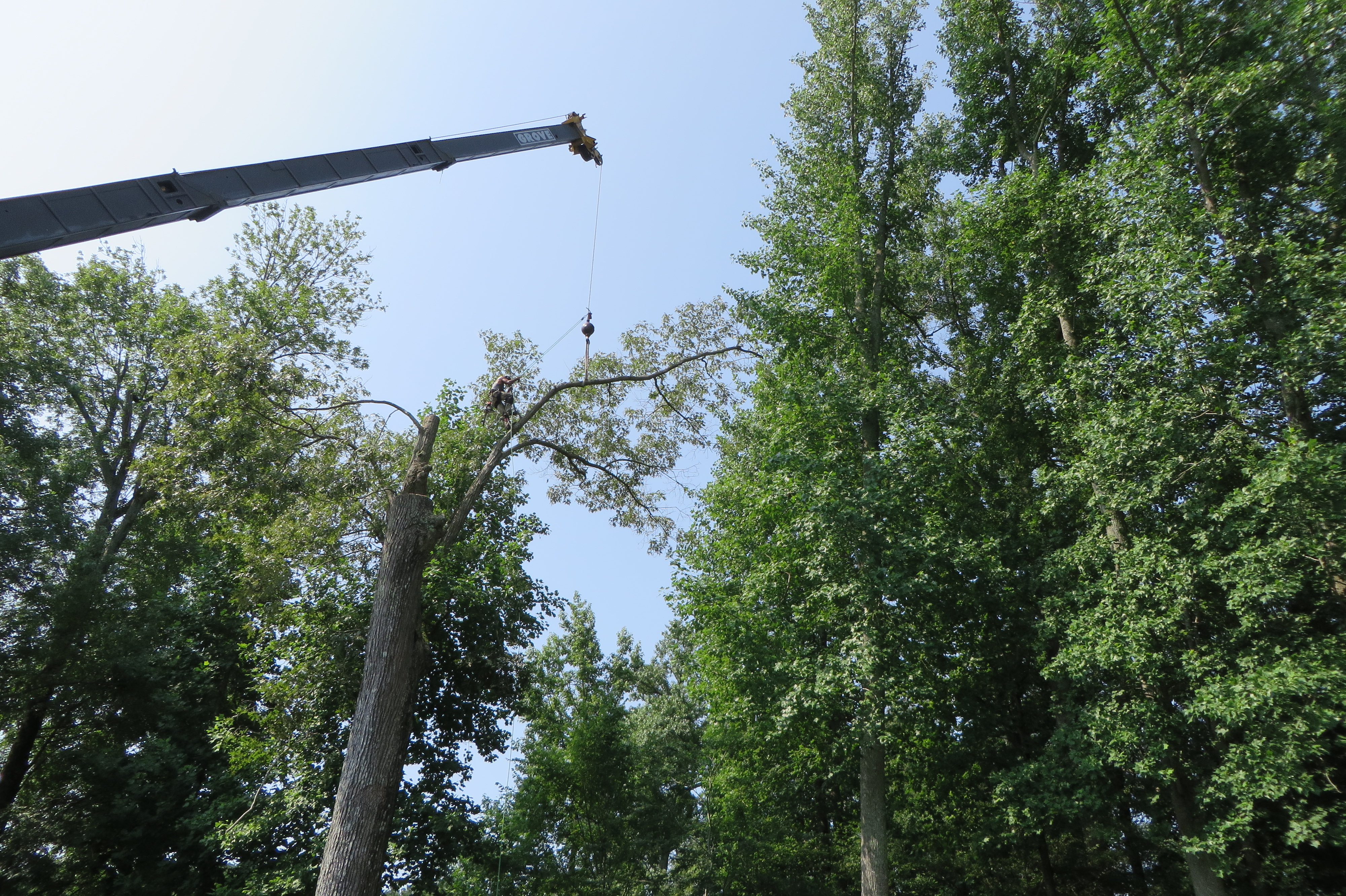
You’ll have to look closely to see that man walking along the branch.
And this was after the scariest part was over! York County, July 2015
“Risk brings out the ingenuity and resourcefulness which ensure success.”
— Robert Rawls
“There are men climbing around in the top of your tree!” Darla reported with excitement when I answered the front door that morning. She knew the tree surgeons were coming to remove our giant oak that day, but the sight of them working in the lofty branches was still amazing to her.
“I’ve been afraid to look,” I confessed.
“DON’T! Don’t look!” Darla knows how nervous I can get.
Despite this good advice, a few hours later I could not resist stepping outside to see how things were going. Through our large back windows, I had seen HUGE branches lowered to the ground by the crane, so I figured they might be getting to a point where most of the tree was gone and it wouldn’t be terrifying to watch. Bad assumption on my part.
That tree was so tall that, even after the top part of it was gone, it was still dizzying to watch the climber walking around up there, attaching the crane before sawing the branches or trunk. It was so fascinating that I could not pull myself away — and in fact, true to form, I had to go for my camera. I’ve never been to the circus, but I can’t imagine it being more thrilling than this. I only wish I had photographed the whole thing from the beginning, when the tree still towered over all the others.
One thing that made it somewhat less frightening was the expertise and precision with which they went about the task. Clearly, these folks knew what they were doing. I had somehow imagined someone standing safely inside a cherry-picker sawing all the branches off, but I guess that doesn’t work when there are trunks that weigh several thousand pounds being removed (the heaviest piece they took that day weighed over 8000 pounds).
I felt tremendously grateful that there are people who make a career of knowing how to go about such momentous tasks. Ditto for construction workers who build skyscrapers, or first responders who tackle wildfires, or any number of valiant people who are willing to face the considerable risks inherent in keeping our world going.
Watching these tree professionals at work, I realized the truth of what Rawls says about ingenuity and resourcefulness. Whoever designed the tools and methods, as well as those who spent the many hours of practice it would take to get good at using them, displayed determined competence that benefits all of us. While their efficiency did not inspire me to learn tree work, it did encourage me to become better at what I have to do.
Risk is a part of everyone’s life, though the type and degree of it varies greatly. I’m a cautious person who is averse to taking chances of any kind. Because of this, risk can induce fearful procrastination on my part, or passive avoidance of situations that seem precarious. I need to remember that risk can be used as an incentive to sharpen my perception and get me moving, adjusting circumstances to improve the probability of success and decrease the likelihood of misfortune.
What risks are you dealing with right now? How can you transform uncertain situations, using them as assets rather than liabilities?
This post was first published seven years ago today. The original post, comments and photo are linked, along with two other related posts, below. These links to related posts, and their thumbnail photos, do not appear in the blog feed; they are only visible when viewing the individual posts by clicking on each one. I have no idea why, nor do I know how they choose the related posts. That’s just the way WordPress does things.
Truly artistic

Several people were the subjects of this artist’s attention.
By Friedrich Bischoff (1819–1873) Public domain, via Wikimedia Commons
“The more I think it over, the more I feel that there is nothing more truly artistic than to love people.” — Vincent Van Gogh
Quick, think of your stereotype of an artist. Did you picture someone isolated, temperamental, aloof or demanding of perfection? Someone slightly out of touch with “normal” life? I have to admit, that’s what first comes to mind for me. But such typecasting can be inaccurate or unfair, and this is a good example.
It’s true that many artists often appear noticeably different, and by the very nature of their work, they must spend huge chunks of time in solitude. But perhaps our ideas of artists, and of what constitutes art, are too narrow.
Think of the joy that art brings to our lives. Think of the close observation that must be necessary for capturing that undefined quality in a piece that instantly resonates inside us with both familiarity and surprise. Dedicating one’s life to such diligence and attention is no small feat, and that’s not even considering the endless hours required to become proficient at rendering that vision into music, painting, dance or drama. It’s hard to imagine producing art without affection and benevolent intention, but if it can be done at all, work produced with contempt toward others is unlikely to live in people’s hearts the way great works have done throughout history.
Maybe more important, think of all the artists who surround you every day, and include yourself in that number. Most of us spend a good portion of our day helping, serving or otherwise interacting with people, directly or indirectly. Over time, we usually become fairly good at one or more of the things it takes to keep the world turning. It’s not that I would equate baking a cake, stitching a quilt or writing a letter with the masterpieces produced by those rare individuals with exceptional gifts. But artistry is a way of life that involves process more than product, and striving for artistry in daily living is a worthy goal.
We don’t have to be phenomenally talented to be creative and unique in what we do. Indeed, as Van Gogh implies, the more we love, the more likely we will approach even our mundane tasks with the same loyal diligence as the great masters applied to their creation. Could it be that artistry seems elite and unavailable to us simply because we mistakenly see it that way? Might it transform our results, as well as our moods, to approach our everyday tasks with enthusiasm and originality?
For those of us who revere God as the greatest Creator of all eternity, Van Gogh’s quote makes perfect sense, because “God is love.” Through that lens, the beauty of the natural world becomes a divine love letter, a daily reminder that God is present in our lives, and speaks with an eloquence that transcends our ability to fully understand. And our own yearning to create is a logical facet of being created in God’s image.
Artistry starts with paying attention. I’ve found that paying attention to people almost always changes how I see them, and even when it takes time and effort, I typically end up feeling more sympathy and affection for them than I do when I rush past them, too busy to see who they are.
Next time I feel really fed up with the details and detours that fill my days, I’m going to try to re-focus on the people for whom I am doing what I do, including myself. If Van Gogh is right about this — and I really believe he is — there will be more color in my hours; more beauty in the play of light and shadows.
Let’s think of today as our canvas. How can we paint our love into the endless large and small strokes it will take to finish this day well?
This post was first published seven years ago today. The original post, comments and photo are linked, along with two other related posts, below. These links to related posts, and their thumbnail photos, do not appear in the blog feed; they are only visible when viewing the individual posts by clicking on each one. I have no idea why, nor do I know how they choose the related posts. That’s just the way WordPress does things.
Vitally appealing

Matthew greets guests with a smile at the PORT Shelter, March 2008.
“The emotional energy created by the critical illness of a child is unlike anything else in a family. The medical situation devours much of the family’s life and leaves its mark on everyone involved: parents and siblings, grandparents and friends. Passions are generated, enormous resources are called upon, any moment can suddenly turn into a life-threatening crisis. Yet the child at the heart of all this, time and time again, is a vitally appealing human being who seems to concentrate and radiate the intensity around him in a powerfully sustaining way, as if it were a form of light.”
– Reeve Lindbergh
Some children face a formidable uphill battle from birth onward, and others are hit with a devastating diagnosis before their teenage years. Lindbergh’s quote, drawn from a book review of one father’s memoir, touches on several aspects of these crises. Her description sounds a bit overwhelming, but if anything, it is an understatement. There is nothing that changes family life more permanently than a child’s chronic serious illness.
Yet, as Lindbergh attests, there is something almost superhuman about the way many such children not only survive, but thrive. Sometimes they seem happier than their peers who have no such burdens. Perhaps the focused effort of so many who care — parents, siblings, therapists, educators, doctors, and friends — instills a deep sense of being loved that enables them to endure the physical and psychological pains that are inseparable from being challenged daily with obstacles most of us cannot imagine. Or perhaps they are blessed in unseen ways we will never see or know about.
Whatever the reasons for their inspiring psychological stamina and endearing smiles, I hope you are lucky enough to have at least one or two such children — or the adults they grew up to become — in your life. Please don’t assume that their stubbornly cheerful demeanor implies that they are free from loneliness or the need for human caring and everyday friendship. Quite the opposite, in fact.
One of the sadder aspects of living with such diagnoses is that, almost inevitably, most of the people in one’s life are paid to be there. While we all are profoundly grateful for those who choose careers in service to others, remember that the doctors, therapists, teachers and families get tired too. More importantly, we all long for connections that exist purely for the sake of relationship, separate and apart from our needs and challenges. Reaching out in friendship to a child or adult with chronic illness and/or disability might feel awkward at first, but you are likely to find them among the most appreciative, understanding and forgiving people you have ever known.
If you are experiencing difficult times and dark days, try going where the light shines. It’s sometimes brightest where you least expect it.
This post was first published seven years ago today. During the years since it first appeared online, Matthew has endured a fifth complex open heart surgery, another valve replacement surgery in May of this year, a broken arm that required weeks of difficult physical therapy last year, a devastating diagnosis of irreversible cardiac cirrhosis, and several cardiac hospitalizations scattered over the past seven years, with the next one already scheduled for this September. As if all this were not enough, during those years he lost his beloved Daddy, who was his best friend and companion, and all three of the loving grandparents he knew. At 37 years old, he has been through more than anyone of any age that I know personally, but he remains cheerful, loving and full of faith, only occasionally giving way very briefly to frustration, sorrow or resentment. Day after day, he and the ever-increasing team of professionals who care for him continue to live out the truth of Reeve Lindbergh’s beautifully articulated quote. I thank God for him and don’t really know how I would have survived thus far without his shining spirit.
The original post, comments and photo are linked, along with two other related posts, below. These links to related posts, and their thumbnail photos, do not appear in the blog feed; they are only visible when viewing the individual posts by clicking on each one. I have no idea why, nor do I know how they choose the related posts. That’s just the way WordPress does things.
A pathological nostalgia
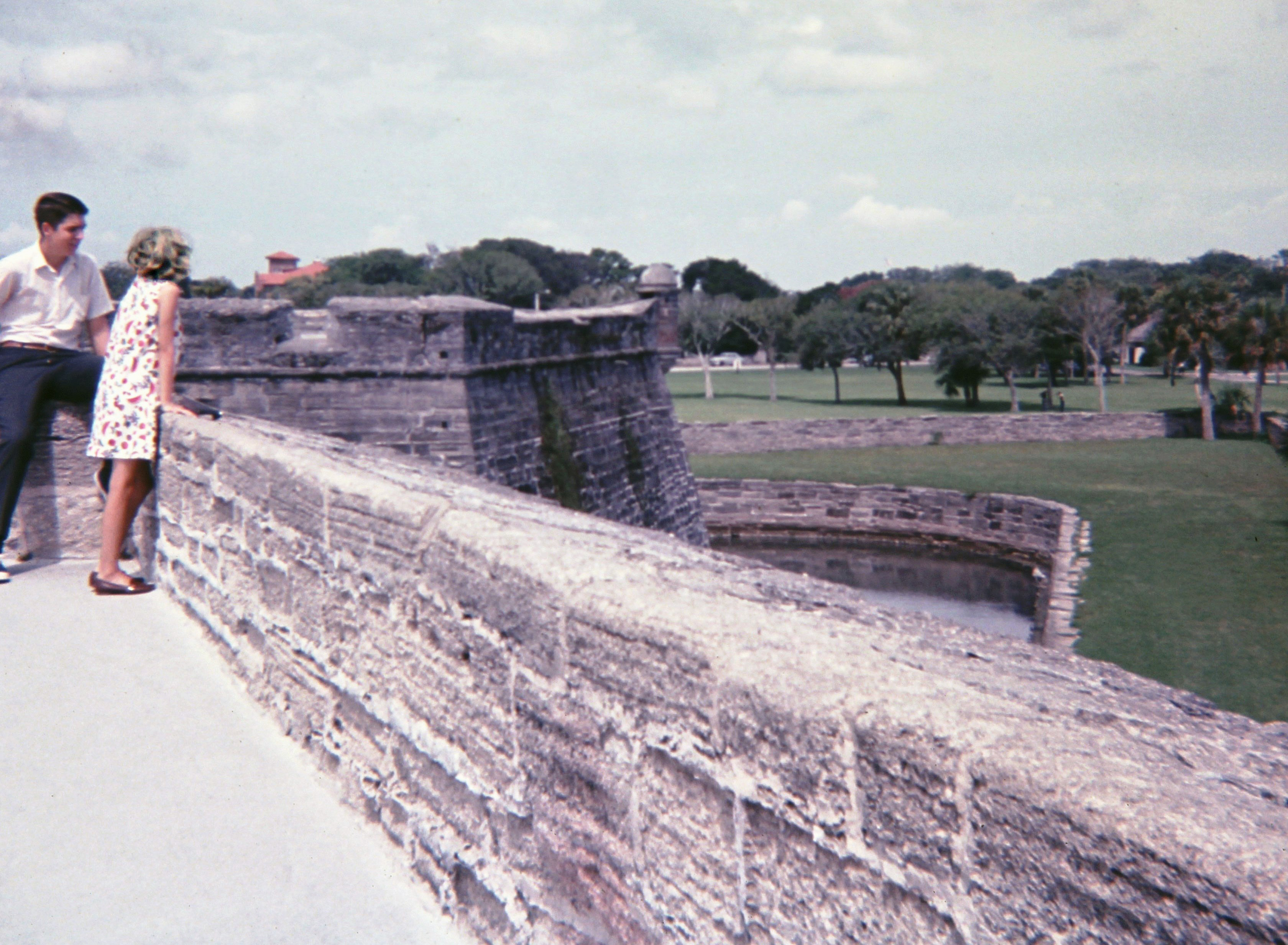
Eric and me at Castillo de San Marcos, Florida, sometime in the 1960’s
“I had a pathological nostalgia. I grieved not only for my own rapidly receding childhood but also for the years, ‘the pasts,’ that I would never experience. The past seemed as real to me as the present, as real as another country. But unlike another country, its borders were closed…pictures felt like the next best thing to time travel.” — Chris Wild
Illustrations, particularly photographs, are a natural complement to reading, or perhaps just another version of the same activity in a different dimension. When I read this quote, I understood my own “pathological nostalgia” as one reason for my enduring compulsion to take pictures. I’ve been creating conduits for time travel into my own personal past, having taken many such journeys into our collective past through the work of camera enthusiasts from Matthew Brady to Dorthea Lange to my own father.
In childhood, biographies written for and about children were among my favorite books. Even in my early travels, I quickly sensed (or perhaps imagined) that historic sites retain some intangible remnant of what has passed there; traces of atmosphere redolent of previous decades, or sometimes even centuries.
I used to dream of time travel with three parts longing tempered by one part spellbound terror. On some level I knew that it would be frightening and dangerous to find myself in another era, but that didn’t stop me from wishing I could visit history in person.
My first vivid memory of wanting to transport myself back in time was on our family trip to Castillo de San Marcos in Florida. Something about that well-preserved fortress captured my imagination and made me feel as if I could almost hear the sounds of cannon fire and soldiers speaking in rapid, urgent Spanish. But when I turned from gazing dreamily over the ramparts, there were my parents and siblings looking blandly contemporary, and the exotic sounds and images vanished.
Wild is correct: no matter how real the past might seem or really be, its borders remain closed to us in a physical sense. Yet thanks to digital images, we are able to get closer than ever before, as obscure photographs, drawings, journals and other ephemera from bygone days are scanned and made available in numbers that stagger the imagination. I smile to think that having such easy access to these abundant collections might seem as exotic and impossible to my great-grandparents as time travel is to us, and wonder whether those now-closed physical borders will ever be crossed by generations that come after us.
Until then, though, we travel on the wings of imagination, navigating with photographs, stories, historic preservation and that mysterious sixth sense that springs to life occasionally, when we stand in a place where others stood long before we were alive. Do you like to visit the past? If so, send postcards from your next imaginary journey — and maybe I’ll see you there sometime!
This post was first published seven years ago today. The original post, comments and photo are linked, along with two other related posts, below. These links to related posts, and their thumbnail photos, do not appear in the blog feed; they are only visible when viewing the individual posts by clicking on each one. I have no idea why, nor do I know how they choose the related posts. That’s just the way WordPress does things.
Doing more
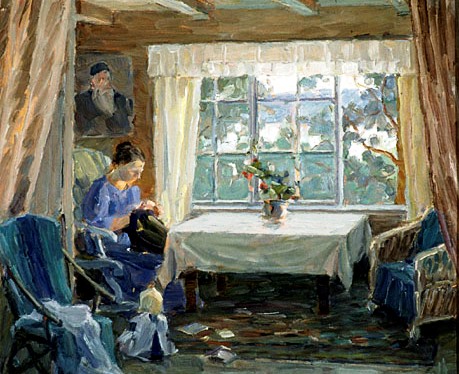
Was her life harder than ours? Easier? Or both?
“Housework” by Jonas Heiska [Public domain], via Wikimedia Commons
“There’s no question that labor-saving devices save labor. But they also manufacture labor. The washing machine and the dryer don’t save time if you end up doing more washing.” — Ruth Schwartz Cowan
Let’s talk about expectations. Is it my imagination, or do they mostly trend upward? Specifically, do we increasingly “need” to do more, have more, excel more and achieve more to feel content?
It would seem that greater efficiency would make our lives easier, but it’s more complicated than that. In his interesting book The Distraction Addiction, Pang discusses how Jevon’s paradox applies to more than energy consumption. When availability and/or efficiency increase, so do expectations, offsetting any potential decrease in expenditure of limited resources.
When you get a raise or other additional income, do you save 100% of it? I’m guessing not. In fact, I don’t know anyone who does that, and I’m not saying we should. But if we keep adding more and more to our already abundant collection of possessions, experiences and expectations, we don’t need to wonder why we end up feeling stressed and slightly crazy. As it turns out, more is never enough, yet paradoxically, it’s also too much.
Do you do more laundry than you would if you had to do it by hand? Do you ever buy a new appliance or piece of equipment and then feel guilty for not using it enough (in other words, for not spending more of your already limited time with it)? Did getting a cell phone make you feel obligated to leave it on and be interrupted by non-urgent calls and texts throughout your waking hours? Why?
Today, I invite you to join me in taking Pang’s advice. What aspects of your life are actually being made more difficult by things that were supposed to enhance your time, sanity and happiness? I don’t know the ultimate answer of what to do about it, but I think it’s a question worth asking. Feel free to share your own hints, tips and coping strategies in the comments below…but only if you have the time, can do it easily, and want to join the discussion.
This post was first published seven years ago today. The original post, comments and photo are linked, along with two other related posts, below. These links to related posts, and their thumbnail photos, do not appear in the blog feed; they are only visible when viewing the individual posts by clicking on each one. I have no idea why, nor do I know how they choose the related posts. That’s just the way WordPress does things.
A logic all their own

I can’t help but feel hopeful when I walk past this scene to the mailbox each day.
Our Alexandria neighborhood, May 2015
“Summers had a logic all their own and they always brought something out in me…they made me want to believe.” — Benjamin Alire Sáenz
As incredible as it seems to me, the summer is already beginning to wind down. The days are getting shorter and there have been a few touches of cool weather here and there that remind me it won’t always be hot, or even warm.
I always see the end of summer with mixed emotions, don’t you? I can’t remember a summer that didn’t seem unusually short. I don’t think of it as my favorite season, but the words quoted above definitely struck a chord with me. Summer does have its own agenda, and part of it shouts to me: “SLOW DOWN and take it easy!” no matter how much activity I try to cram into its three-month duration.
Summer makes me want to believe that good things are possible. Children are playing outside, the ice cream truck joins the birds in sending musical notes into the air, and the evenings find neighbors sitting on their porches or decks, or walking their dogs in the cool of those wonderfully shady hours just before the sunlight disappears altogether. Watering the plants, weeding and tending the lawn take precedence over staying indoors cooking, cleaning or working on homework with the kids. The exposure to daylight really does boost our moods, or at least it seems to do that for me.
What are your plans for the remainder of the summer? I hope that your travels and other urgent activities are mostly behind you, so you can take your time to relish the warm early mornings and cool evenings for a few more weeks. What does the summer bring out in you?
This post was first published seven years ago today. The original post, comments and photo are linked, along with two other related posts, below. These links to related posts, and their thumbnail photos, do not appear in the blog feed; they are only visible when viewing the individual posts by clicking on each one. I have no idea why, nor do I know how they choose the related posts. That’s just the way WordPress does things.
We don’t need as much

“Hmm, it says here that we need…just a little bit more than we have.”
Painting by Marinus van Reymerswaele [Public domain], via Wikimedia Commons
Miller’s words may sound controversial or oversimplified, but the more I think about them, the more I agree. I think one of the great secrets to a full and happy life is to live beneath our means. And because the best things in life really are free, I think living beneath our means is almost always possible, if we have at least a small (minimum-wage) income. I have known many people who have done it successfully for years.
I am thinking of a family who chose to share one car among five people, and a woman who heated her home only with a wood stove, and several people who refuse to this day to get a cell phone or internet service. All of these things are in the category most of us think of as “necessities” but none of these people who went without them ever complained; in fact, they seemed happy with their decisions. For them, these were (and are) conscious choices that left them feeling more empowered rather than less.
The interesting thing is, in almost every case, there were some of us who tried to pressure them to get what we thought they REALLY needed. The family with one car actually had people offer to donate a car to them. The few folks still without cell phones are frequently looked at as aliens from another planet when they tell people they have no mobile phone. (I know, because I used to be one of them.) And internet access is something I’m guilty of trying to talk people into on a regular basis. For me, the internet is up there with indoor plumbing, but not everyone sees it that way, and when I think about it I say: hats off to them.
If you examine your own life, I know you will find that there are things — maybe many things — that you happily do without, that your friends seem to find essential. The trick to living beneath one’s means is learning to think that way about other things as well, things that seem desirable to us, but aren’t really necessary.
It’s not that I think there’s anything wrong with spending money on clothes or restaurants or entertainment. We all do it. But most of us don’t NEED to do it to the extent that we have become accustomed. Jeff and I have a predictable little dialogue that we go through seemingly every time we discuss a potential purchase:
Me: Should we get a (fill in the blank)?
Jeff: Do we need it?
Me: Jeff, we don’t NEED anything!
OK, so maybe we do need groceries (but not overpriced processed foods) and electricity (but not a thermostat set at 70 in the summer) and transportation (but not a huge gas guzzling vehicle to run to the store that’s a mile from our home). I’ve found that it becomes fairly painless to “just say no” to unnecessary spending, because doing so has given us a lot of freedom, in direct and indirect ways.
There’s a quote I’ve kept on my refrigerator for years: “He who knows he has enough is rich.” (The quote is variously attributed, so I’m not sure who said it first.) That’s the heart of the matter, really. There is no freedom quite like the freedom from financial worries.
That freedom often comes after years of career advancement, and having saved enough to have a cushion against unexpected expenses. But it almost always starts with recognizing that money can never do what we may think it can do: add happiness or peace to our lives. More is never enough, and most of us have, right now, all that we need to be happy and content.
Today, let’s celebrate our freedom from needing more money. Let’s focus on those best things that are free. Take a walk and enjoy the trees, grass and flowers, breathing deeply to take in all that oxygen they make for us. Contact a friend or two for a quick hello, just to let them know how much you appreciate them. Go shopping and enjoy exploring the aisles knowing you do not need to buy a thing. Look through some old photographs, or tune in your radio or portable device (if you have one) to a station that plays music you like. Go to the library and browse among the books, magazines, newspapers, DVDs and CDs, most of which are available to check out at no cost. Chill some water and drink it when you are hot and thirsty — it’s incredible how wonderful cold water tastes when we are really thirsty. Sing. Pray. Exercise. Nap. Laugh.
I could go on, but I probably don’t need to. I’m sure you can think of quite a few things that are not for sale, or that you already have, to enjoy today. Share some of them with us by describing them in the comments. And here’s a bonus: I’ll happily send you a FREE tea bag (specify the type and flavor you prefer) or a blank note card for your personal use, or a copy of a poem chosen just for you, or a link to an upbeat song or a funny video. Just send me your postal or email address (as always, I will not publish it online or use it in any other way), let me know which of these little items you prefer, and look for a surprise to come in your electronic or old-fashioned traditional mail box.
If finances are an area of deep concern for you, I’m hoping that you will find new ways to understand that money (or a lack of it) will never define who we are. But all of us, whether we have a lot or a little, struggle with buying into the continual messages telling us it does. Just for today, let’s make an effort to ignore those messages, and drink in (literally or figuratively) those best free things.
This post was first published seven years ago today. The original post, comments and photo are linked, along with two other related posts, below. These links to related posts, and their thumbnail photos, do not appear in the blog feed; they are only visible when viewing the individual posts by clicking on each one. I have no idea why, nor do I know how they choose the related posts. That’s just the way WordPress does things.
Ashore

People at Pigeon Point Beach — and all over the world — love to watch the sea.
Tobago, March 2010
The land may vary more;
But wherever the truth may be—
The water comes ashore,
And the people look at the sea. — Robert Frost
I haven’t been to the seashore in awhile, and I’m missing it. Carla, Matt and I enjoyed a late breakfast at the Belvedere recently, but we didn’t have enough time to get out on the beach. I actually enjoy the beach more when it isn’t so hot outside, but something about summer seems to call for gazing out at the ocean. Since I’m not planning to go there in person, I can visit in my mind, and as a bonus, I’ll be avoiding the crowds and sunburn and sand in my shoes.
Want a quick break? Join me for some virtual beach therapy. We can watch the waves in Melbourne, Florida:
Or meditate to the mesmerizing surf on the rocky California coast:
Or catch the sunset at the beach pictured above, Pigeon Point in Tobago:
OK, I guess it’s time to get back to work…Sheila, I’ll join you for our imaginary meeting at Club Verandah (aka Chez Vann) this evening to enjoy your ocean views! Have the iced tea ready, and I’ll bring some freezing-cold watermelon. Sorry, Raynard’s chocolate/coffee/caramel cake is all gone now!
This post was first published seven years ago today. The original post, comments and photo are linked, along with two other related posts, below. These links to related posts, and their thumbnail photos, do not appear in the blog feed; they are only visible when viewing the individual posts by clicking on each one. I have no idea why, nor do I know how they choose the related posts. That’s just the way WordPress does things.
So much your own

Do they look alike or what? Grady and Megan, March 2014
“Child, who sculpted you,
that your face is so like mine
and yet so much your own?” — Joan Walsh Anglund (I think*)
I was about to draft a post for today when I realized something exciting: it’s Grady’s birthday! But without giving you the exact date, or the number of years that separate them, I have to mention that his mother Megan’s birthday is very near to the same day.
This is one of my very favorite pictures of the two of them. It’s not particularly flattering; it was one of those casual snapshots that nobody is expecting. They’re not dressed up and putting on their camera faces here. But the moment I saw it, I was struck with how very much alike they look in this shot.
From the day Grady was born, I always thought he looked like Megan. At times, I will see an expression or a behavior that reminds me of Drew, but for the most part, I think he has more of his mother’s looks. Yet he is very much an individual too. It has always amazed me that no matter how much we try to imagine babies before they are born, they always defy our predictions and turn out to be completely unique. I think that’s a wonderful and divine thing.
I’ll bet you have lots of children in your family who look remarkably like one of their parents or grandparents, and yet are completely, unforgettably themselves. Fred Rogers is right: there is no one in all the world exactly like each of them — or you either, for that matter.
Happy Birthday Grady! And Megan, too! You both are cause for great celebration.
*Disclaimer: This poem is quoted completely from my memory; I believe that it came out in Joan Walsh Anglund’s wonderful book A Cup of Sun, which was published in 1967. Though she is a prolific author whose work was enormously popular (I met her at Rich’s department store at the height of her fame, and she is a beautiful person), much of her work has become mysteriously obscure. In fact, the U. S. Postal service recently featured a poem from that same book on the Maya Angelou stamp, and President Obama (among many others) mistakenly quoted that poem as having been something Angelou wrote.
I don’t want to add to the confusion by misquoting her again, so if any of you happen to have access to a copy of A Cup of Sun, please enlighten us and/or correct that verse if my memory has failed me!
This post was first published seven years ago today. Obviously, a lot has changed since then.
Shortly after this published the first time, two different readers in opposite corners of the USA were thoughtful enough to track down copies of A Cup of Sun and send them to me. Yes, I was right about the poem, and had remembered it word for word.
The original post, comments and photo are linked, along with two other related posts, below. These links to related posts, and their thumbnail photos, do not appear in the blog feed; they are only visible when viewing the individual posts by clicking on each one. I have no idea why, nor do I know how they choose the related posts. That’s just the way WordPress does things.
You’d think I knew
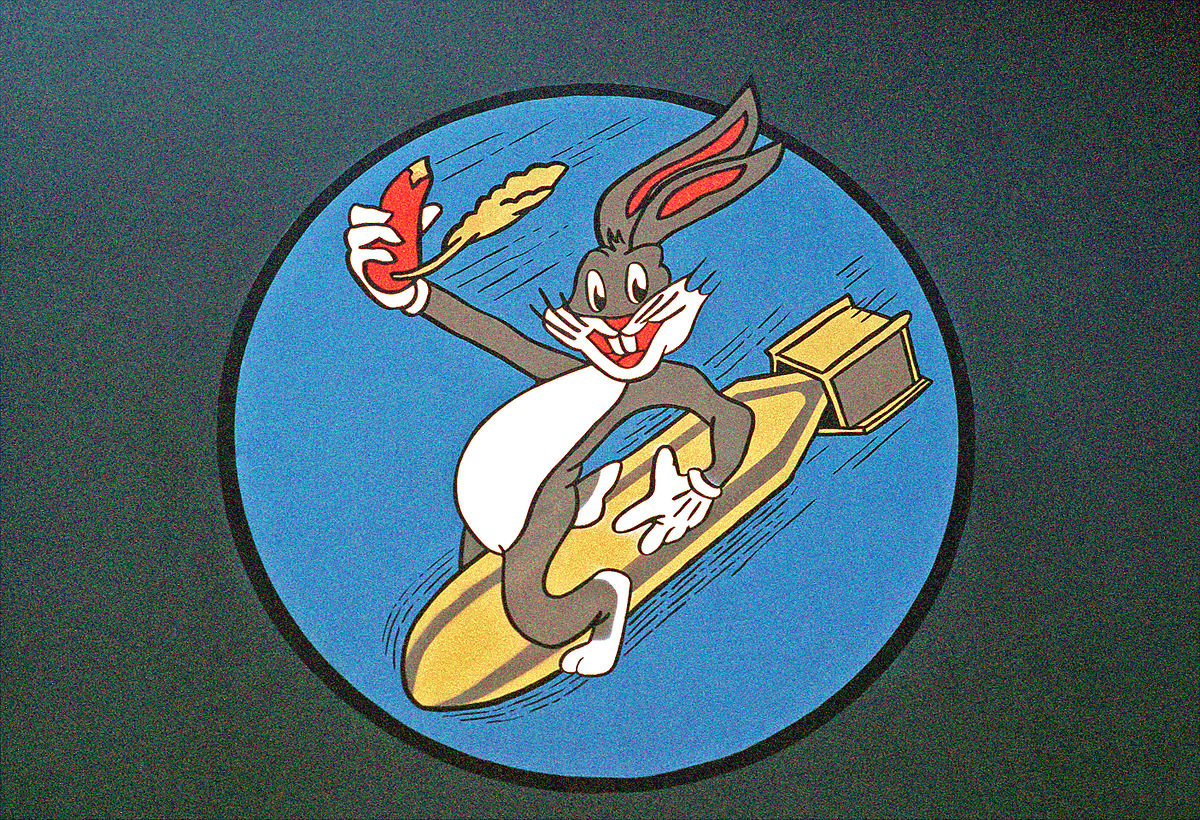
A youthful Bugs Bunny appeared as nose art on many Allied planes in World War II.
FB-111 Bugs Bunny by MSGT Jose Lopez Jr., National Archives via Wikimedia Commons
“The way I run this thing you’d think I knew something about it.” — Bugs Bunny
Bugs Bunny is 75 years old today! No puns about gray hares, just heartfelt celebration for the laughs he has given us all these years. Bugs had some very similar cartoon cousins who came before him, but the general consensus is that the Bugs we know and love made his debut in the animated film A Wild Hare, released on this day in 1940. (That is, the film was released on this day, not the rabbit.)
Bugs Bunny is, hands down, my favorite cartoon character of all time. For as long as I can remember, I have admired his casual confidence and ability to be unfazed by any situation. He’s a lovable smart aleck whose wisecracks manage to be congenial rather than combative. His irrepressible personality must appeal to a lot of other people, too, because he’s the 9th most portrayed film personality in the world, according to Warner Brothers.
He’s even a veteran of World War II, having been named an honorary Master Sergeant in the Marine Corps, and the official mascot of Kingman Army Air Field in Arizona, where Clark Gable and Charles Bronson were among the trainees. Bugs showed up as a mascot for a number of other military squadrons, decorating the noses of aircraft. Though his personality is relaxed, good-natured and mostly passive, his ability to outwit Elmer Fudd (or anyone else who had it in for him) sends a clear message: don’t mess with me, or your aggression will backfire.
Bugs moves through his world with a detached curiosity, inquisitive without ever being drawn in by any attempts to sabotage him. But he doesn’t take himself too seriously, and when he’s wryly amused at the foolishness of others, he cuts his eyes towards us with a conspiratorial expression that tells us he knows we are in on the joke.
Bugs is still going strong at 75, which should be an encouragement to those of us who are getting closer to that milestone. He is an amusing illustration of the truth behind the old saying that those who laugh, last.
This post was first published seven years ago today. The original post, comments and photo are linked, along with two other related posts, below. These links to related posts, and their thumbnail photos, do not appear in the blog feed; they are only visible when viewing the individual posts by clicking on each one. I have no idea why, nor do I know how they choose the related posts. That’s just the way WordPress does things.
Not actually alone

On a day trip into the city, I enjoyed strolling through another world entirely.
Pacific Heights, San Francisco, January 2004
“There are only two things I like to do alone: reading and traveling, and for the same reason. When you travel, and when you read, you are not actually alone, but rather surrounded by other worlds entirely, the footsteps and phrases of whole other lives keeping you company as you go.” — Shauna Niequist
There’s nothing to compare with sharing the beauty and excitement of travel with friends and family, but even so, I completely agree with what Niequist says here. I also enjoy traveling alone, and reading alone, and for the same reason.
Oddly, there’s a sense in which, traveling solo, I connect with new people more (because I notice them more) and I end up having some interesting conversations with strangers. When I travel with friends and family, I am in a sort of cocoon of the familiar and safe. On my own, my senses are more alert, more finely tuned, less distracted, and I enter those “whole other worlds” more completely.
Reading is, of course, the ultimate solo escape; one doesn’t have to worry about timetables or personal safety or finances or finding a decent place to have lunch. If I had to choose one or the other, reading would win out over actual physical travel every time. But traveling, whether near or far, can open the mind to awareness of the wider world in a way that reading cannot do as completely. No matter how vividly we re-create sights and sounds and smells in our imagination, it’s not quite the same as actually being there
Sometime this year, I hope you will make time for a solo getaway, even for just an hour or two. If you’re timid about traveling alone, choose a place closer to home that seems safer, but try to choose something a bit unfamiliar. Museums, parks, even riding the public transportation to a different destination can be a fun adventure. Take along a few things that will make your day easier or more complete — a camera, a water bottle, sunscreen or some energy snacks — but try to travel light, to enjoy the sense of freedom that comes with being by yourself.
What other worlds and other lives are out there waiting to make your acquaintance?
This post was first published seven years ago today. The original post, comments and photo are linked, along with two other related posts, below. These links to related posts, and their thumbnail photos, do not appear in the blog feed; they are only visible when viewing the individual posts by clicking on each one. I have no idea why, nor do I know how they choose the related posts. That’s just the way WordPress does things.
Time to relax

Have a seat and relax! I’m bringing some virtual refreshments.
San Juan Capistrano, California, July 2003
“The time to relax is when you don’t have time for it.” — Sydney J. Harris
I’m guessing today is a busy day for you. All the more reason to give yourself a quick break, or maybe even a long one. See that bench in the garden, pictured above? That’s your virtual space to sit down for a few minutes and relax. I’ll bring some imaginary iced tea or lemonade or a frozen fruit slushy.
As I write this today, I’ve been watching a team of men working in the massive undertaking of bringing down our majestic old oak, which towered well over 100 feet high until yesterday. It’s a job that is expected to take three full days, and we’re now halfway through day two. Not only is the work amazingly difficult and risky (can you imagine climbing that high to attach a crane to a tree limb before sawing it down?) but they are doing it with temperatures in the 90’s and very high humidity.
It’s thrilling to watch them, and also interesting. They can’t be in a hurry because a lot of care is needed with every step, and the work goes in stages. The huge chunks of tree that go sailing in the air over our roofs have to be set down with surgical precision by the crane operator, so as not to hit fences, roof lines, or existing landscaping.
When they started, I was a bit anxious for their safety. I kept bringing out pitchers of ice and water, and watching with held breath as one or another of them would go high into the tree branches, or stand on the ground while the crane slowly lowered a massive section of trunk.
At first I was surprised that they had such a large crew working, but then I noticed that some were busy sawing, climbing, lifting or carrying, while others were resting, wisely sitting underneath the shade of the poplar and dogwood trees surrounding the work area. I would guess that the rest time is vital to the overall process; when work is this strenuous, I don’t see how it could continue in the stifling heat without allowing for breaks.
Among the millions who work hard every day, they are probably more aware than most that working nonstop can be dangerous. Muscles, after all, cannot go endlessly without some relief.
But can the mind or the soul do it? Sometimes it seems as if we think so. Surrounded by urgency that may be real or devised, fueled by caffeine or sugar or nicotine, and kept artificially wakeful by electric lights, we might be ignoring our need for rest and relaxation. And it will be quite risky for us to keep ignoring it.
I couldn’t remember knowing anything of Sidney J. Harris until I started writing this post. As is my habit, I looked for information to link to his name. It seemed ominous to read that he died as the result of a heart attack at 69, an age that sounds increasingly young to me. I wonder whether his words about relaxation are the result of hard experience.
Let’s all resolve to remember his words, and not get so caught up in activity that we forget to take breaks. As such paradoxical truths often go, we are sometimes least likely to rest when we most need to do it. If you are thinking to yourself “That sounds lovely, but it’s just not possible right now,” try extra-hard to carve out some time, even 5 minutes. The virtual lemonade will be ice cold and waiting for you!
This post was first published seven years ago today. The original post, comments and photo are linked, along with two other related posts, below. These links to related posts, and their thumbnail photos, do not appear in the blog feed; they are only visible when viewing the individual posts by clicking on each one. I have no idea why, nor do I know how they choose the related posts. That’s just the way WordPress does things.
The great cure

She must be thinking “Hmmm, I feel better already!”
Liebesglück (“The Diary Entry”) by August Müller (1836–1885)
public domain via Wikimedia Commons
“Whenever you are fed up with life, start writing: ink is the great cure for all human ills, as I have found out long ago.” — C. S. Lewis
It seems that a great many people don’t like to write, and I find that amazing. Whether I’m writing a letter, an email, a blog post or a grocery list, there is nothing that comes more easily to me (as my patient readers have discovered). That doesn’t mean I’m a good writer; plenty of people who are exceptionally good writers, including my husband and older son, don’t write nearly as much or as often as I do — though I wish they did. And plenty of us who write reams will never be numbered among the gifted, or even the widely published. It’s still a wonderful exercise for the mind, heart and soul.
I agree with Lewis that writing is therapeutic. It benefits the writer, and in some cases, it also benefits those who read the writing. In fact, it can even benefit those who never read it. I have often written poems, stories and letters that I never intended anyone to read. In doing so, I have unburdened myself without unduly burdening others. Thus my unread writings may have benefited those who know me, whether they realize it or not. I’m sure many others could say the same.
But sometimes we have the great good fortune of encountering an author who loves to write, and is very good at doing it. Such writers somehow convey their joy in the writing process without ever mentioning it. Their fluid pace or razor-sharp descriptions imply years of close acquaintance with pen and ink. The act of writing surely served a helpful or joyful end in their own lives, but its greatest contribution by far lies in the untold numbers of people who are led to ponder, rejoice, laugh or cry at the bits of life that have been translated into words through ink coupled with imagination.
If you’re feeling fed up, remember the wise words of my favorite author. Ink (even the electronic version of it) is a great cure. Spend a few minutes confiding your thoughts to a paper or screen. Promise yourself that you can burn, erase or delete anything you don’t want anyone else to see. Then start. You might be surprised how much it will help.
This post was first published seven years ago today. The original post, comments and photo are linked, along with two other related posts, below. These links to related posts, and their thumbnail photos, do not appear in the blog feed; they are only visible when viewing the individual posts by clicking on each one. I have no idea why, nor do I know how they choose the related posts. That’s just the way WordPress does things.
Don’t lose sight
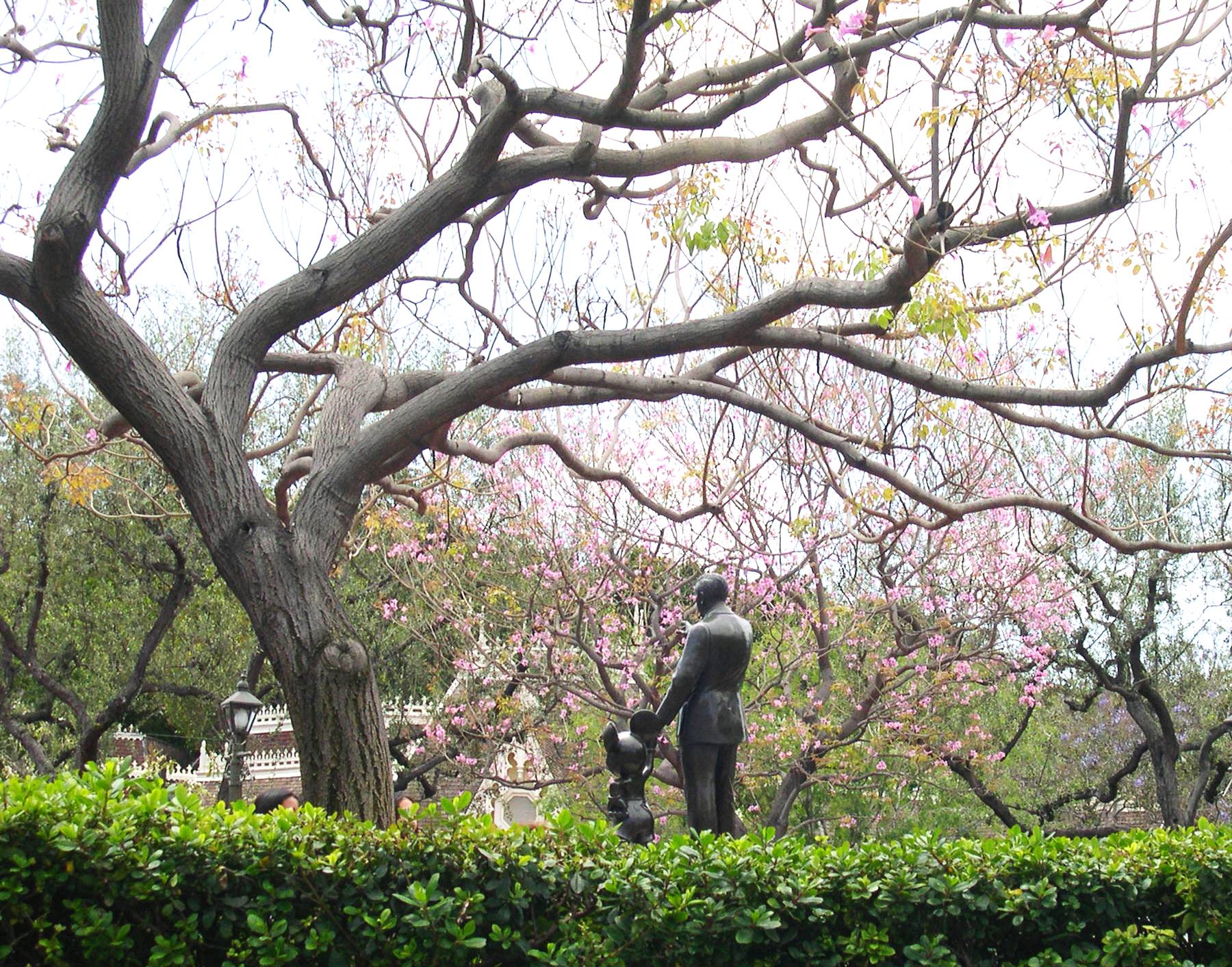
A statue of Walt Disney and Mickey Mouse stands in the park they built together.
Disneyland, California, April 2003
“I only hope that we don’t lose sight of one thing — that it was all started by a mouse.”
— Walt Disney
Walt Disney’s success is legendary, and the tough road he took to get there is well documented. He died in 1966, soon after his 65th birthday, an age that sounds far too young to me now. I had recently had my tenth birthday when he died, and I remember feeling sad when I heard of his passing. Though at that time I had never been inside a Disney park, or seen more than one or two of his movies, I can remember thinking that he had changed history as surely as any politician or statesman.
Our family has always been fond of Disney, and we have spent many happy hours enjoying the parks and movies that bear his name, so it’s not surprising that we find him inspirational. But surely even the most anti-Disney curmudgeon out there would have to admit that it’s rather amazing that such a huge empire came from a little cartoon mouse.
Mickey had an early name change (he started out as Mortimer Mouse) and several cosmetic alterations over the years. His first feature film, Steamboat Willie, was rejected by nearly every film executive in the industry, leaving Disney deeply in debt until he found success by allowing just one theater to run it at a very low price. Mickey was a smash hit, and the world — especially the world of children — would never be the same.
Big things almost always start small, which can be good news or bad news, depending on which direction things go in the beginning. Are there any small things in your life that later became great assets, or more unhappily, tremendous liabilities? Are the small steps you take each day leading you in the right direction?
If it seems that you are not accomplishing as much as you wish, remember the plucky little cartoon mouse with the dubious beginnings, and channel his cheerful, never-give-up attitude. It’s doubtful that you will ever build the kind of game-changing industry that Disney did. But I’m sure he would be the first to agree: if you set your sights high and refuse to let discouragement get you down, you CAN live happily ever after.
This post was first published seven years ago today. The original post, comments and photo are linked, along with two other related posts, below. These links to related posts, and their thumbnail photos, do not appear in the blog feed; they are only visible when viewing the individual posts by clicking on each one. I have no idea why, nor do I know how they choose the related posts. That’s just the way WordPress does things.
Come as children

Outside is Grady’s favorite place to be!
On the trail back from my Mama and Daddy’s garden, Fayetteville, Georgia, May 2015
O men, grown sick with toil and care,
Leave for awhile the crowded mart;
O women, sinking with despair,
Weary of limb and faint of heart,
Forget your years to-day and come
As children back to childhood’s house. — Phoebe Cary
Today I invite you to set aside a few moments for remembering what it was like to be a child. Are you able to step back in your imagination and experience it through a lens unclouded by the years that have passed since? If you can manage it, you might find yourself moving back to the present with a slightly different focus.
It’s a mistake, of course, to see childhood through overly sentimental eyes; if we think of it as a time that was easy or consistently happy, we aren’t remembering accurately. Childhood is difficult in many ways, and it’s much harder for some than for others. But the powerlessness we experience as children, the nagging insecurities borne of knowing how much lies just outside our understanding and ability, is balanced by the sheer wonder at things we haven’t yet grown accustomed to seeing.
Grady’s parents tell us that one of his first spoken requests consisted of a single, insistent word: “Outside!” He loves being outdoors, and notices things we adults stroll past, with our eyes focused high above his head. We are looking farther out, into the direction in which we are headed, and don’t usually notice what’s right at our feet.
Like most children, Grady isn’t in that sort of a hurry. Recently at my parents’ home in Georgia, Drew asked him if he wanted to go down to the garden and help compost some yard waste. I don’t need to tell you his answer. In fact, it was much easier to get him down there than it was to talk him into coming back. He wasn’t eager for “outside” to be over.
If he was moving slowly to begin with, he stopped in his tracks when he heard the neighbors’ goats bleating in the distance. He was entranced, and wanted to see them. “Goats!” he cried, and it was not a statement, it was a request. Drew told him that we couldn’t see the goats because they were in their shed at the moment. Grady kept crying for the goats, and Drew kept patiently explaining. I’m not sure Grady understood what a shed was, let alone that the goats were confined in it, but he did seem to conclude that we were not refusing him anything that was in our power to grant him. With a last sniffle, he changed tracks. “Bunnies?” he asked hopefully.

Grady was not happy when he couldn’t see the goats.
Children grow accustomed to having little say over many areas of life, and Grady is no exception. He’s quite good at moving on from disappointment. Once he started back down the trail to Granny’s home, he found other things to capture his interest, and the whining ceased. Clearly, he understood that crying over deferred requests was a waste of time; there were too many other things to enjoy.
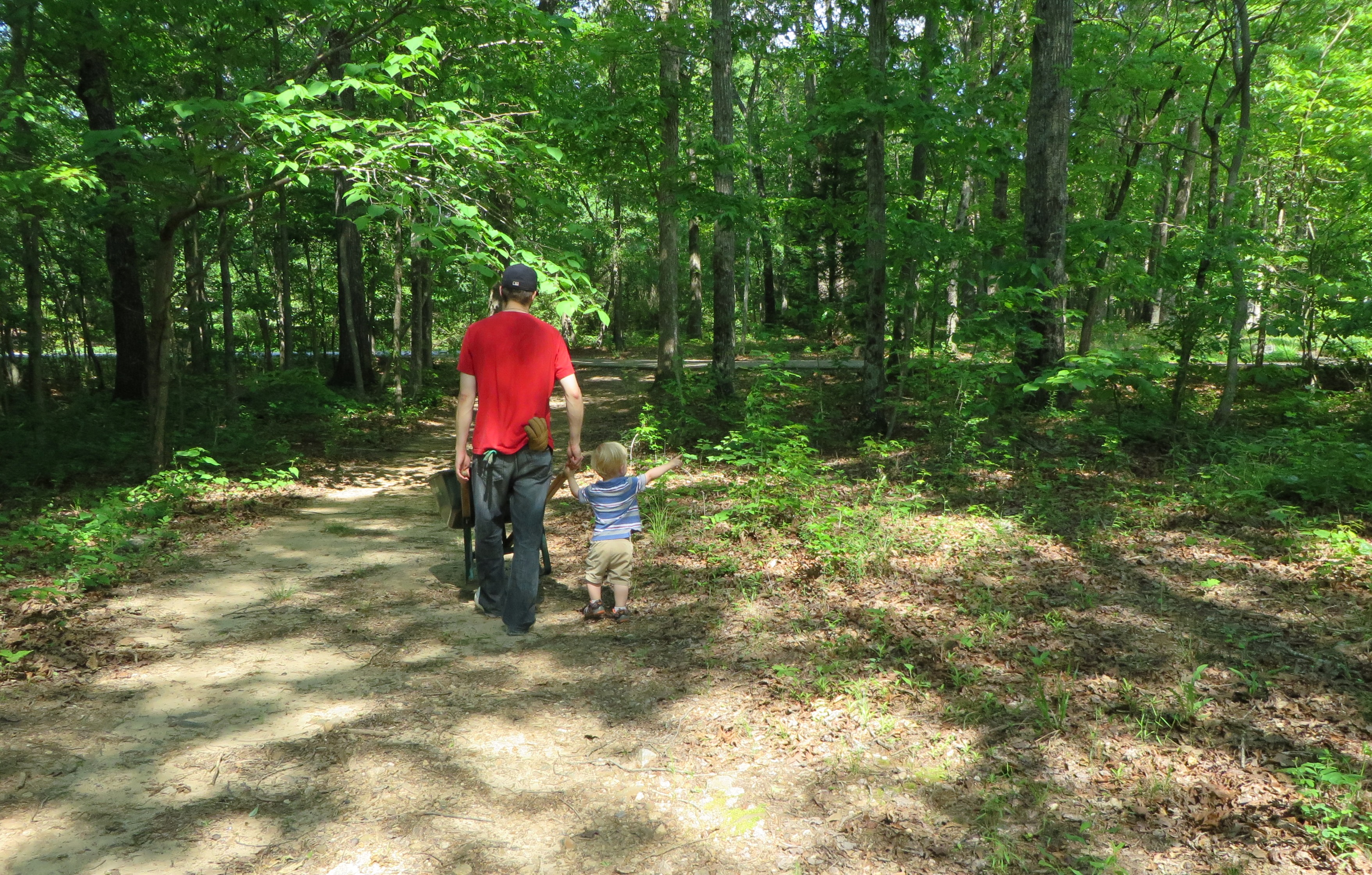
He soon forgot his disappointment — too many other things to see!
Whenever I find myself daydreaming about childhood, I come back to the present refreshed, happy to be an adult with a considerable amount of discretion over my circumstances, as well as power over my own attitude about them. But I do bring with me the awareness of what it was like to believe ardently, to trust completely, to explore joyfully. I remember again that dandelions and clover blossoms are pretty, no matter what grown-ups say, and seeing a bunny or squirrel lightens my heart, even if they are munching on my carefully tended plants.
In most ways I believe the years have been a friend to me, but along the way I definitely accumulated more baggage than I intended to bring into old age. You are welcome to join me in temporarily setting excess baggage down and forgetting the years for a short time. Put on your play clothes and tennis shoes — or just go barefoot. I’ll race you to the garden!
This post was first published seven years ago today. The original post, comments and photo are linked, along with two other related posts, below. These links to related posts, and their thumbnail photos, do not appear in the blog feed; they are only visible when viewing the individual posts by clicking on each one. I have no idea why, nor do I know how they choose the related posts. That’s just the way WordPress does things.
Created for the transcendent

Jeff enjoying the beauty of Lancaster County, Pennsylvania, June 2015
“We were made to enjoy music, to enjoy beautiful sunsets, to enjoy looking at the billows of the sea and to be thrilled with a rose that is bedecked with dew…Human beings are actually created for the transcendent, for the sublime, for the beautiful, for the truthful…and all of us are given the task of trying to make this world a little more hospitable to these beautiful things.” ― Desmond Tutu
The more I understand the great truth of Bishop Tutu’s statement, the more I understand and like other people. One thing I’ve loved most about blogging is the way it has opened my eyes to how many people in the world share common joys and observations about the blessings that surround us in this world, however dismal the news may be. When we look at beautiful things together and share our appreciation, it connects us to each other.
I encourage you to spread happiness by sharing your joy with others. It doesn’t have to be in a blog or book or song or painting; it can be a casual remark to a cashier or mail carrier or person waiting with you at the bus stop. Most of us love to hear someone else making a cheerful remark about the weather or the colorful flowers or anything else worthy of praise, even (and maybe especially) when we are feeling down ourselves.
What are some ways we can make this world a bit more hospitable to these beautiful things?
This post was first published seven years ago today. The original post, comments and photo are linked, along with two other related posts, below. These links to related posts, and their thumbnail photos, do not appear in the blog feed; they are only visible when viewing the individual posts by clicking on each one. I have no idea why, nor do I know how they choose the related posts. That’s just the way WordPress does things.
The experience of a great people

The flags were flying proudly in Lancaster County, Pennsylvania, June 2015
“The flag of the United States has not been created by rhetorical sentences in declarations of independence and in bills of rights. It has been created by the experience of a great people, and nothing is written upon it that has not been written by their life. It is the embodiment, not of a sentiment, but of a history.”
— Woodrow Wilson
As the number of stars on the U. S. flag increased over the years, so have our population, our industry and our government. While not all of the changes and phases have been good or happy ones, few citizens of this country would wish to go back to former times. Nostalgic fondness for childhood notwithstanding, most of us have an easier life than our parents or grandparents could have imagined.
With our nation’s birthday celebration approaching, I’m mindful that today we are at the midpoint of a much more somber anniversary, that of the three-day Battle of Gettysburg fought on July 1-3, 1863. Wilson’s words about the flag having been created by the experience of a great people are true of the painful crucibles of our freedom, as well as the joyous moments of glory and unity.
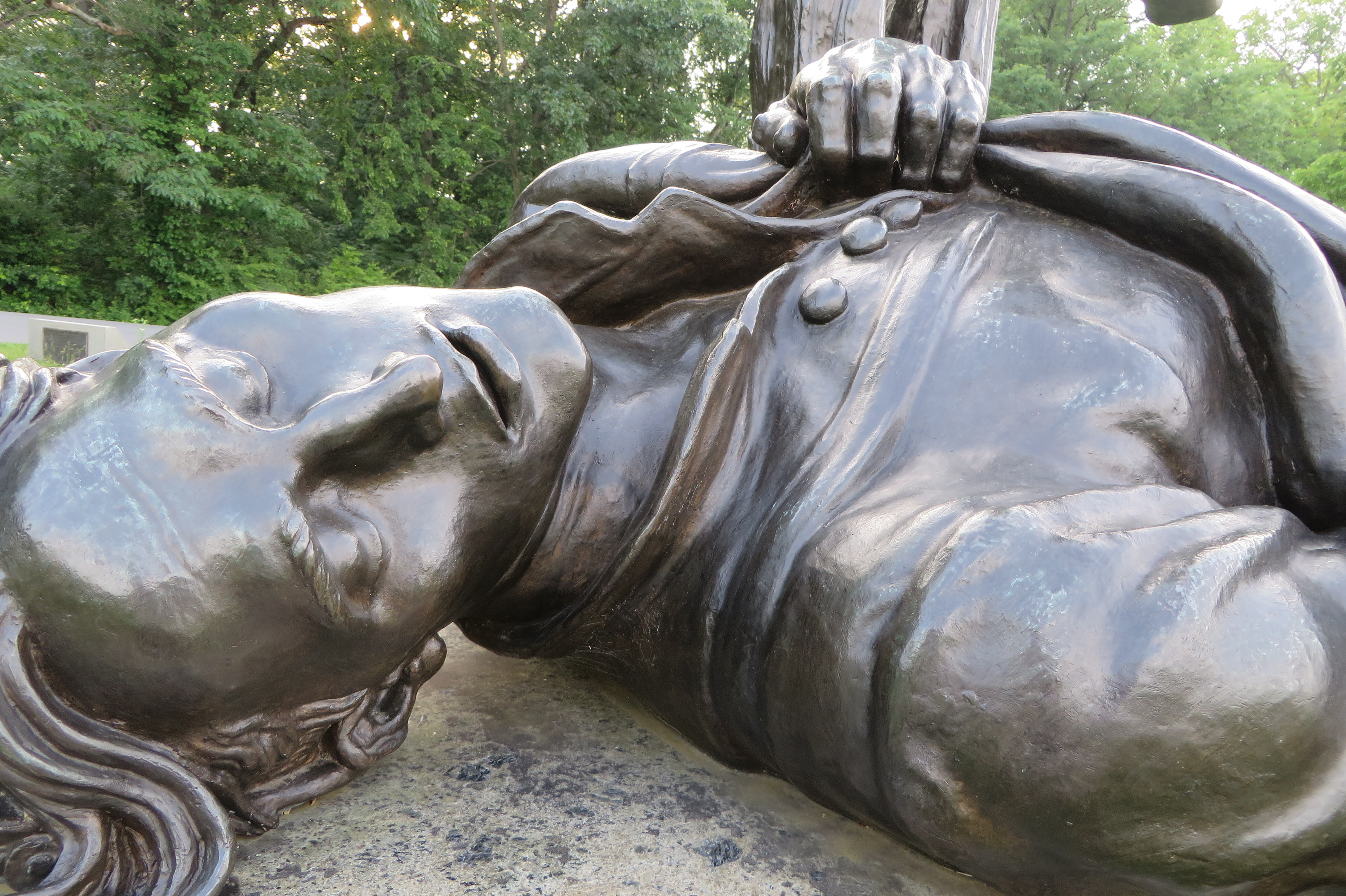
Detail of a monument to a fallen soldier at Gettysburg
There’s a pall of sadness that lingers over the fields of Gettysburg, where so many American lives were spent in the taking of other American lives. In the polarized climate of political argument that dominates so much of the media, it’s easy to wonder whether we could ever be brought to such a state of affairs again.
I hope not, and I trust not. Our flag has survived trial after trial, none more devastating than the Civil War that threatened to destroy our national unity. Such hard-earned lessons are not easily forgotten by those who take the time to examine them. While we celebrate the 4th with picnics, ball games and other fun events, let’s take a few minutes to reflect on the sacrifices of previous generations who gave us the freedom to live unencumbered by the burdens they bore.
Happy Birthday, USA!
This post was first published seven years ago today. The original post, comments and photo are linked, along with two other related posts, below. These links to related posts, and their thumbnail photos, do not appear in the blog feed; they are only visible when viewing the individual posts by clicking on each one. I have no idea why, nor do I know how they choose the related posts. That’s just the way WordPress does things.
Hopeful signs

Tracy Caldwell Dyson is looking in your direction, and so am I!
Self-portrait by Dyson, Expedition 24 flight engineer, International Space Station,
September 2010. NASA photo via Wikimedia Commons.
“I’m looking for some hopeful signs — and something keeps telling me to look in your direction.” — Ashleigh Brilliant
Today is my 800th published post, not counting the special posts linked above. That number becomes more amazing to me the more I think about it. Not only have I been writing that much, but many of you have been reading that much!
This blog contains enough of my words to constitute several full length novels, which is proof that writing a little bit every day can eventually make you an author. Or not. But at least it’s a substantial amount of practice. And those of you who have read most of my posts have now read the equivalent of several full length books, in terms of quantity (no claims about quality implied). At the very least, you have earned my respect for your stamina.
If each of these blog posts had been an annual Christmas newsletter, I would have been sending them out every year since 1215, when noteworthy happenings to report would have included King John signing the Magna Carta, Genghis Khan and the Mongols capturing Beijing, and the birth of Kublai Khan, an event that would have resounding consequences for American high school English students centuries later.
All that to say, I am deeply honored to realize that you have been willing to join me here read my rambling thoughts, and to exchange ideas, observations, jokes, joys and sorrows. For those of you who have been with me steadfastly for over two years, I now have had more contact with you, more frequently, than with almost anyone else I know. Considering that there are some of you whom I’ve still not met face to face, I think that’s a special kind of wonderful.
I got a letter yesterday from my British pen pal, Sue, and we had shared our amazement at having been writing to each other for 25 years now. We have met face-to-face only once, in 2001. Yet our friendship has outlasted many relationships that were largely based on geographic proximity.
Maybe this says something about the power of the written word. Or maybe it means I’m easier to take in writing than in person. Either way, I’m humbled by the many ties I’ve formed through this blog. On a continual basis, I see and hear things that remind me of you. And I have learned so much from you!
I smile so often to think of Sheila (and Bill and Walter and Jack) in their oceanfront home in South Carolina. I think of Merry in Oklahoma and Susan in New Hampshire and Carolyn in Tennessee and Michael in Washington and Mary Ann in California and Bob in Oregon and Cherie in Florida, and I’m literally all over the USA map without taking a step outside my door.
When we visited Lancaster County recently, I thought of Judy when I saw the exquisite crafts, and of Raynard when we went to the Shady Maple. (We weren’t hungry enough for the Smorgasbord, Raynard, but we did enjoy shopping and snacking — and plan to go back one day with bigger appetites! It really is amazing.) We had never been to that part of Pennsylvania, but it felt more familiar than it would have felt even three years ago.
Thanks to Sheila, I know what a Sun Conure is– in fact, I count one among my animal friends now (hello, Walter! 😀 ). Thanks to Boomdee, I know that Canadian rabbits change colors with the seasons. Thanks to Eric, I know those rabbits are called Snowshoe Hares. Thanks to Alys, Michael and others, I know a lot more about the flowers and shrubs I love so much. Sometimes I’ll catch myself saying “I wonder why this plant isn’t blooming? I need to ask Alys” or “What kind of flower is that? Maybe Michael would know…”
I shouldn’t have started naming names, because now so many of you are coming to mind that there’s no way I can write about all of you. When I hear news from around the world, there are so many I’ve met via this blog whose faces come to mind, bringing to life countries where I’ve never had the privilege of traveling. When I pray, I remember the struggles and trials you have shared with me, and ask for blessings in your lives.
Each of you, with your comments or your cheerful Gravatars left at the bottom of my posts, have been part of this online world that has been a source of comfort and joy since the earliest days of Defeat Despair, when our family was coming to terms with lives that had abruptly and unexpectedly and irrevocably changed. Though I don’t post daily now, I still feel connected to all of you every day, and count my associations with you, whether brief or extensive, among the blessings of my life.
I hope you can keep looking here for encouragement. And when I’m in need of reminders of goodness, I know I can look in your direction. As I’ve said so many times– thanks for being here!
This post was first published seven years ago today. Since that time, the British pen pal I mentioned, Sue, came to spend two wonderful weeks with me in late 2019, just before Covid hit the world. In that seven years I also met several of my readers in person. Susan has been to visit me several times. On one visit she went with Matt and me to celebrate Raynard’s birthday, with his wife Mary and dozens of his friends and family at the Shady Maple, a memory I now treasure. Another memory close to my heart is my visit to Judy and Stew and their sweet doggie in Pennsylvania. And those are just a few examples of the gifts this blog has given me.
The original post, comments and photo are linked, along with two other related posts, below. These links to related posts, and their thumbnail photos, do not appear in the blog feed; they are only visible when viewing the individual posts by clicking on each one. I have no idea why, nor do I know how they choose the related posts. That’s just the way WordPress does things.
For a moment

This sweet bird has been keeping me company this month. Alexandria, June 2015
“I once had a sparrow alight upon my shoulder for a moment, while I was hoeing in a village garden, and I felt that I was more distinguished by that circumstance that I should have been by any epaulet I could have worn.” — Henry David Thoreau
Not long ago Jeff called me to the front door to show me a robin’s nest in the cherry blossom branch that extends over our front walkway. It was fairly low, only a few feet from where we pass back and forth underneath many times each day, but the bird nesting there seems unafraid of us or our activity. I suppose suburban birds grow accustomed to human traffic.
I’ve been watching this nest for several days now. It’s set where I can’t get a good photo of it, because the sunlight is always coming into the lens and putting the rest of the picture in the shade, and my little semi-automatic camera doesn’t have the range to compensate for it very well. That’s okay, though, because the important thing is to enjoy seeing the nest with my eyes, while it’s still an active home. I’ve learned from our York “bird condo” (which is what I call the privet hedge where the robins and cardinals like to nest) that these little ones go from egg to hatchling to fledgling surprisingly quickly.
I’ve seen the mama bird (and maybe the papa bird too) standing on the edge of this nest feeding worms to the babies, so I know they have hatched. Since I can’t see inside the nest, I watch daily to see if it’s still attended, just so I’ll know if the babies are still there. I like having the birds making their home so close to ours. It feels friendly and, as Thoreau expressed, it’s also a bit flattering in some strange way.
If it wasn’t for Jeff, I probably would never have noticed the nest at all. Jeff has a sort of radar for the natural world, spotting deer and birds and other critters with an eagle’s eye, though he has a more benevolent interest in them than the raptors do. It’s nice to live with someone who can point such things out to me, because I am always excited to see them, even though I’m not good at noticing on my own.
How about you? Do you have an eye for the natural world? If not, are you lucky enough to have someone around who can act as a scout for you? If you have this type of radar for nature, do you share your observations with others? Some of us are better at seeing than others, but I think most of us do care for animals (and people) when we slow down enough to notice — or when someone else points the way for us.
And sometimes, as with Thoreau, we have the happy experience of having a creature notice us first, and seemingly ask outright for our attention. Such encounters are doubly delightful, and I wish you many of them, along with the eyes and heart to enjoy them.

Update one week later: the babies are growing! Their eyes and beaks are open.
Soon they will leave the nest. Alexandria, June 2015

Second update: the light was good the morning this post published (Thursday),
and I was thrilled to get this wonderful photo of the parent with hungry babies!

Third update, 8:35 am: WHOA! This one started fluffing feathers,
and before I knew it, it was standing up, almost ready to fly away!
I told you they grow up quickly! It sat back down when the worms arrived, though.
And speaking of robins…look what Alys gave me! Enjoy their lovely song here:
This post was first published seven years ago today. The original post, comments and photo are linked, along with two other related posts, below. These links to related posts, and their thumbnail photos, do not appear in the blog feed; they are only visible when viewing the individual posts by clicking on each one. I have no idea why, nor do I know how they choose the related posts. That’s just the way WordPress does things.
Foundations of ease
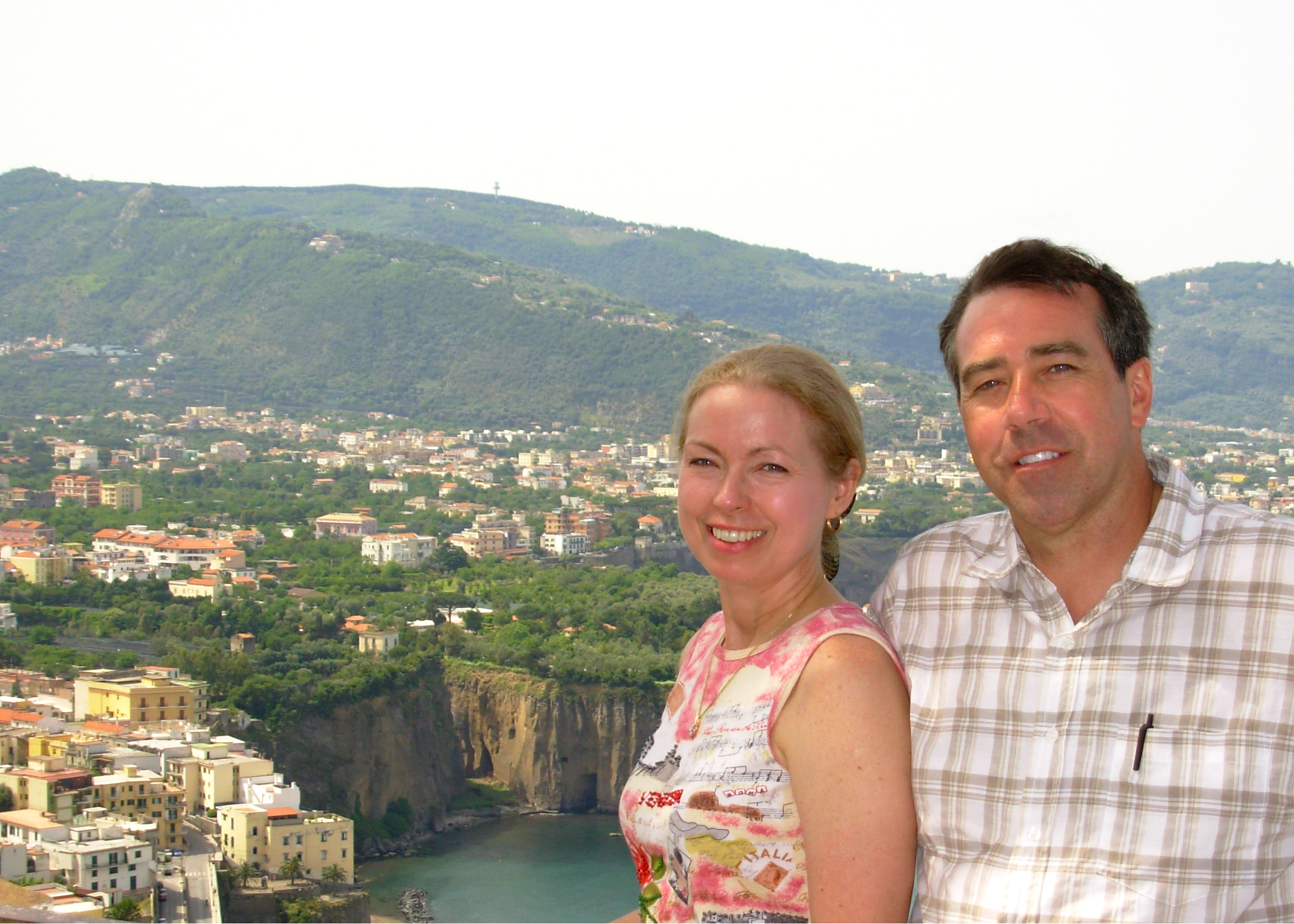
After decades of wishing, our Mediterranean cruise was the vacation of a lifetime.
Jeff and I enjoy the Amalfi Coast of Italy, May 2008.
“Burdens are the foundations of ease and bitter things the forerunners of pleasure.” — Jalāl ad-Dīn Rumi
I had to really think about this one for a few minutes; I wasn’t sure whether it was truth or wishful thinking. Then I remembered the joke about the man who, when asked why he hit himself repeated on the head with a hammer, replied “Because it feels so good when I stop.”
Nobody I know really wishes for burdens or bitter things. Yet some people seem more ready than others to take them on, especially if it means in doing so, they are helping someone else. We tend to label such people as “saints” or otherwise distance ourselves from the expectation that we should measure up to a bar that has been set so high. But no matter how much we try to avoid it, we all end up with cares of our own to endure.
And really, all joking aside, we would not know the meaning of ease if that was all we had ever experienced. Jeff and I are grateful for the relative poverty of the early years of our marriage, when we literally could not afford to eat out even at McDonald’s. Not only did we learn how to enjoy life without spending large sums of money; we also knew how to appreciate the comparative ease that would be ours in the decades to come. When Jeff first finished dental school and got into the Air Force, what some would have viewed as a bare minimum of income felt like wealth to us, and we’ve felt wealthy ever since.
In the same way, the challenges we have faced as parents of a son with significant disabilities have created a unique appreciation for those rare moments we are able to get away together, just the two of us. We don’t have to do anything special at such times for it to feel like a vacation.
I’m sure you have experienced similar levels of gratitude for things that others have always taken for granted. A student who has labored for years toward a degree will someday know just how amazing it is to have evenings and weekends free for hobbies and relaxation. A patient who has suffered through a broken leg or back surgery will have a sharpened understanding of the joy of pain-free movement. A couple who endured the challenges of infertility treatments must have a heightened sense of excitement over a pregnancy or adoption.
Today, think of your own personal burdens and bitter things. In what ways might they be the forerunners of pleasure?
This post was first published seven years ago today. The original post, comments and photo are linked, along with two other related posts, below. These links to related posts, and their thumbnail photos, do not appear in the blog feed; they are only visible when viewing the individual posts by clicking on each one. I have no idea why, nor do I know how they choose the related posts. That’s just the way WordPress does things.


 Defeat Despair