A light from within

Detail of a stained glass window in Cologne Cathedral, Germany, April 2007
“People are like stained-glass windows. They sparkle and shine when the sun is out, but when the darkness sets in, their true beauty is revealed only if there is a light from within.” — Elisabeth Kübler-Ross
I love stained glass, from tiny sun-catchers hanging in kitchen windows, to magnificent soaring panels in cathedrals. Whenever I see these works of art I have the impulse to capture their colors in photos. If time allows, I like to study the intricate details and imagine the stories they tell. But even the briefest glance is stunning when the light is shining through.
Kübler-Ross makes an interesting analogy to the inner beauty that doesn’t become evident until revealed by extraordinary circumstances. Almost anyone can be fun, appealing and attractive when all is sunny and bright. But when things go wrong, there are some people who continue to shine despite the gloom.
Such people are champions of fighting despair, refusing to let outside darkness extinguish the hope and joy they carry inside. When we feel overwhelmed by sadness or defeated by adversity, we need the radiant examples of those who stand with us in times of trial, reminding us that even in the darkness, the light of faith, hope and love cannot be overpowered.
I hope you have many such people in your life, and I trust that you can and will be a source of light for others.
Achieved, not bestowed

The FDR Memorial in Washington D.C. includes statues of his wife Eleanor and his dog Fala.
December 2004 (Click on Fala to read more about him!)
“In the truest sense, freedom cannot be bestowed; it must be achieved.”
—Franklin D. Roosevelt
We often speak of freedom being granted, as if it is something given. While it’s appropriate to view our freedom as a gift, it is also a quality that has to come from within. We can become the willing slaves of fashion, wealth, popularity or any other craving or addiction. Or we can allow fear, ignorance and indifference to confine our minds and spirits. If we confuse freedom with reckless disregard for rules, we’re missing the point and merely swapping one master for another that is potentially more menacing.
On this weekend when we celebrate freedom in America, I wish you a day that is free from all that is detrimental to you, body and soul. Let’s resolve to make the most of our freedom to learn, grow, and help one another be the best we can be.
The torch of freedom

A statue of John Paul Jones stands in West Potomac Park, Washington D.C., April 2005
“The stature of our homeland is no more than the measure of ourselves. Our job is to keep her free. Our will is to keep the torch of freedom burning for all. To this solemn purpose we call on the young, the brave, the strong, and the free.” — John Paul Jones
Many of us associate John Paul Jones with his legendary words “Surrender? I have not yet begun to fight!” While there is some debate as to whether these were his exact words, no historian questions the desperate circumstances under which he refused to give up. Those brave and defiant words are engraved on the monument pictured above, the first memorial raised in Potomac Park, Washington D.C., in honor of the first American naval hero.
More than five years of grueling war followed the adoption of the Declaration of Independence on July 4, 1776. The spirit exemplified by John Paul Jones and others enabled the colonies to press on through times of misery and despair, never losing hope in their dreams of freedom and a new form of government.
The Fourth of July is a happy time for most U. S. citizens, partly because it’s associated with picnics, fireworks and summertime fun. But it’s also a great time to remember that courage, determination and tenacity can lead underdogs to unprecedented victories.
Freedom is a fragile and demanding legacy. For all people everywhere, it demands conviction and courage to sustain freedom in the face of opposition and oppression. As the USA celebrates its 237th birthday, I wish you a weekend of reflection on the great achievements of those who stood firm through fierce adversity. May we all be inspired to do likewise!
Through all the gloom

The sun lights an American flag on display in Boston, September 2007
“I am well aware of the toil and blood and treasure that it will cost to maintain this Declaration, and support and defend these States. Yet through all the gloom I can see the rays of ravishing light and glory. I can see that the end is worth more than all the means; that posterity will triumph in that day’s transaction, even although we should rue it, which I trust in God we shall not.”
– John Adams, in a letter to Abigail Adams, July 3, 1776
On the day my country celebrates its Declaration of Independence, I could not have quoted from anyone other than the individual I consider most responsible for the adoption of that Declaration: John Adams, whose unflagging tenacity and fierce determination overcame considerable opposition from his more fearful colleagues. Though Adams would go on to become our first Vice-President and second President, his most important work likely was done before such offices existed.
If you don’t know much about Adams, I encourage you to learn more. The HBO mini-series John Adams, which I mentioned just a few days ago, is an excellent introduction to this man, as is the surprisingly accurate (in spirit if not in detail) Broadway musical 1776. As much as any individual in American history, Adams refused to be defeated by despair.
It’s easy to look back in hindsight and applaud the courage of these “founding fathers” (and mothers) who supported independence. But their mutual pledge of “our lives, our fortunes and our sacred honor” was not lightly taken. For their Declaration, they could have been hanged as traitors to the crown. I will always feel profound gratitude that the story did not end that way, though it did cost years of bloodshed and many lives.
I pray that the United States of America will remain true to the courage, love of freedom, and “firm reliance on the protection of Divine Providence” that have served us in centuries past.
Happy Birthday, USA!!!
A safety place

A wall inside my garret, July 2007
“It is strange how a man believes he can think better in a special place. I have such a place, have always had it, but I know it isn’t thinking I do there, but feeling and experiencing and remembering. It’s a safety place. Everyone must have one, although I never heard a man tell of it.” — John Steinbeck
Nine years ago when we first moved to Virginia from northern California, I was terribly homesick for the west coast, and had not yet discovered much to love about our new location. That would change within a year, but the first few months were difficult. On the plus side, I loved our home with its large, wooded (and partly overgrown) lot, detached spare garage, and abundant closets. The house contained a few lighted, floored attic spaces tucked beneath the rafters, a feature I’ve always loved in houses.
The door to one of these spaces was located inside a walk-in closet that I turned into a craft storage area. Finding that this particular attic space was large enough for a desk and chair, a bookcase, and several storage files and drawers, I decided to convert it to my own personal hideaway. I covered the walls and rafters with favorite photos, sayings and mementos, many of which were reminders of the home I missed. I filled it with old paperbacks and stationery, and put a rug on the plywood floor. (I featured another photo of my little attic nest in this post.)
That tiny garret is a place such as Steinbeck describes above. I go there to think, prowl among books and old ephemera, or just sit in the quiet and reflect on whatever it was that drove me into the space I jokingly call my “inner sanctum.” (It’s especially wonderful to go in there when I can hear the rain falling directly above me.) That small room, unfinished and without heat or air conditioning, is one of my favorite things about our York home. If we ever decide to move, I’ll be sad to leave it behind.
Do you have a favorite retreat where you go to be alone with your thoughts? Or a place you have decorated with significant trinkets, saying or photos? If so, I hope you will make some time to enjoy an uninterrupted visit there soon. If you don’t yet have such a place, I highly recommend finding one, outdoors or indoors, where you feel safe and removed from day-to-day distractions. Happy daydreaming!
Dear earth
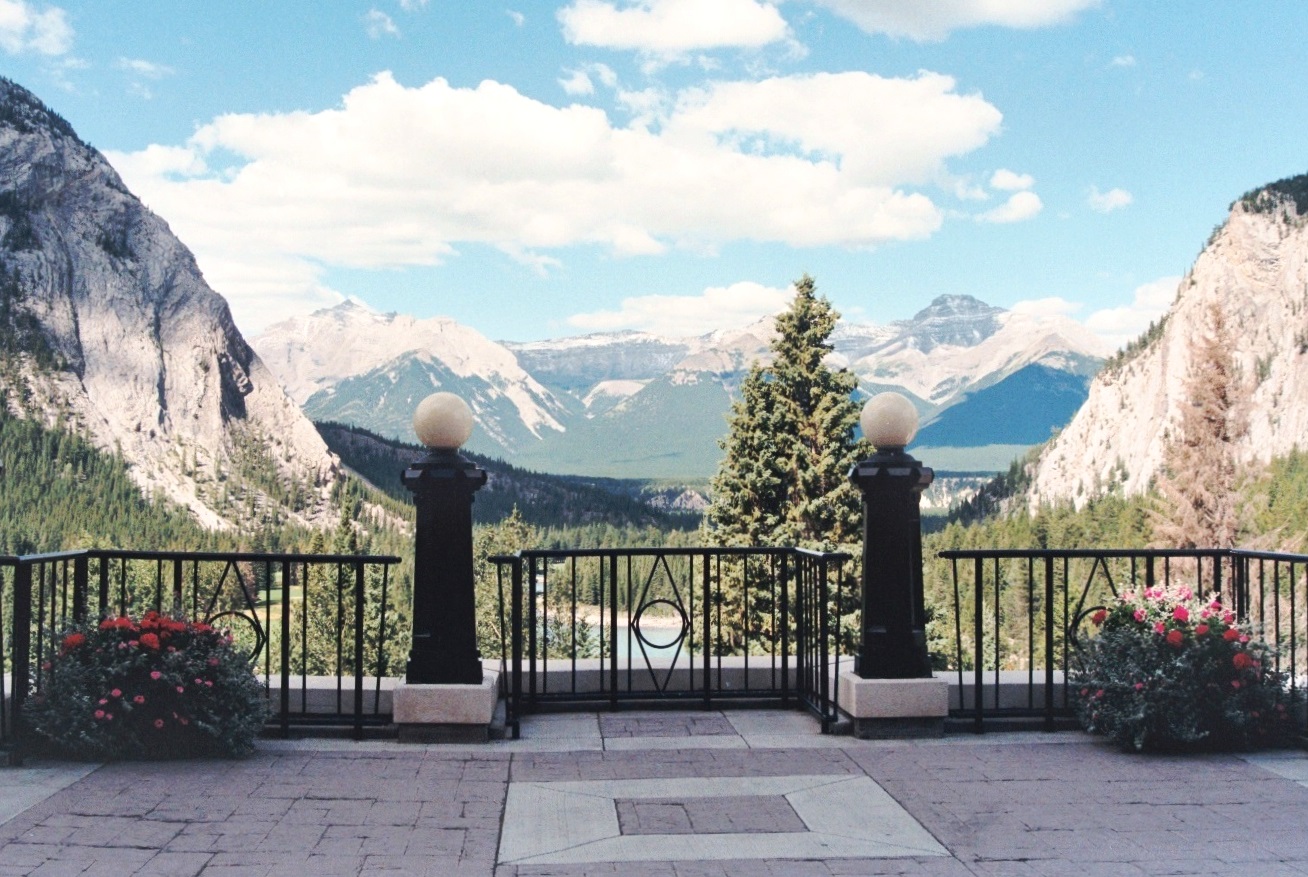
The terrace of the Banff Springs Hotel, Alberta, Canada, September 1999
“…a greater glory I may one day see, but oh today, dear earth, how I love thee.”
— Louise E. Weber, as recorded in The Notes by Ronald Reagan (page 47)
Skeptics sometimes describe those of us who believe in heaven as people for whom religion is a crutch; a desperate hope to which we cling when things go wrong. That may be true in some cases, but I believe it’s mostly a misconception among those who don’t understand or share our beliefs. While we do hold fast to our faith in hard times, we never feel closer to heaven than when we see earth at its best.
Standing among breathtakingly beautiful surroundings that could never have been crafted by human hands, I feel deeply the need to say “thank you” and equally deeply, the sense that the Creator hears me. It may sound contradictory, but there is something unearthly about the most beautiful sights and experiences we take in during our relatively short sojourn here.
When we see indescribable vistas, experience moments of love, warmth or humor, or feel elation at the first touch of spring or fall in the air, it feels perfect, yet often it’s also, somehow, incomplete. The deepest ecstasies of life carry within them tiny fragments of sorrow or at least wistfulness; we wish the moment could last longer; we wish we could share it with loved ones not present; we wish earth did not hold so much ugliness to counteract its beauty.
At such times, I think most of the believers I know will see in the incomplete perfection of earth a hint of what lies just beyond our reach as physically finite people who can conceive of, and long for, infinity. I hope you will be touched by beauty today, and if it is tinged with sadness, I hope you can reach beyond what is seen, and open your heart to the unseen.
Read history

Plaster castings at Pompeii, a haunting reminder of past disasters and difficulties. May 2008
“If you think you have it tough, read history books.” — Bill Maher
I’m no fan of Bill Maher, but he has a point about history. It’s a great way to gain some perspective. Not long ago I read Bill Bryson’s fascinating book At Home, and I realized I’d never fully appreciated such things as electricity and sewer systems. From relatively trivial blessings such as comfortable furniture, to life saving improvements such as modern medicine, we are fortunate to be living in today’s world.
A couple of years ago our son gave us the DVD set of the HBO miniseries John Adams, based on the book by David McCullough. The gruesome scenes of very early (and thus quite risky) smallpox vaccinations, or the equally sobering portrayal of the Adams’ daughter’s breast cancer surgery, done without benefit of anesthesia, offer graphic reminders that even the prominent and privileged of past centuries had a far less easy life than the average person today.
Look around you and notice how many things in your environment were not readily available to your grandparents or great-grandparents. Aside from the endless digital and electronic devices that we increasingly depend on as necessities, there are slightly older but no less essential comforts such as air conditioning, spacious kitchens, bathrooms and closets, and abundant, affordable choices in everything from clothing to housewares to groceries and fresh produce.
It’s easy to romanticize the past, but reading one of the many popular books by gifted historians such as McCullough, William Manchester or Barbara Tuchman will be an eye-opening experience that will leave you thankful for being who you are, where you are, and when you are. Besides, even the history books themselves are better now!
The mystic moon

I stood in our York driveway to photograph the “super moon” of June 2013
At midnight, in the month of June,
I stand beneath the mystic moon.
An opiate vapor, dewy, dim,
Exhales from out her golden rim…
—Edgar Allan Poe
Last Saturday, just after the summer solstice, I returned from a wonderfully cool evening walk with Pasha. Although it was nearly 9:00 pm, there was still daylight outside. Jeff told me there was to be a glorious “super moon” that night, so of course I dashed outside with my camera a couple of hours later, and took some photos just before the gorgeous light was blurred by clouds.
The moon was surrounded by a hazy halo of light larger than any I could remember seeing. It was absolutely magical, definitely a night to remember.
I hope you were able to get a glimpse of the “super moon,” but even if not, there are lovely full moons to enjoy each month, and crescent moons and multitudes of stars. Sometime while the weather is still warm and the night is clear, take a few minutes to go outside and enjoy the night lights of nature!
A garden and a library

The lower level of the public library in Camden, Maine
opens onto a beautiful waterfront garden. June 2012
“He who has a garden and a library wants for nothing.” — Marcus Tullius Cicero
Several weeks ago one of our readers sent me this quote, and I immediately thought “That would make a great post for the blog.” What makes the quote so appealing is that most people can have at least a small library and garden, or even if they cannot, can have access to public or private libraries and gardens — sometimes very grand ones.
As much as I love my own library (not a place, but a collection of books scattered throughout two different homes) and my own modest attempts at gardening, I will never tire of exploring the wonders of public libraries and gardens. I also enjoy the more modest but equally appealing libraries and gardens of like-minded friends. In such settings there is wealth enough to fill several lifetimes with exploration, discovery, and joy.
I read a translator somewhere who said that he imagined Cicero must have been referring to a garden as a gathering place where people could sit and discuss ideas. While that sounds logical, there are all kinds of reasons for gardens, just as there are all sorts of reasons why people need libraries. Wherever you find them, and whatever you find within them, I wish you an abundance of opportunities to enjoy both.
So rare

A perfect June day near Kennebunkport, Maine, 2012
And what is so rare as a day in June?
Then, if ever, come perfect days… — James Russell Lowell
June has been a blur for us this year, as perhaps it has been for you. We’ve been overwhelmed with hospitalizations, seemingly endless appointments, backlogged tasks indoors and out, and the yearly traffic snarls from summer travelers hitting the roads.
Even with the distractions, I can’t help noticing it’s a lovely time of year. Several times in the past weeks I’ve headed out for an evening walk, mentally laden with worries and stress, and felt my agitation melt away as I am bathed in the serenity of a cool summer twilight. The sun is not yet scorching enough to leave heat lingering after sunset, and the grass is thick and green. The flowers are fully blooming, not yet faded and leggy. Summer is still new enough to feel refreshing after a cold winter and wet spring.
Before the perfection of June passes into the sweltering heat of July and August, why not make some time to enjoy the longest hours of daylight we’ll have until this time next year? Although it’s easy to forget, these days are rare; enjoy them!
When there is nothing
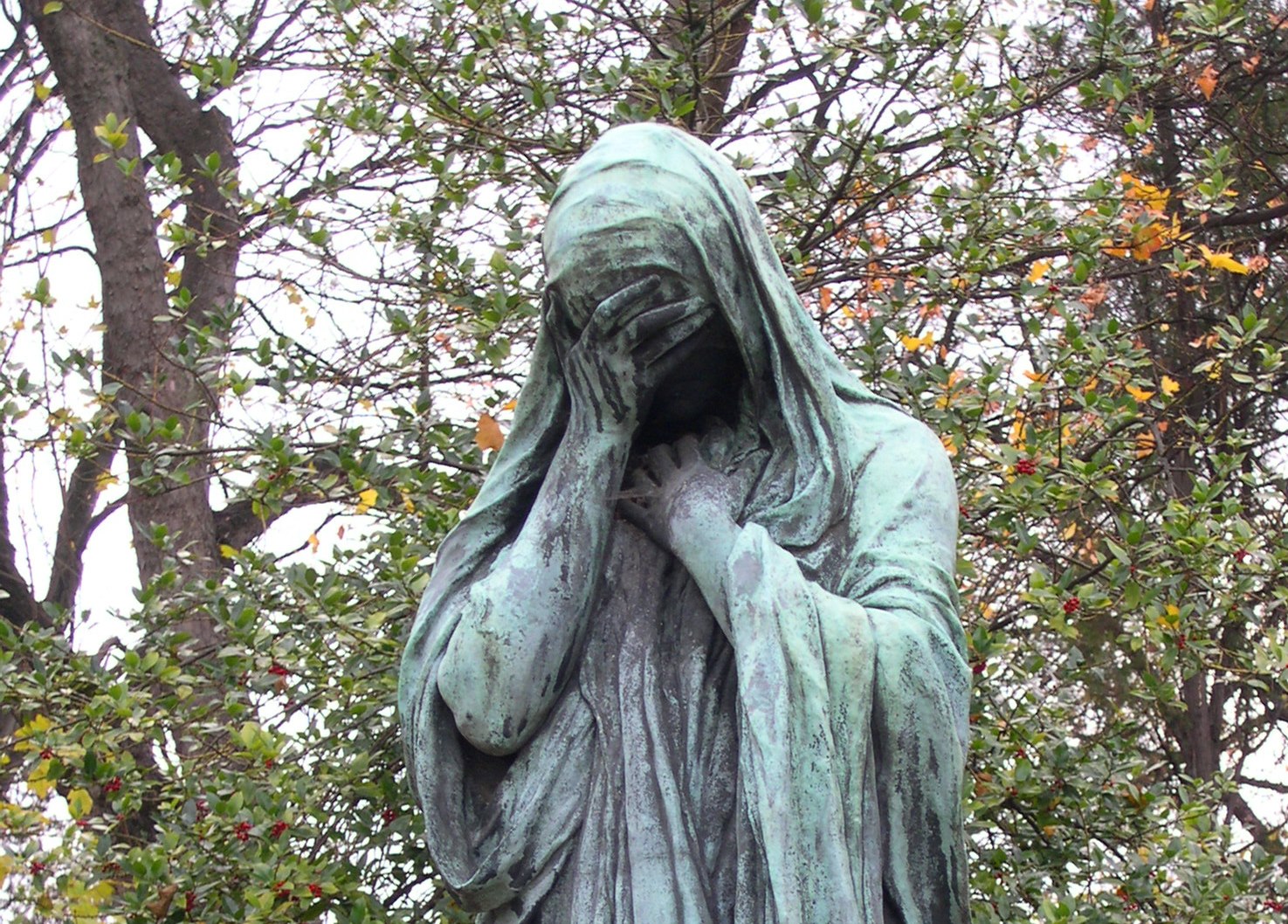
A statue in Le Cimetière du Père-Lachaise, Paris, December 2005
If you can force your heart and nerve and sinew
To serve your turn long after they are gone,
And so hold on when there is nothing in you
Except the Will which says to them: “Hold on!”
— lines from the poem “If” by Rudyard Kipling
Over 200 posts ago, on my second-ever post on this blog, I quoted a different part of the poem from which I drew the lines above. Tonight as I write this, not quite two weeks from the day it will be published, this verse has been on my mind for days.
To many people, I suppose the lines suggest a physical or even athletic contest, or the grueling exhaustion that sometimes overtakes soldiers, sailors, laborers or others who are pressed beyond normal endurance. But for some, including me, the will to hold on is most crucial when we are drowning in sorrow or overwhelmed by sadness; when we feel alone, isolated or afraid. At such times, it seems hypocritical to wear a smiley face and laugh through tears. There are times when acknowledging our broken spirits can help us to hold on when all other sources of support are absent or inadequate.
Thousands of years ago an inspired poet wrote, in lines that are still spoken and sung today,
“…there is…a time to weep and a time to laugh.” As important as it is to choose optimism and good cheer, we must not deny or obscure the burdens of grief that each of us must bear, however unevenly the weight of such sorrow may be distributed among us. One of the most beautiful and healing things a true friend can do for us is to cry with us, saying nothing profound or inspiring, simply sharing our sorrow.
If you are burdened with a heavy heart as you read this, I hope you will feel less alone to realize that so many of us have been, will be, or are now in places quite similar. Even if there is nothing left in you except the will to hold on, I pray that you will be able to endure; to pass beyond the dark night of your soul and find joy in the morning.
Related posts
To flowers

Many of our neighbors have stunning hydrangeas this year. June 2013
“I perhaps owe having become a painter to flowers.” — Claude Monet
It’s easy to believe that flowers inspired Monet to capture beauty on canvas, creating some of my favorite masterpieces. Add one more amazing gift to the lengthy list of the ways flowers have enhanced our lives.
The flowers seem even more beautiful than usual this year. I don’t know whether it’s something in the weather that has made them more vivid, or whether my soul is so thirsty for the joy they bring to an otherwise difficult season for us. I haven’t had much time for gardening in recent months, but my neighbors have filled the gap, tending glorious blooms that brighten my walks and lift my spirits.
What flowers have you seen today, or this week? I hope you’re finding as many to love as I am!
It still matters
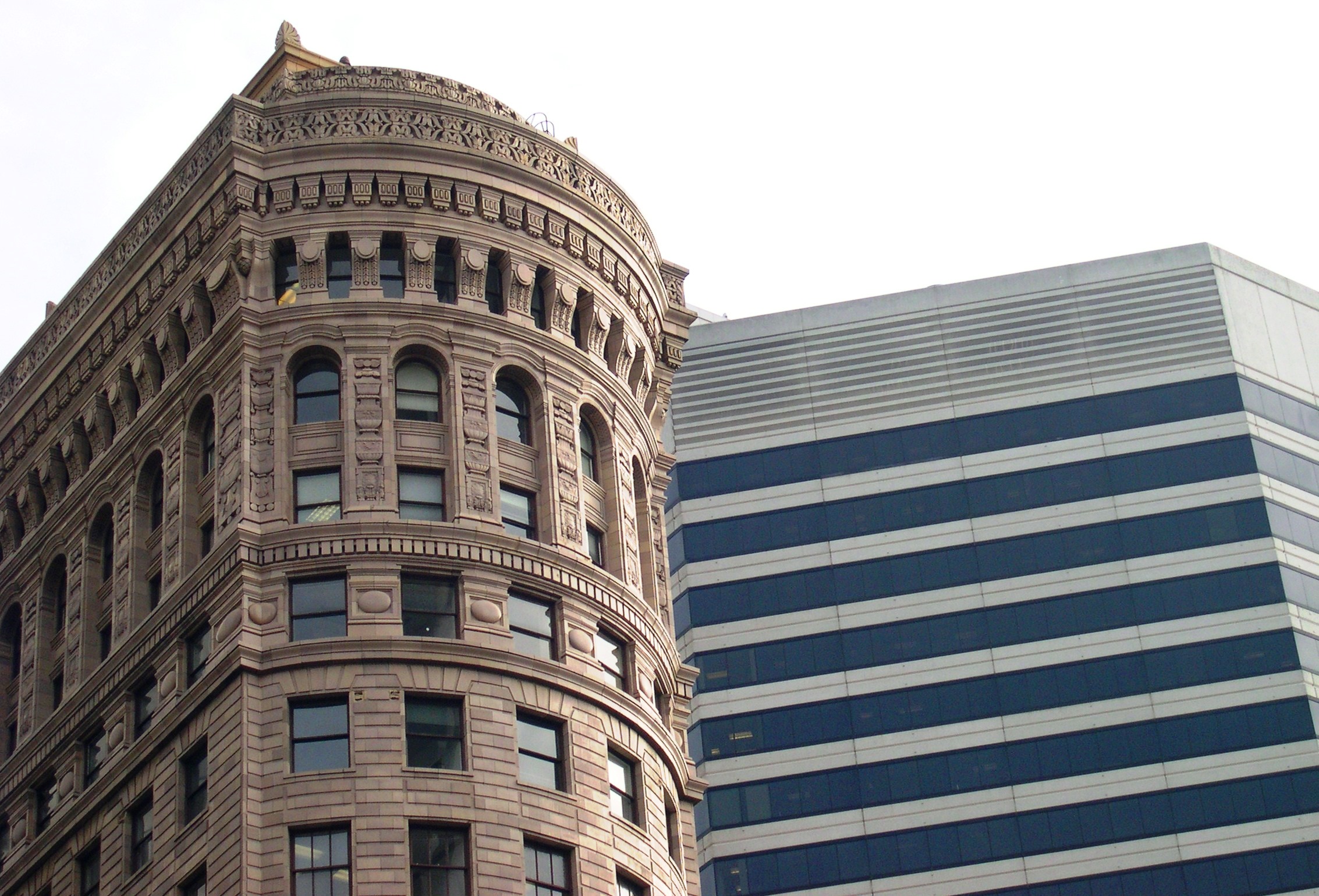
In San Francisco, as everywhere, tradition often stands in contrast to modernity.
January 2004
“Tradition does not mean a dead town; it does not mean that the living are dead but that the dead are alive. It means that it still matters what Penn did two hundred years ago or what Franklin did a hundred years ago…” — G. K. Chesterton
Tevye isn’t the only one who prizes tradition. I count among my friends and relatives many who are loyal to tradition in various aspects of life, and I am certainly into tradition in many ways (you don’t want to get me started talking about Christmas traditions here).
However, like Tevye, many of us who prize tradition have been taking some hard knocks lately. The world is changing at a head-spinning rate, and while change is not necessarily bad, it isn’t necessarily good, either. Much that seems eternally valuable to us appears to be increasingly disregarded, sometimes without adequate thought or reasoning. Many of us may find ourselves in the position of Tevye, carefully debating when and where to draw the line between welcoming the new and standing our ground on matters of principle, faith or personal ethics.
Regardless of where one stands on controversial issues, perhaps we all could start by agreeing that history does matter; that we need to understand how we got to the place we are now, in order to see the way forward. It bothers me to hear people talk as if history is meaningless. History is a rich, largely undiscovered gold mine of wisdom that, though it is often interpreted in conflicting ways, can tell us much about who we are, what to embrace, and what to avoid.
I hope that you’ll spend some time, today or someday soon, to discover a bit more about the history and traditions of your state, your town or your family. Like it or not, we all continue to live with the influence of what has happened long before we got here, and we would do well to know it better. Happy time traveling!
And then there is…

This sign greeted visitors to Disney’s California Adventure Park, July 2004
“There is science, logic, reason; there is thought verified by experience. And then there is California.” — Edward Abbey
In case Abbey’s quote leaves anyone in doubt, I mean it as a compliment. Whatever else can be said of California, it is certainly unlike any other state in the USA. It’s a web of contradictions; a place of unparalleled beauty that is more frequently the butt of jokes than admiring tributes. Could there be just a bit of sour grapes flavoring some of the criticism? Perhaps, but even those who love California will readily admit that its fiscal woes and multitude of other challenges are driving away many residents who once dreamed of living an entire lifetime there.
Even if you can’t afford to live there, I do hope you will be able to visit and get a taste of what makes this state so dear to so many hearts. Whether you go to the breathtaking National Parks, to Disneyland and other amusement parks, or to the countless tourist destinations in every category you can name, I hope you will manage to get “off the beaten path” and explore the coast, valleys and lakes as well as the vibrant cities. Be sure to sample some fresh fruits or veggies; almost anything you can think of is grown nearby. You’re likely to see flowers everywhere, for the weather in most of California is so pleasant that even annuals come back perennially. As do many people, who will never quite forget what made their years in California some of the happiest of their lives.
Brilliantly disguised

Sunset over Naples, Italy, May 2008
The light keeps breaking through the falling darkness!
“We are all faced with a series of great opportunities, brilliantly disguised as impossible situations…” — Charles Swindoll
I will always remember the first time I saw this quote. It was fairly recently, in an email I got from an extraordinary person, Dr. Anitha John. She specializes in adult congenital cardiology, a relatively new field that is both demanding and in demand. Dr. John has this quote appended to her email signature and contact details.
When we first sought her help as a local expert to work in consultation with Matt’s cardiology team in Norfolk, we were deeply apprehensive about Matt’s ongoing medical challenges. Seeing this quote in Dr. John’s email was wonderfully reassuring, and my impression that we were in excellent hands was underscored and magnified. You just have to love a physician with that kind of signature line, which matches perfectly with her attitude, expertise and compassion.
One of the great blessings to come out of our medical trials and tribulations has been the opportunity to know some of the most amazing medical professionals in the world. Some have international reputations, and some are known only locally, but all have had a wonderful combination of education, experience, competence, humility, understanding, and respect for their patients and families.
There’s an unfortunate stereotype that physicians (and surgeons in particular) can be arrogant and uncaring, but we have never, ever found this to be the case with any of the doctors, therapists, nurses or other staff who have worked together to save Matt’s life more times than we can immediately recall. Perhaps those who go into any pediatric subspecialty have an extra measure of the helping heart that draws people to careers in medicine, but I’ve had many years of close proximity to all sorts of medical personnel, and I know firsthand that they live and work with one impossible situation after another, always finding the opportunity within the challenge. As much as any other support we’ve been blessed to enjoy, the faith and diligence of these providers has kept us going over the years.
Our proximity to health care professionals has given me a deep gratitude for the excellent medical care we’ve received, along with an abiding interest in eliminating the obstacles that still prevent far too many people from access to appropriate, compassionate health care. If you have good health care providers, be thankful! May we all draw inspiration from their tireless determination to find the opportunities that lie within the impossible.
The real secret

The kitchen of the Tasha Tudor Dollhouse at Colonial Williamsburg, December 2004 —
A perfect example of fitting small things into small spaces!
“The real secret of how to use time is to pack it as you would a portmanteau, filling up the small spaces with small things.” — Sir Henry Haddow
Much has been written about the importance of prioritizing major tasks and important duties first, and fitting everything else in around them. But sometimes there still does not seem to be enough space for everything. Haddow is on the right track when he speaks of small spaces, those tiny slivers of time that cumulatively add up to a significant part of the day.
I find that there are quite a few such spaces in an average day, many of which seem to involve waiting on something or someone. Waiting for the water to boil for tea, waiting in a telephone hold queue, waiting for the computer to boot up, waiting for a bus or a subway train. Aside from carrying reading material of a type that can be easily read in short segments, there are probably many things we can do to pack those small spaces with small things.
Since I’ve often found myself in the kitchen while waiting, I have learned to do 60-second cleaning routines: wiping counters, scouring sinks, hand-washing a dish or two. I can get a lot done this way without feeling as if I’ve worked at all. In fact, I’ve discovered that it’s helpful, even when I have a long period of time available, to break distasteful chores into steps, so that I don’t feel as if I have a hour or two of drudgery ahead of me. Sometimes I’ll tell myself that I’ll work on something for ten minutes and then I can stop, but then when I get involved in whatever it is, I often keep working longer. Getting started really does seem to be half the battle sometimes,
Today, try giving yourself a five or ten minute assignment to work on something you’ve been putting off. You just might end up finishing a task you’ve been dreading, but even if you don’t, at least you’ve taken a small step, which might make the next ones easier to take. I wish you a productive day!
Solace, inspiration, adventure

Jeff and Matt stroll along the water’s edge at Acadia National Park, Maine, in September 2007
“Nature has been for me, for as long as I remember, a source of solace, inspiration, adventure, and delight; a home, a teacher, a companion.” — Lorraine Anderson
Whatever may be bugging you, I’ll bet it would be eased somewhat if you could manage a few moments to get away to a place without electronics, cars, concrete or advertising. A vacation to a gorgeous national or state park may not be possible (although I highly recommend saving and planning for one as soon as you can) but surely you are near a spot of green somewhere. A city park, a back yard, a pasture or forest, anywhere you can close your eyes and listen to birds and breezes, or open them and see grass, sand, trees or sky.
If you don’t have more than five minutes to spare today, do an online search for beautiful photos of nature. You’re likely to come up with some pretty scenes, many of which may be set to music in an online slide show designed to give people a quick nature fix. There is no more agreeable home, teacher or companion than God’s beautiful creation. I hope you will enjoy at least a few minutes of it today!
Resolved in the morning

Sleeping like a baby: Mama naps with her first grandchild, Ryan, in 1976
“It is a common experience that a problem difficult at night is resolved in the morning after the committee of sleep has worked on it.” — John Steinbeck
If you’re an insomniac, a night owl, or both (as I am) you have probably done a good bit of work and/or worry in the late hours of the evening, or even the wee hours of the morning. If so, you may have reluctantly concluded, as I did years ago, that staying up late does little to contribute to facing tough problems or challenges. I’ve watched early risers such as my husband for many years, and they are all fairly insistent about getting to bed at a reasonable hour. They are also, almost without exception, far more accomplished than I am.
Although it’s not in my nature to be an early-to-rise, early-to-bed sort, I’ve come to the inescapable conclusion that guarding my sleep habits to ensure at least 7-8 hours of sleep per night is one of the most important things I can do to preserve my own health and sanity. And I have to agree with Steinbeck that sleep often yields a mental clarity and focus that cuts through what seemed insurmountable obstacles the night before.
I’ve read that insomnia is an increasing problem in today’s world. Little wonder, with all that we have to keep us up at night. The bright side of this national sleep problem is that there are good, sound articles almost everywhere you look, online and in print, that include simple tips and information to help us maintain good sleep habits. I hope you are making sure to get adequate sleep. It’s one of the kindest things you can do for yourself, and ultimately, for all the people who are depending on you.
Just the thing

Matt and Drew are among countless readers who love Eeyore. Walt Disney World, 1995
“Eeyore, what are you doing there?” said Rabbit
“I’ll give you three guesses, Rabbit. Digging holes in the ground? Wrong. Leaping from branch to branch of a young oak tree? Wrong. Waiting for somebody to help me out of the river? Right. Give Rabbit time, and he’ll always get the answer.”
“But, Eeyore,” said Pooh in distress, “what can we — I mean, how shall we — do you think if we –“
“Yes,” said Eeyore. “One of those would be just the thing. Thank you, Pooh.”
— Eeyore, as quoted by A. A. Milne
Don’t you just love Eeyore? Of course his gloom can be tiresome, but after awhile it becomes very endearing. And anyway, even those of us who are more like Tigger or Piglet or Pooh have at least a bit of Eeyore in us. Sometimes when we’re very tired and in need of help, the last thing we feel like doing is answering a lot of well-intended questions that only add to our exhaustion because they have no quick or easy answer — or, as in Eeyore’s situation above, the answer seems so obvious to us that it baffles us why anyone would need to ask.
Next time you’re having an Eeyore day (and maybe it’s today!) go easy on yourself and just accept being Eeyore for awhile. He may be a tad depressed, but he certainly has staying power! Just look how long he has lived, delighting the hearts of countless children for generations.
Being peace

The Pentagon, as seen from Arlington National Cemetery, April 2012
“It is not by going out for a demonstration against nuclear missiles that we can bring about peace. It is with our capacity of smiling, breathing, and being peace that we can make peace.” — Thich Nhat Hanh
The tragedy is that the world is a very broken place, and probably always will be so. The beauty is that we can make it better.
If we allow ourselves to be distracted by cataclysmic events over which we have no control, we tend to let ourselves off the hook in terms of personal behavior. How righteous we feel as we rail against evil, while ignoring those who need us, who are nearby and would benefit from such small efforts.
Today, let’s all focus on making the world better, right where we are. Smile at people. Let cars merge in front of you in traffic. Give a cashier a sincere greeting and say “thank you.” Visit an elderly person who is unable to leave home and feels forgotten. Send a handwritten note to a relative who lives far away, to whom you haven’t written in years. Pretend, just for today, that it might be the last day you spend with your family or friends; how would you treat them?
If such deeds seem too small, tell yourself you will start there and move forward into greater efforts. You will be energized by the joy of showing compassion, mercy and friendship in small ways, thus being readied for larger things. Don’t be overwhelmed by the magnitude of evil and suffering. Become part of the even greater magnitude of all that is good, right and holy.
One who knows the way

A mother duck and her ducklings at Walter Reed National Military Medical Center, May 2013
“A leader is one who knows the way, goes the way and shows the way.”
— John C. Maxwell
As Reneé, Roger, Tammy and I walked through one of the outdoor courtyards at Walter Reed NMC, one of them said, “Look, a mother duck and her babies!” Naturally, I had to take some photos. It was really interesting to watch how the mother duck reacted to my presence, and how her nine ducklings responded to her every move. They were clearly accustomed to people, and showed no fear as long as we kept a distance. The mother would waddle along and the babies would hop along behind her, often in single file. But the instant she stopped — which she did whenever I got too close — the ducklings would cluster next to her and freeze until she moved again.
We watched them until they traversed the courtyard and turned into the bushes on the other side, although they froze several times when I approached, and their actions followed an amazingly identical pattern each time. As far as I could tell, she gave them no vocal signals, nor even a gesture with her wings, unless it was so subtle that I missed it. But her confidence must have been enough for the ducklings, who watched closely and imitated her actions without fail.
My best teachers in life are people I remember mostly for who they were and what they did, not for things they said. Certainly verbal instruction is an important skill, but no didactic lesson compares with an example in action. Wherever your career, interests or circumstances lead you, I hope you will have some great leaders who know, go and show…and maybe you can be one yourself!
More than a hundred

Jeff and the boys at our home at Vandenberg AFB, California, December 1990
“One father is more than a hundred schoolmasters.” — George Herbert
Watching someone fight bravely the battles Jeff has fought these past 9 months, it’s easy to get overly sentimental about him. Yet I think I can say without exaggeration that I have never known a man more devoted to his wife and children than Jeff has been for over 30 years and counting.
When women think of ideal traits to look for in a husband, those who plan to have children would do well to prioritize qualities that make a man a good father. But this is a more complex task that it seems, as there is no “one size fits all” description of a good father. If I try to pin down one characteristic that seems to be an absolute requirement for parenthood, devotion is the quality that keeps coming to mind.
Devotion to family comes at a price, of course, especially when extraordinarily challenging situations arise. Hobbies are forgotten or nonexistent; career decisions and personal preferences take a backseat to the welfare of the children; at times one’s individual personality seems to vanish into the web of demands that shape every day. Usually, none of these sacrifices are obvious in a devoted father; they are so inseparable from his character that it’s easy to be fooled into thinking he’s sailing along, living the same life he might have lived without children. But those who look closely will know better.
Herbert touches on the truth about what makes a father’s role so unique. A devoted father teaches continually, sometimes with words but mostly by example, and the cumulative effect of being ever-present in his children’s lives is a more profound lesson than any educator can impart. I know, because I was blessed with a father whose example would be a hard act to follow. I thank God every day for giving me a husband more than equal to the task.
I have mixed emotions about Father’s Day as I do about Mother’s Day, because there are so many for whom this is not a happy occasion. But I hope that those who may feel that they don’t have much to celebrate on Father’s Day will find ways to honor the crucial and often unsung role that fathers play. However imperfect they may be, loving Daddies are almost everywhere we look: in history, in our extended families, in our local school or play group. If you didn’t have the kind of father you wished for, you can still be one, or see one, and be strengthened by the gifts only a father can give.
One step at a time
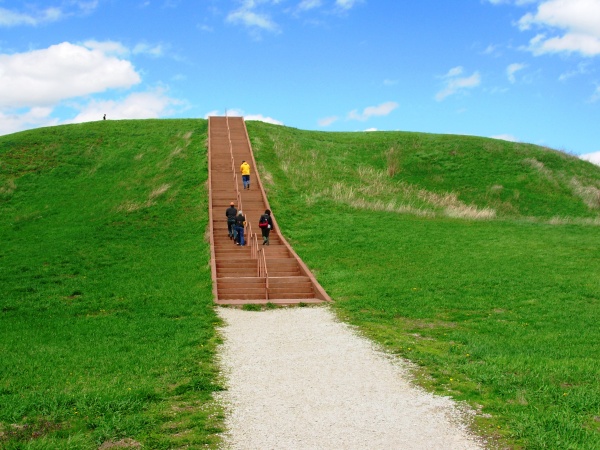
Visitors climb the Cahokia Indian Mounds near St. Louis, Missouri, April 2008
“The elevator to success is out of order. You’ll have to use the stairs…one step at a time.” — Joe Girard
Years ago when I wanted to lose about 5 pounds, I was able to accomplish that goal by making just one small change. I worked on the third floor of a large building, and I began walking the two flights of stairs instead of using the elevator. Since my job involved some errands, I frequently made more than one trip up and down per day, but it was never unduly difficult or time consuming. In fact, I came to see that taking the stairs for just a couple of flights can often be quicker than an elevator, especially going down. In just a week or two, my weight had come down. I don’t think I ever took the elevator in that building again, even when I was pregnant.
Now when I’m with Jeff someplace and he wants to take the elevator, I take the stairs and see who gets there first. It’s a fun game for me, and a fairly painless way to get some exercise.
It’s tempting to look for shortcuts in life, but often we actually lose time by cutting corners. More importantly, being in a hurry adds immeasurably to our stress. No matter what I’m doing — driving, cooking, cleaning, or anything else — the amount of stress I feel is directly proportional to how quickly I’m trying to get finished. I think that principle applies to long range goals as well. When I start dwelling on all the goals I had hoped to accomplish by my mid-fifties, it can be downright depressing until I pay attention to what I have already done, and the direction in which I’m heading.
Next time you get impatient with your progress, whether it’s a big project or a small daily task, it might help to remind yourself that taking one step at a time will almost always get you there– and often, you’ll arrive in better shape for having allowed yourself to skip the shortcuts.
A place once visited

City lights are enchanting, nowhere more so than in Venice. June 2008
“Venice appeared to me as in a recurring dream, a place once visited and now fixed in memory like images on a photographer’s plates…” — Gary Inbinder
Sometimes a place seems magical because of the circumstances of our time there, but some are inherently spellbinding. Venice is certainly such a place, especially as the daylight is waning and the lamps begin to sparkle.
I have fond memories of a night Jeff and I spent wandering among the canals and seemingly endless bridges, winding pathways through shops, restaurants and alleys, past silent buildings closed for the night. Moonlight and lamplight were reflected in the canals, and the music in St. Mark’s Square wafted over the breeze. The atmosphere was so thick that even several years later, it comes back vividly in my imagination, ever-alluring and probably slightly embellished by my memory.
What are your favorite enchanting places? Take a few minutes to daydream about your ideal visit there. Feel free to share a photo or a memory in the comments.
Delicate enjoyment

A balcony with an inviting tea table overlooks Disneyland, July 2004
“Another novelty is the tea-party, an extraordinary meal in that, being offered to persons that have already dined well, it supposes neither appetite nor thirst, and has no object but distraction, no basis but delicate enjoyment.” — Jean-Anthelme Brillat-Savarin
Whatever else can be said of contemporary culture, it seldom suggests “delicate enjoyment” or for that matter, delicate anything. We live in an age where “extreme” has somehow become a favorable concept, over-used by advertisers and enthusiasts.
Tea is a delightful exception. It comes in a wide array of flavors, but none of them are strong compared to most beverages. Its benefits, like its flavor, are subtle: calming, relaxing, mildly stimulating.
Sometimes I think that much of my enjoyment of tea comes from the simple but methodical preparation, which harmonizes perfectly with the leisurely sips taken during agreeable activities such as conversing, reading or merely gazing outside at a pretty landscape.
Today, I hope you will prioritize a few minutes of delicate enjoyment. If a cup of tea is “not your cup of tea” (sorry, I couldn’t resist) perhaps you can enjoy some soothing music or a few minutes of restful meditation. I think our lives could use a little more delicacy, don’t you?


 Defeat Despair