Odd but true

Grace reading at Howth Bay by William Orpen, Public domain, via Wikimedia Commons
“It’s odd but true that there really is consolation from sad poems, and it’s hard to know how that happens. There is the pleasure of the thing itself, the pleasure of the poem, and somehow it works against sadness.” – Carol Shields
When I first read this quote, I thought about the song “Fast Car” by Tracy Chapman. That’s a song, of course, not a poem, but it reminds me of poetry in its grace and power. Like the pleasure of a sad poem, the haunting sorrow of Chapman’s lyrics somehow work against sadness when I listen to it. Perhaps it gives me perspective, or helps me feel less lonely. Or maybe it’s just the resonant beauty of Chapman’s voice, dissolving my sorrow into her artistry.
I’ve found that reading poetry is sometimes exactly what I need to move into a sense of resolution when I feel troubled. A great many poems — maybe most of them — are not particularly cheerful. Some are downright heartbreaking. Among my favorite sad poems are The Broncho That Would Not Be Broken by Vachel Lindsey, Losers by Carl Sandburg, Incident by Countee Cullen, One Art by Elizabeth Bishop, and Do Not Go Gentle Into That Good Night by Dylan Thomas. Are there any sad poems that you love?
I think learning to defeat despair means accepting that sadness is inevitable, part of the fabric of what it means to be alive. For centuries great artists have captured the depths of human emotion in art and literature, proving to generation after generation that however much times may change, all humans carry universal baggage. Happy endings and humor and whimsy are all wonderful and necessary, but we also need those voices that remind us of the somber truths we cannot escape.
Whether you are feeling happy or sad today, I hope you’ll pause for a few minutes and read a poem or two. You can choose one from a favorite, well-worn volume, or you can search the wonderful archive at the Writer’s Almanac. Or you can ask me for an alternate recommendation if you are not in the mood for the sad ones linked above. However you choose to access it, find some time to lose yourself in the pleasure of a poem.
Love at the board

With Carla on our last Thanksgiving BC (before cancer), Alexandria, November 2011.
For hearts that are kindly, with virtue and peace,
and not seeking blindly a hoard to increase;
for those who are grieving o’er life’s sordid plan;
for souls still believing in heaven and man;
for homes that are lowly with love at the board;
for things that are holy, I thank thee, O Lord!
For many of us, this Thanksgiving will be a bittersweet time as we observe the holiday without loved ones. This year, our family feels the absence of our Daddy who worked so hard for 87 years to ensure that we would celebrate this and all days with bounty, gratitude and reverence. We honor him today with the thankfulness he instilled in each one of us, bolstered by faith and renewed by deep joy in all that is beautiful and right in our world.
One year ago (2014), our family had experienced another sudden loss shortly before Thanksgiving. Even so, we were able to come together as a family and reflect upon those blessings that remained, and encourage one another with hope for the future.
The year before that (2013), we had a most unconventional Thanksgiving day, exhausted yet filled with thankfulness and hope.
The year before that (2012), we were reeling in the shock of Jeff’s stage IV cancer diagnosis, having received bad news followed by worse news followed by even worse news. Yet even that year, there were reasons to be thankful. Among them were the readers of the newly-begun Defeat Despair.
I didn’t know then that a blog I started as a personal effort to stay focused on blessings amid the trials was to introduce me to wonderful people all over the world. Though I could not know it in those early days, I would find myself three years hence with dear friends whose existence was then unknown to me, and my dear husband, my rock and surest support, would still be with us, still working full time, still defying the odds.
Thus we face another Thanksgiving Day with full hearts and a deep sense of gratitude for mercies that truly are new every morning. May each and every one who reads these words experience love, joy, peace and many reasons to be glad. Happy Thanksgiving!
Poetic memory

Drew and Matt at Kepaniwai Heritage Gardens, Maui, 1991
“The brain appears to possess a special area which we might call poetic memory and which records everything that charms or touches us, that makes our lives beautiful.”
— Milan Kundera
Memory, we are told, is highly selective and not always accurate. We may remember a time or a place as being so full of wonder that it’s hard to imagine a reality that could live up to our recollection of it. Maybe we are looking back on a mentally enhanced version of what actually happened, as if it was retouched in some sort of cerebral Photoshop.
Or maybe not. Sometimes, as in the photo above, we have clues that our memories are not mistaken; in the words of Dave Barry, we are not making this up. Sometimes the poetry was present from the beginning, not composed over time by nostalgic delusions about a magical moment frozen in our consciousness.
I think Kundera is right about the poetic memory. It’s a sort of neurological scrapbook; the repository of all that has made life wonderful for us, and when the present moment becomes almost unbearable, we can wander into that corner of the mind, and see the colors and hear the lovely cadences that can’t be captured by grammatically correct sentences.
What scenes from your past sprang to mind when you saw the words “poetic memory?” What verses will be added today?
The quiet of power

Quiet and strong, two oxen stroll down Duke of Gloucester Street.
Colonial Williamsburg, Virginia, October 2005
…slow things are beautiful:
The closing of day,
The pause of the wave
That curves downward to spray,
The ember that crumbles,
The opening flower,
And the ox that moves on
In the quiet of power. – Elizabeth Coatsworth
Recently I read a book that discussed the pervasive effects of technology on how we view ourselves. The author explained that the increasing speed of computer processing leaves us feeling less intelligent when we cannot keep up with the machine’s pace. But he pointed out that humans have capabilities that no machine will ever be able to duplicate, and there is more to ability than speed.
Our world seems little inclined to value a slow pace in anything. We expect gadgets, cars, service providers and even schoolchildren to deliver the quick results we want, and waiting for anything taxes our ever-decreasing stores of patience. Pursuits that can be done more rapidly by machine or assembly-line procedures have consigned such arts as sewing, cooking and woodworking to the category of “hobbies” rather than occupations.
Sometimes we sense that life is not meant to move at such breakneck speeds, but we feel vaguely guilty and inefficient when we slow down — and even if we are enjoying our deliberate pace, someone else is likely to come along and pressure us to step it up. Exhausted, we fall into bed each night with tomorrow’s “to-do” list nagging at us from a far corner of our brain, if not the front and center of our last waking thoughts.
We have heard “time is money” so often that we may begin to think we can never have enough of either. That might be true, but only if we allow it to be. Time pressure can create the illusion that frenzied acceleration will serve us, but haste really does make waste in some circumstances. Power need not depend upon speed; often, it is quiet and steadfast, as with the drops of water that gradually wear away solid rock.
Today, I invite you to celebrate with me the beauty of slow things. Turn off the television’s frantic voices of urgency, whether in the news or on commercials, and turn on some Debussy or Brahms or Enya. Fill the kettle to the top and watch the tiny bubbles gradually forming as the water comes to a boil. Breathe deeply, taking in the unique aroma of the fruit or bread or coffee you enjoy. I wish you blissful hours that pass at a relaxing tempo, leaving you serenely smiling at day’s end.
A fine autumnal day

A brilliant addition to my pictures of people taking pictures!
Susan photographs a tree on our walk to lunch, November 2015.
“It was, as I have said, a fine autumnal day; the sky was clear and serene, and nature wore that rich and golden livery which we always associate with the idea of abundance. The forests had put on their sober brown and yellow, while some trees of the tenderer kind had been nipped by the frosts into brilliant dyes of orange, purple, and scarlet.” – Washington Irving
The most wonderful thing happened in early November. Remember that fabulous photo of New Hampshire that Susan recently shared with us? Well, she decided to zip on down the coast to Florida, and along the way, she was able to visit with Raynard, Mary and Ms. Ella, and the next day, with me. So not only was she able to share the fall foliage of her home with us; I was able to share what remained of Virginia’s autumn colors with her too — live and in person! I’m always excited to meet people I’ve come to know through this blog. Each face-to-face encounter feels like a sparkling little miracle.
Washington Irving might well have been writing about us instead of Ichabod Crane when he penned the lines quoted above. Susan’s visit happened to fall on a day when the weather couldn’t have been finer. We decided to walk to the café for lunch, and I had not been outdoors for five seconds when I decided I didn’t even need the light jacket I had on. It was sunny and clear and gorgeous, and even with a short-sleeved shirt on, I was as warm as if it had been summer.
As I’ve written here before, I love taking pictures of people taking pictures, and Susan was a good sport about it. In fact, she was a good sport about everything. At the time she arrived, I had been having one of those days when I was distracted by large and small worries. Our time together was a wonderful respite from business as usual. We took a few extra minutes to stroll down the lovely wooded walk behind our home; you may recognize it as the one I shared in this post, though it looks different in the fall.

Ever patient, Susan paused for another photo during our woodland walk.
Thank you, Susan, for being willing to interrupt your trip for a brief visit that shone a bright light into my day! Thank you, Washington Irving, for your description of autumn that lives on with as much relevance today as when it was published nearly 200 years ago. And special thanks to our blog community here for being with us through these words and photos. You’re all invited along on our next adventure. Stay tuned!
The transporting wonder

Despite a devastating diganosis and a grim prognosis, some things remain untouchable.
Jeff and Matt reading, November 2012
“Those of us who know the transporting wonder of a reading life know that…when we read, we are always inside, sheltered in that interior room, that clean, well-lighted, timeless place that is the written word.” – Alice McDermott
All of my life, reading has been a shelter for me, and never more so than in the past three years. In the roller-coaster sequence of events fraught with emotional highs and lows, I’ve depended on having that cozy, well-lighted, dependable world awaiting me.
Reading calms my soul when I’m too exited or agitated, and it comforts me when I’m lonely or sad. Through books, letters, and now blogs, I can play host to people long passed from this life, or visit with others whom I’ve never met except through published words. When a rainy day keeps me indoors and deprives me of the sunshine I crave, what might be a gloomy spell is instantly transformed into cozy contentment with a book and a cup of tea. When I’m tossing and turning in the frustration of insomnia, a book (especially a scholarly or devotional work such as the Bible) can lull me back to sleep, or at least provide company.
Whether you are battening down the hatches for another winter, or preparing for the heat of summer soon to come, I hope you will stay in touch with fictional friends and narrative neighbors who will be ready for you when you need them most. And may you draw wisdom, consolation and refreshment from holy scriptures, classic poems and other timeless works that have survived for centuries to remind us we are never alone.
Settle down for a nice chat with C. S. Lewis, or whisk away to enchanted worlds with Harry Potter and his friends. Make a friendly visit to a charming town such as Mitford, or travel backward or forward through time with any number of imaginative guides. Explore Ireland with Maeve Binchy, or go to India with Jhumpa Lahiri, or savor the warmth of Botswana with Alexander McCall Smith. The transporting wonder of a reading life is ours to enjoy! And it’s available free, or at very little cost — how fabulous is that? Where will you spend time today?
Be one of the rare few
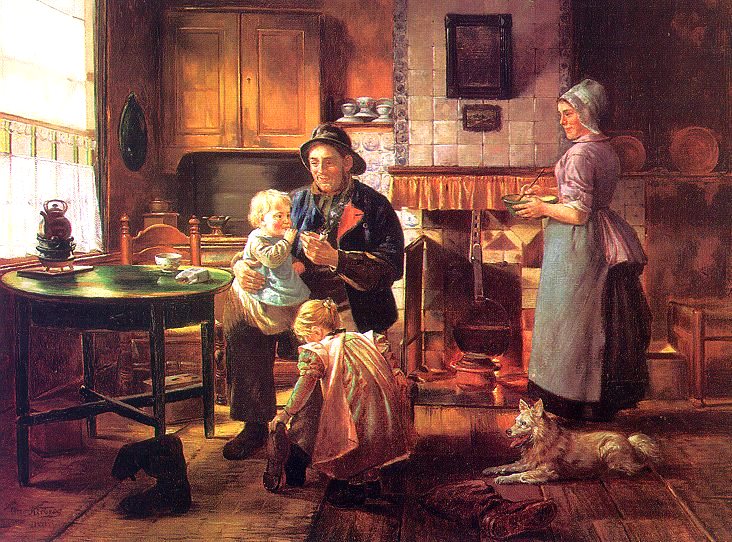
Returning Home by Otto Karl Kirberg,(1850-1926) Public domain, via Wikimedia Commons
“Never despise the mundane. Embrace it. Unwrap it like a gift. And be one of the rare few who looks deeper than just the surface. See something more in the everyday. It’s there.” – Lysa TerKeurst
I’m a practical person in most respects, so I tend to give gifts that are useful or inexpensive modestly priced. I enjoy taking a humble present and wrapping it in gorgeous paper with a lovely fabric bow. While some might see this as false advertising, it’s really just my way of adding to the fun. I’ve noticed that most of us like surprises, even little ones, and the trimmings add to the suspense.
I suspect it’s also a sort of reverse twist on a phenomenon that seems at least a little bit regrettable: too often, the most precious and priceless aspects of our lives are camouflaged, hiding in plain sight behind unremarkable appearances.
Have you ever injured your thumb or foot, and found yourself realizing how much you have taken it for granted? It happens with many blessings, I think. Whether it’s a really comfortable pair of shoes, a sturdy and reliable appliance, or an old car that never fails to get us to our destination, we are surrounded every day by things that make our lives easier and more pleasant– things we scarcely ever notice until they are no longer available to us.
Even more truly, we are blessed with aspects of the natural world that require only our attention to bring us joy. A quick walk to the mailbox can show us a tiny wildflower or a spider’s intricate web, sparkling with dew. Ordinary animals, both indoors and out, warm our hearts and put smiles on our faces. And some of the most endearing and fascinating people are the least flashy or glamorous.
There is almost always more to anything than meets the eye at first glance. What will we see beneath the surface today? So much is there, waiting for us to notice and celebrate.
Power to gather

Choose a flower to study, and be filled with joyful wisdom!
Daffodil doubles, April 2015
…he is happiest who hath power
To gather wisdom from a flower…
What is your favorite flower? That’s a tough question to answer; I tend to be fondest of whatever I happen to be seeing at the moment. But if I had to choose, the delightful daffodil is my favorite.
I gather many bits of wisdom from this perky blossom. Its early appearance each spring shows me the radiance of hope for sunny skies on the way. Its bright yellow hue (or creamy pastel shades in the fuller “double” blooms, as pictured above) and beautiful green leaves teach me the power of color to lift our moods and decorate our lives.
The daffodil spends the fall and winter strengthening its roots, resulting in showy blooms when March arrives. It grows in clusters, and spreads across wide areas in dazzling displays that inspired the famous Wordsworth poem. The daffodil’s exquisite shape seems to suggest openness and readiness; if it’s possible for a flower to seem friendly, this one does.
Tell us about what blossoms you love best. Take a few minutes to do an online image search, and marvel at the wonderful photographs that are freely available to cheer us when this year’s flowers have mostly faded. Have you ever gathered wisdom from a flower? If so, feel free to share it with us here. It’s one of the happiest topics I know!
A festival season

Halloween New England by -jkb- (CC BY 3.0 via Wikimedia Commons)
Just after the death of the flowers,
And before they are buried in snow,
There comes a festival season,
When nature is all aglow—
Aglow with a mystical splendour
That rivals the brightness of spring,
Aglow with a beauty more tender
Than aught which fair summer could bring….
(attributed to Emeline B. Smith, about whom I could find no biographical information)
If you are lucky enough to have kids in your life, you probably have plenty of festivity awaiting you this weekend. Even without trick-or-treating, however, it’s easy to get into the spirit of autumn. Just look at those gorgeous pumpkins and chrysanthemums, glowing with a colorful harmony that suggests they were created to go together.
There are lots of phrases that memorably describe this season, but “aglow with a mystical splendour”* seems as perfectly apt as any I’ve heard. I hope this finds you enjoying a cheery lightness of heart “that rivals the brightness of spring.”
*I left the spelling just as I found it. Emeline Smith must not have been from the USA. Wish I knew more about her…
To be wronged

If you focus on the flowers, you’ll scarcely notice the weeds.
Bar Harbor, Maine, September 2007
“To be wronged is nothing, unless you continue to remember it.”― Confucius
Gardening teaches me many lessons. I love the way nurturing the flowers and pulling the weeds can make such a difference in how beautiful a small spot of ground may be. Left alone, the weeds can choke out the flowers in no time. But if I carefully encourage the growth of what is pleasing, and eliminate the unwanted vegetation, the rewards are evident.
It does require maintenance, though. The weeds are always there, ready to encroach on the beauty and consume the results of effort. Fortunately, the incentive of enjoying the colorful blooms and foliage provides a steady diet of encouragement that keeps me going through times when the weeds seem to be winning.
It’s the same with our thoughts, only more so. I don’t know anyone who has never been wronged by someone else, and most of the people I know have been wronged many times. Even friends and family can act thoughtlessly, and sometimes people can be deliberately cruel or hostile. There’s not much we can do to prevent others from hurting us, but we can control how we react to it.
Have you ever known anyone who was perpetually angry or hurt at someone else? The topics of their ruminations may vary, but it seems that they are continually distressed and venting about someone else’s misbehavior. These complainers often have abundant reasons to be thankful, but they choose to focus their attention elsewhere; someone is always raining on their parade.
How do you feel when you are with someone who lets the weeds choke out their blossoms? Do you find yourself avoiding them? I know I do. Such people feed my own tendency to nurse grudges, and I don’t want to waste one minute of my life that way. Life is difficult enough without re-visiting some real or imaginary slight. I’d rather nurture the joys that surround me and decorate each day.
It’s not easy to shift gears when we are feeling the fresh sting of deeds that were genuinely rude or unfair. Just being aware of our own thought patterns is the first step. It’s okay to feel hurt, but there are loving, encouraging people who will support you and help you turn your attention elsewhere. You have important, joyful and beneficial ways to spend your time, and a great deal of happiness awaits you, if you encourage and nurture it.
Remember not to feed the weeds!
A riot to the senses

Susan is giving us a quick getaway to New England, where the colors are a joy to behold.
She took this lovely photo in New Hampshire, October 2015
“October proved a riot a riot to the senses and climaxed those giddy last weeks before Halloween.” ― Keith Donohue
Blogs are a wonderful way to connect to people all over the world, and today’s photo is one example of the fun that can result. As I write this, we aren’t yet having riots of color here in Virginia, though there are hints that the best is yet to come.
However, New England is legendary for its fall foliage, and Susan sends us a stunning example that she was kind enough to let me share here. I cropped it a bit so it would fit in the blog format, but otherwise it’s untouched by any digital enhancement. No wonder autumn in New Hampshire is so famous!
If your brightest colors are likely to come a few days later than Halloween (or, in the southern hemisphere, six months later) I hope you will enjoy this lovely lakeside scene today. Let’s have a virtual party right where Susan took this photo. Just imagine there’s a ginormous picnic table behind us, loaded with festive snacks. Do I smell a campfire and hot dogs roasting? Pour me some hot cider from that thermos and fill me in on what’s happening in your neck of the woods.
That’s when you start

Isolated, or independent? Triumphant or terrified? You get to choose!
Public domain photo by Julia Caesar, shared via Pexels
“…when you realize that the story of your life could be told a thousand different ways, that you could tell it over and over as a tragedy, but you choose to call it an epic, that’s when you start to learn what celebration is.” — Shauna Niequist
Let me guess: your life is fantastic, a journey you never expected and wouldn’t have chosen, but one you will never regret.
Or maybe your life is a boring slog through endless tasks you don’t love. Maybe you spend a lot of time wishing things were different somehow. Perhaps other people were blessed with gifts denied to you, and you feel trapped by circumstances that keep you from being all the things you once dreamed of being.
The really amazing thing is, most all the people I know well (including me) could point to certain facts about our lives that would support either viewpoint. Some choose the first way of seeing life, and others choose the second, but most of us vacillate between the two. Depending on how our day has gone and how we are feeling and a thousand other tiny and seemingly irrelevant details, we could be tossed back and forth between conflicting perspectives, afraid to be happy but determined not to be sad.
In an epic, things don’t always go well for the protagonist. In fact, things usually get downright dicey. But that’s an inescapable part of the narrative. A story about an endless vacation would get pretty boring, wouldn’t it?
When we celebrate something or someone, we honor the totality of what created that particular event or person. We focus on the beauty that emerges from the complex details. We feel not only gratitude, but a deep appreciation of the many layers of meaning underlying our observation.
Your life is an epic. Really! And you are its star. I wish you the faith, strength and determination to navigate all the twists and turns, and celebrate a happy ending.
Just too used to it

Just another mandevilla flower, blooming in our Alexandria kitchen. October 2015
“I think life is staggering and we’re just too used to it. We are all like spoiled children no longer impressed with the gifts we’re given – it’s just another sunset, just another rainstorm moving in over the mountain, just another child being born, just another funeral.” — Donald Miller
Do you ever read the obituaries of people you don’t know? I do, on those increasingly rare occasions when I give myself a few minutes to spend with a newspaper. It’s sobering and staggering to realize how many people are born and how many die each day. How rich and full, how sad and happy, how triumphant and tragic those lives will be!
Life is totally amazing, when you think about it at all, in any context. Biologically, psychologically, socially, spiritually…it’s all profound. But we don’t stop to think deeply about it very often. We’re too busy with car maintenance and dental appointments and updating the software on our gadgets; with eating and sleeping and talking and (hopefully) listening.
I agree with Miller that we are surrounded by gifts– immersed in them, really– and we are just too used to it most of the time. How many marvelous things do we rush past every single day, too busy to notice? Even the air we breathe, and the ability to draw that breath, is something most of us take for granted.
Today, I invite you to focus on just one gift that you tend to overlook. It can be a flower, or a sunset, or an animal. It can be a person, place or thing. It can be anything at all that brings you joy, or solace, or serenity, as long as it’s something you scarcely notice most of the time.
Is there anything you might delight in seeing today, except that you’re just too used to it? Tell us about something in your everyday life that is wonderful or beautiful or even staggering, and let’s remember what it means to be impressed with the gifts we are given.
In the slanted light

Feathery grasses and fiery foliage: get ready for the autumn show.
Yorktown, November 2008
All the feathery grasses shine in the slanted light. It’s time to bring in the lawn chairs
and wind chimes, time to draw the drapes against the wind, time to hunker
down. Summer’s fruits are preserved in syrup, but nothing can stopper time.
— from the poem “And Now it’s October” by Barbara Crooker
Just when we were wondering whether our relief at the cool weather was greater than our disappointment at how fast the summer flew by, the brilliance of October arrives to remind us that the passage of time is a magnificent spectacle.
Our years are a long-running pageant of laughter, trouble, love, sorrow, joy, sighs and grief. How appropriate that the waning of the year brings such a combination of emotions, sights, scents and sounds. Nature provides a vivid demonstration of the gifts inherent in approaching death, as even the dried grasses, fallen leaves and faded flowers enrich the soil of new growth in the spring.
Nothing can stopper time, but its sweet fruits are preserved, etched into memories that we will savor through the cold months ahead. Light a candle, put the kettle on and rejoice in the wealth of being right where you are, right now.
Look closely

This little creature sat amazingly still while I took many photos.
Our York back yard, July 2015
“Look closely. The beautiful may be small.” – Immanuel Kant
Sometimes I choose the photo, and find a quote to go with it. Sometimes I choose the quote and look for a photo. This is one of the times I chose the photo first. It wasn’t easy to choose the quote for it.
When I first considered this quote in connection with the photo, I thought, “The beautiful may be ugly, too.” I can appreciate why so many people are fascinated by dragonflies, but I can’t look at this photo and see pure loveliness. The wings are striking, but those eyes…
The stillness of the insect was beautiful, though, and the memory of how it didn’t fly away as I took photo after photo. The cool serenity of the evening when I was taking the picture was beautiful too; that wonderful glare-free light that bathes everything just before dark settles in. It all comes back to me when I look at this shot.
Today you will be surrounded by small glimpses of beauty; moments and memories that are easily missed. Look closely!
So glad

No matter our moods or circumstances, October brings treasures to warm the heart.
Our Alexandria neighborhood, October 2012
“I’m so glad I live in a world where there are Octobers.” — L. M. Montgomery
As I write this, I’m feeling sad and very tired. I’ve not been sleeping well lately, and it feels as if everything in my life is currently a source of some sort of worry. This evening, despite having many other things I needed to do, I went out for a walk for the first time in days.
The air was deliciously cool with that first taste of autumn. I didn’t experience the euphoric joy that often hits me at this season, but I did feel a sense of healing. Just being outside for a short time gave me a chance to step away, however briefly, from the many cares that have been weighing me down in recent weeks.
I’m still sad, tired and disappointed about a lot of things. But I still believe that happier times lie ahead, and October brings me a bit of enchantment to remind me that “this too shall pass.”
I hope you are enjoying lovely weather, whether it’s spring or fall in your neighborhood. I wish you the dazzling delights of flaming foliage and pumpkins and cider and all the excitement of the season. And if you, like me, are feeling a bit low right now, I hope October will fall gently over your sadness, giving you the comfort of peace, and joys that go deeper than sorrow.
The land comes alive

My afternoon walk was brightened by my encounter with this fellow stroller.
Hickman County, Tennessee, September 2015
“The land comes alive through its wild creatures.” — Charles Fergus
When I was employed by the Tennessee Department of Conservation, one of the foresters with whom I worked heard me say my fiancé was from Hickman County. “Hickman County?” he said. “They got more deer there than people!”
I had to agree with that. In the many years Jeff and I have been travelling together through the highways and byways of that lovely county, it seems that we always see at least one deer as we drive along, and often more than one. Though I hardly ever notice until Jeff points them out to me, I delight in seeing them. If you’re ever traveling on I-40 between Memphis and Nashville and want to see the home where Jeff grew up, take the Bucksnort exit (I am not making this up; it’s exit 152).
So, when we were visiting Hickman County a few days after Daddy’s memorial service in Georgia, I took my camera as I headed out for a late afternoon walk from his sister’s home. I was hoping to catch photos of at least a few of the ten wild turkeys I had counted as we drove down her street earlier that day.
“You might see a deer,” Jeff’s mother reminded me, and sure enough, I had not gone 500 feet down the street before I caught a flash of movement a short distance away. An enormous doe with a long, fluffy white tail had spotted me before I spotted her, and she trotted away from me, then turned to look back, curious yet sensing potential danger.
I stood very still and snapped this photo of her, then decided to walk slowly toward her in hopes I could get a bit closer. No such luck. The moment I took the first step in her direction, she bounded into the woods with that graceful speed that so impresses me.
I did see some of the turkeys, too. I even saw one of them take off and fly a short distance, but when I pointed my camera at them, they insisted on showing me only one angle.

More than any other season, autumn reminds me of the wildlife that become a bit more visible as they forage or browse among foliage that is already beginning to thin out. The weather grows cooler and it’s an ideal time to enjoy being outdoors. Why not take a stroll and watch with joy as the land comes alive?
Invariably imagined

Jeff and Matt enjoy a lovely September day in a gorgeous garden spot.
Luxembourg Gardens, Paris, September 2004
“…it is not surprising that paradise is invariably imagined as a garden.”
— Mac Griswold
Autumn is upon us, with all its promise of splendor, but it’s not too late to bid a fond farewell to the green grass and vivid blooms of summer. I hope you are able to spend a few minutes this week taking in the warmth and sunshine in a large or small garden near you. Bask in the beauty of roses, begonias, mandevillas and hibiscus, and gather ideas for next spring. It will be here before we know it.
I don’t know about you, but I could use a little taste of paradise just now. Find a nice spot and point me in the right direction– I’ll bring the iced tea.
Many worlds

Carl von Bergen takes us to the Piazza Barberini, Rome, 1830
Public domain work, via Wikimedia Commons
“Thanks to art, instead of seeing one world only, our own, we see that world multiply itself and we have at our disposal as many worlds as there are original artists…”
— Marcel Proust
How are you feeling today? I hope it’s a happy day for you, with agreeable weather and time to enjoy a few small pleasures. But you might be feeling a bit sad, or overwhelmed, or fed up with the world. Maybe this is one of those days that is so busy, you wonder how you will fit everything into your tight schedule.
In any case, I invite you add a spark of color to your day. Step out of your immediate surroundings for a moment or two, and enjoy visiting another world entirely — maybe several other worlds — through the vast riches of online art that are available with just a click or two. Whether you like pastoral landscapes or lively city scenes, portraits or still life studies, there is something for everyone in the many worlds made available to us by the lovingly crafted work of artists we have never met.
If you have a favorite painter, sculptor or photographer, or if you know the name of a work you admire, try a quick internet search for it. In most cases you’ll quickly find at least one digital reproduction of it to enjoy. If you can’t find it, let me know what you’re looking for, and I’ll try to help you. Or just take a virtual stroll through the Louvre, or the Hermitage, or the National Gallery of Art, or any of the countless museums and galleries available to explore online.
We are surrounded by so many pleasures, joys, obligations and responsibilities that it’s easy for art to get lost in the sea of urgent or obvious distractions. But even a few minutes of appreciative contemplation can provide a refreshing break. If you have a busy day today, set a timer and limit yourself to just five minutes. Feel free to share a link or two in the comments below, if you’d like to share your experiences with us. And if you happen to be an artist yourself, here’s your chance to introduce us to your work.
I wish you delightful discoveries!
Our heart is not always able

Full hearts, few words: Grady and Daddy communicate.
This is their last photo together. Daddy died nine days later.
August 26, 2015
“…our heart is not always able to say what it wants to say, and frequently has to content itself with less.” — Alexander McCall Smith
In spite of my ceaseless flow of words, McCall Smith’s statement quoted above (as expressed in the thoughts of the winsome Mma. Ramotswe) is more true for me now than ever. As I write this, over a week has passed since my Daddy left behind his earthly existence, and my heart is overflowing with emotions it is unable to express.
There is sorrow, certainly, and a wistful longing for the ability to talk with Daddy, or get an email from him, or see one of his comments here at this blog, or be able, just one more time, to visit him and Mama together in their home. There are worries about how Mama will cope without him, as he was her constant caregiver during the past decade, and her husband, through good times and bad, for over 66 years.
But beyond the sorrow and worry, eclipsing all the painful feelings, is a deep sense of gratitude and wonder. Alongside my appreciation of the long and meaningful life Daddy lived, there is abundant joy and thankfulness for the love and support of friends and extended family. I am humbled and amazed at how the readers of this blog have become a living demonstration of one of Daddy’s greatest lessons to me: that the comforting presence of loved ones does not depend on geographic proximity, and friendship transcends earthly barriers.
Last night I read through some of the many cards that have been sent to me by readers of this blog. Each was unique and so full of the sender’s generous soul that it was almost like a quick visit with a dear friend who gave me a hug of reassurance that said “we are here for you, and we care.” Likewise, the many comments and emails, public and private, have been a constant source of support since Daddy died. In a very real sense, I was sustained by your prayers and warm wishes and expressions of consolation, and I am grateful to you all, more grateful than words can say.
Thus, as Mma. Ramotswe realized, my heart holds more than this post can possibly contain, so I will have to content myself with less. But I hope, especially in this case, that less will be enough. I’ve said it so many times that it may sound trite, but I tell you again from my heart: Thanks for being here.
The noise is democracy
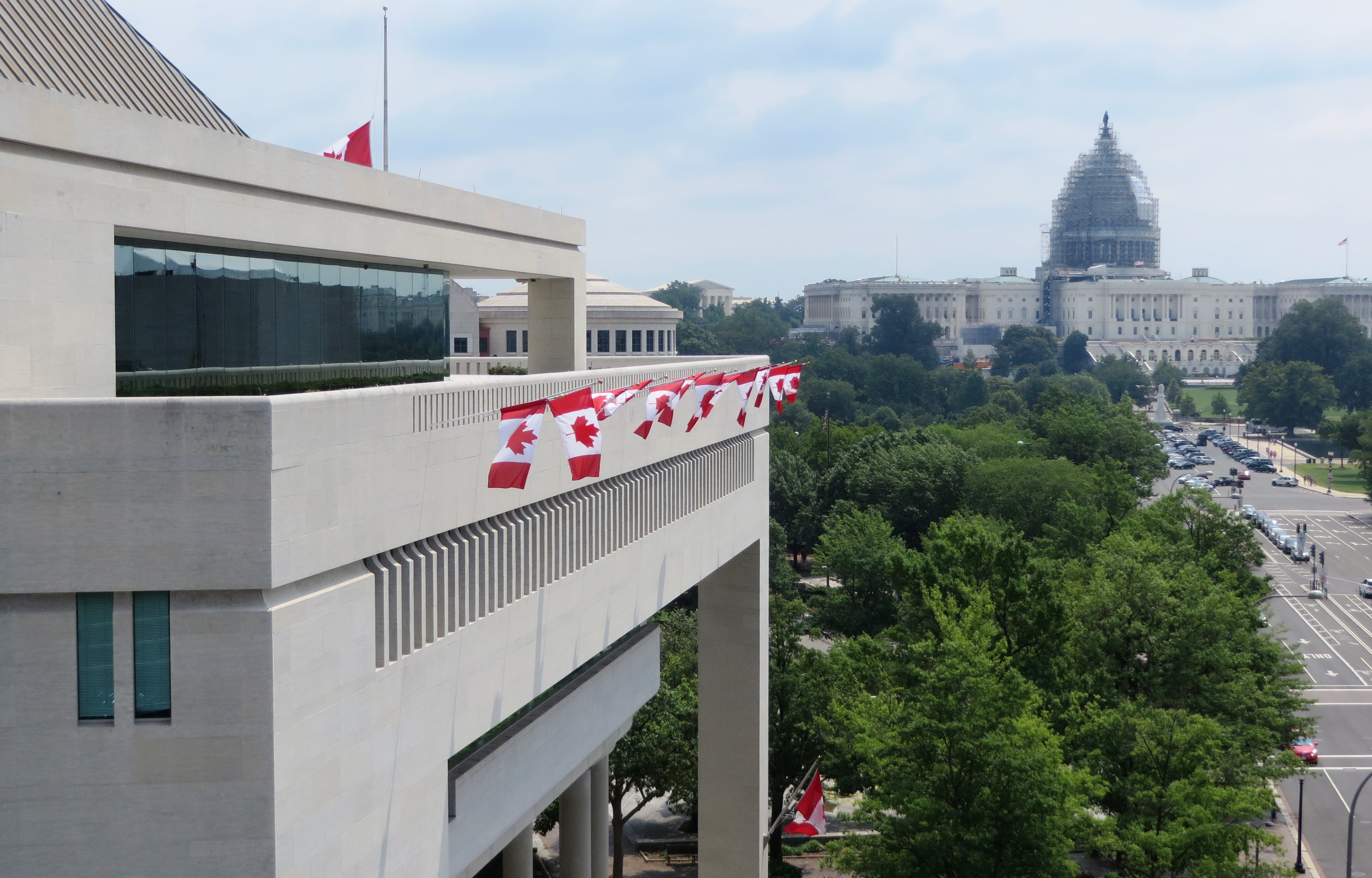
All that clanging requires diligent maintenance and occasional restoration.
The Canadian Embassy and the U. S. Capitol, seen from the Newseum
Washingon DC, July 2015
“Our political institutions work remarkably well. They are designed to clang against each other. The noise is democracy at work.” — Michael Novak
When I first read that quote by Novak, I couldn’t help wondering when he said it, and whether he still feels that way. Everywhere I turn, I hear people complaining about the government. There’s a diversity of opinion about where the blame lies, but there is clear consensus about one thing: a lot needs fixing. If only we could agree on what, and how, and when.
Ah, but that’s really the argument that Novak is making, isn’t it? If there is a great deal of vocal disagreement, maybe that’s an indication that democracy is working. That we feel not only the urge but the freedom to complain; that we examine our leaders again and again in the court of public opinion; that we elect all sorts of representatives who themselves have a hard time reaching agreement — maybe these are healthy signs of government that truly aspires to be “of, by and for” an increasingly diverse people?
I’m not saying it’s right to show disrespect toward our leaders, or toward anyone else whose opinions offend us. I abhor hateful name-calling and gratuitous insults. But constructive criticism, incisive commentary and hilarious satire are all necessary components of a society ruled by a Constitution and a Bill of Rights.
If I could, I would find a way to banish all trolls from the internet; they pollute thoughtful discussions with vicious and often illogical attacks, acting ugly seemingly for the sake of ugliness. It makes me tend to shy away from the comment sections following any news story, particularly if the topic is controversial. It also makes me angry that we allow the lowest common denominator to hijack reasonable argument. Polite disagreement may sound like an oxymoron, but I believe it’s possible.
Meanwhile, with election talk already beginning to dominate the airwaves, let’s brace ourselves and get ready to see this nonstop and often irritating chatter as an inevitable by-product of the incalculable blessing of living in a free country. I invite you to join me in resolving two things: one, I will not let all the complaining and whining and hand-wringing cause me to lose sight of how many reasons we have to feel thankful; and two, I will not become part of the problem by venting my (often reasonable) frustrations in inflammatory speech or over-reactive anger at anyone who happens to disagree with me.
Let the clanging begin!
To produce some good

Should I say something? Let me get back to you on that.
Self portrait, August 2015
“I am very little inclined on any occasion to say anything unless I hope to produce some good by it.” – Abraham Lincoln
To borrow some famous words of Yogi Berra, Lincoln really didn’t say everything he said, but apparently he really said this. And WOW, what a quote. Just think how much better the world would be if EVERYONE followed this rule.
Assuming one doesn’t quibble over the question “good for whom?” (which might be used to justify anything that generates publicity or commercial profit) I think it’s safe to say that a huge percentage of thoughtless and harmful chatter would be promptly eliminated if we took this idea to heart.
Can you imagine how talk radio and news commentary would be transformed by this principle? But closer to home, how might it change our everyday conversations? I like to think most of what I say is at least harmless, but I’m a long way from meeting this standard myself.
I invite you to join me in an experiment this week. I’m going to try being more aware of how much of what I say (or write) can pass Lincoln’s test. For some of us, this will mean saying less; for others of us, it might mean saying MORE, in the form of compliments to those who need them, encouraging words to people who are struggling, and being unafraid to share positive ideas for practical improvements in places where we tend to feel silent disapproval for how things are.
If you were to adopt Lincoln’s policy regarding your own speech, would you end up saying less? Or more? Or the same amount, with a different focus? Share your ideas in the comments, and let’s hope to produce some good with what we say here.
There are no words
Dear blog readers, our wonderful Daddy passed from this life earlier today. Here is a video I made for him on Father’s Day 2014, just a token of the tremendous place he holds in the hearts of his four children. There will be no posts this week. Thanks for understanding.
Update, Monday 12:15 a.m. — Thanks to all for your kind thoughts, prayers and comforting comments. Please be assured I am reading the comments and will respond to each one as soon as time allows. Your friendship and support mean more than I can say. Please pray for our Mama who is having a very hard time after losing her husband of more than 66 years. She has depended on his loving support for so long.
I learn by going
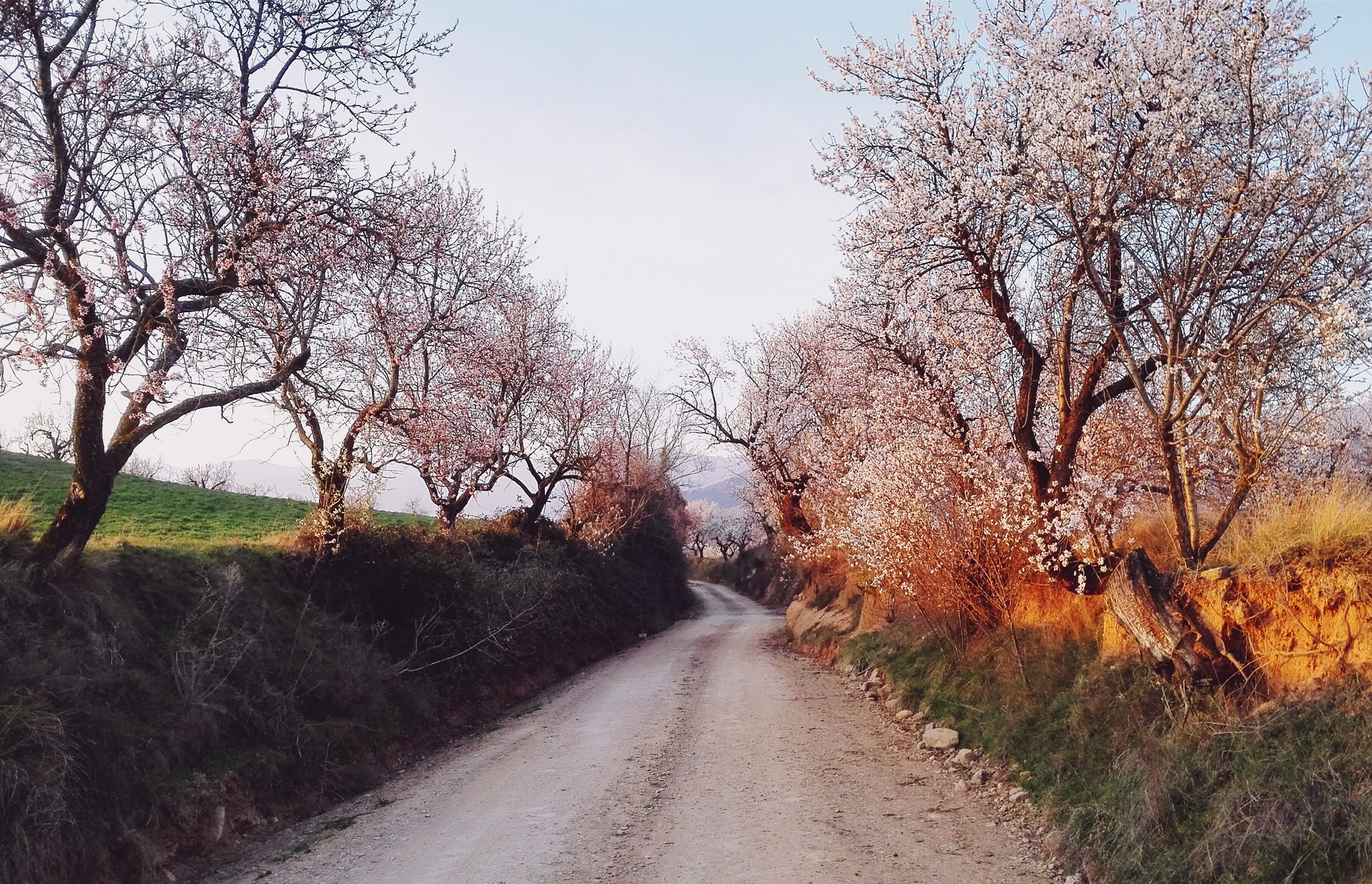
The road we travel is unknown to us, but it’s a beautiful and compelling journey.
Almendros en flor (cropped) by Gregorio Puga Bailón, CC by 2.0 via Flickr
I wake to sleep, and take my waking slow.
I learn by going where I have to go. — Theodore Roethke
I’ve never been fond of awakening from a nice dreamy sleep, and getting up (especially on cold, dark mornings) is not something I do well. I envy and wonder at Jeff’s ability to get up very early, usually without an alarm to wake him, and immediately start his day. Aside from his recent times in the hospital under sedation, I can’t remember a single time when he has shown any reluctance to get up in the morning.
This is the season when it starts to become most difficult, as the morning light wanes and we have to get up in the dark. When the cold sets in, it will be really brutal. But every day, along with millions of others who share my morning drowsiness, I somehow arise and go about my morning routine, my steps seemingly ahead of my brain much of the time.
Life is like that, isn’t it? A lot of what we learn, we learn simply by doing what we have to do and going where we must go, even if we start out in a bit of a fog. Whether we place ourselves in the hands of God, or look elsewhere for direction and reassurance, daily each of us must summon some measure of faith to keep moving into an uncertain future.
The present moment is deceptively familiar, yet totally unknown to us; our entire world can change in the blink of an eye. Little wonder the comforting nest of sleep is something many of us are slow to relinquish. But the day ahead calls to us, and we know it is often beautiful, sometimes amazingly so. With lingering yawns, we move forward.


