The most powerful drug
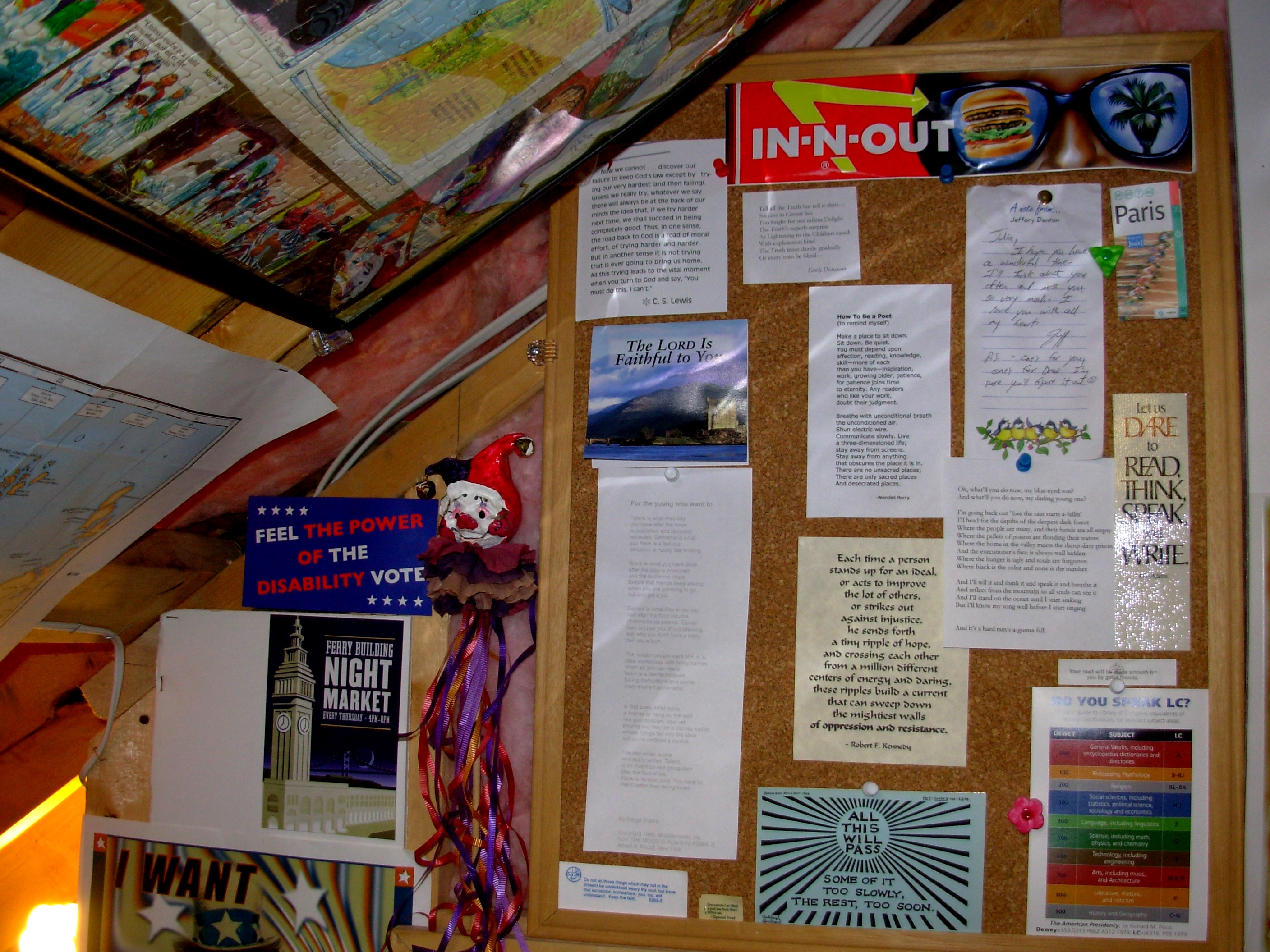
The walls of my garret are covered with words to inspire, support and comfort me. July 2007
“Words are, of course, the most powerful drug used by mankind.” ― Rudyard Kipling
I don’t remember when I first realized that not everyone was as fascinated by words as I am, but it’s something that I still don’t fully understand. I have always been so drawn to words; their meaning, their rhythms and sounds, the infinite variety of ways they can be combined, sometimes with astounding power.
Stories enchant and instruct me; poems speed past logic and go directly to my heart; essays and quotes stir me and set me pondering; even the lyrics of songs reach me as deeply as the music, often more so.
During the years Matt was in school, the special education laws were more often disregarded than they were obeyed in practice (though not on paper). My life was pervasively affected by the continual need for active advocacy to ensure that he received an appropriate education, and sadly, negotiations in the endless meetings with school officials, some of whom never worked directly with our son, often became strained and even adversarial. Though I have never been a litigious person, I was forced to learn more than I ever wanted to know about formal actions such as due process hearings and the filing of compliance complaints.
Acting as an individual against firmly entrenched bureaucratic power can be a very intimidating thing. In continual meetings facing 6-10 people (sometimes even more) I often felt disregarded at best, and threatened at worst. With my anxieties kicked into overdrive for weeks at a time, I found great solace and strength in the words of authors, advocates, musicians and poets. I surrounded myself, literally and figuratively, with the power of their words.
If you are reading this blog, chances are that you also appreciate words as a means of growth, change, and connection. What are some of your favorite quotes, sayings, scripture verses or song lyrics? Have you ever faced a time when you relied on the words of others to give you the strength to keep going?
Higher ground
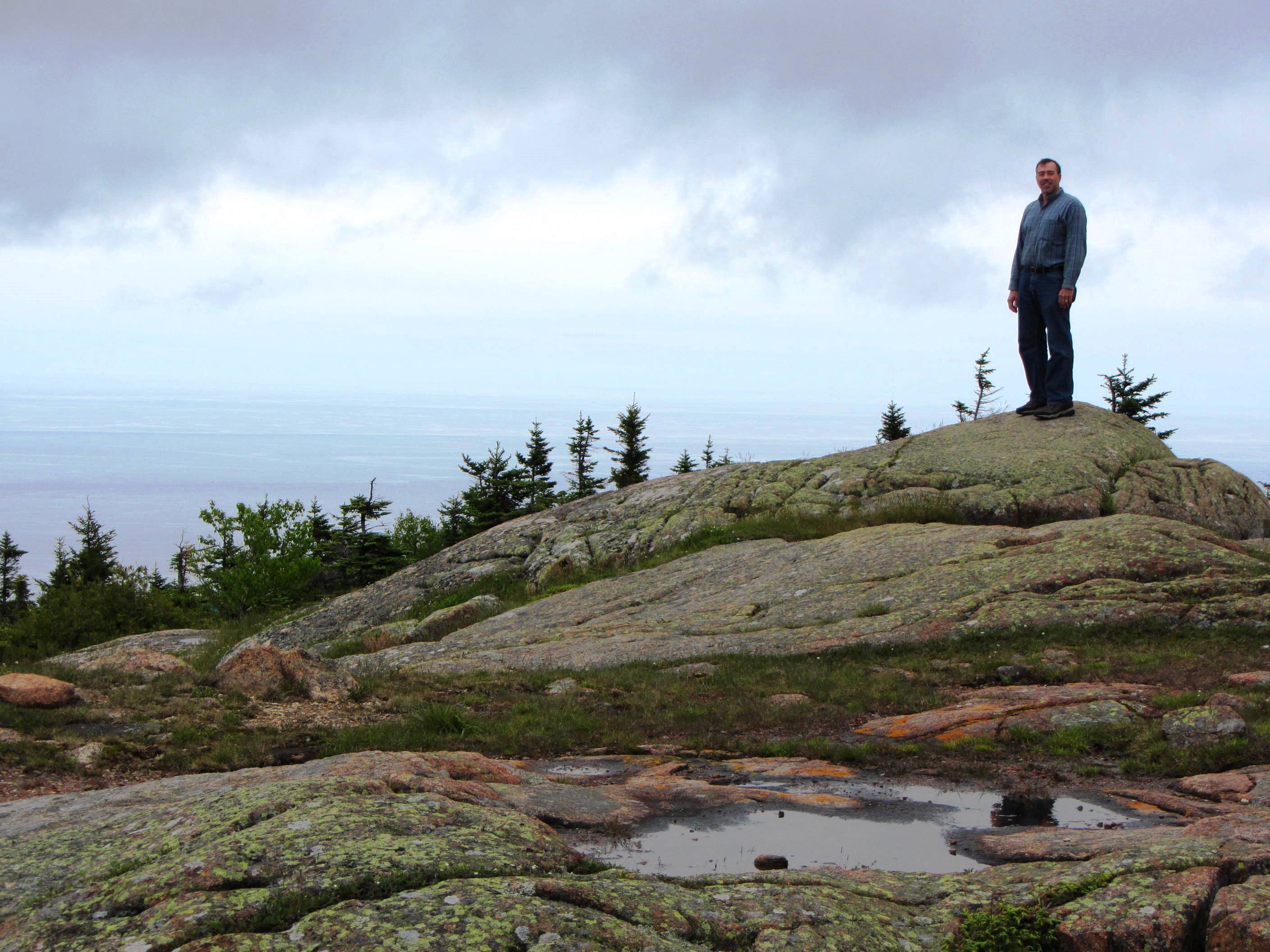
Jeff enjoys the view from higher ground, Acadia National Park, Maine, June 2012
My heart has no desire to stay
where doubts arise and fears dismay.
Though some may dwell where these abound,
My prayer, my aim is higher ground.
–Johnson Oatman, Jr.
Growing up in a church where a cappella singing was a vital part of every worship, I was exposed early and often to verses that carried encouraging thoughts or stirring challenges. I learned to love many of these hymns, which play inside my head to this day and help me face times of trial.
As we have moved around to different churches in different parts of the country, I have come to associate particular hymns with places, people or times in my life. When we moved to Virginia in 2004, I missed northern California terribly, and took longer than usual to start thinking of our new location as “home.” Times seemed uncertain at best, with a husband serving in the military with two wars underway, and a school system that completely rejected the Individualized Education Plan (IEP) that Matt’s California special education team had spent countless hours refining.
Somewhere during those first months in Virginia, this song I learned in childhood came back into my head and heart, and I decided to adopt its words as my theme for this phase of my life. I printed out all the verses to the song and hung the print inside my linen closet door, where I saw it daily, and actually still see it each day we are in York County.
In 2004 I had no idea of the challenges that would lie ahead during the years to come. Multiple cardiac hospitalizations as Matt’s heart condition grew worse, the suicide of a dear friend, and Jeff’s diagnosis of stage IV cancer were only a few of the heartaches that awaited us. Despite this, the determination to rise above the unpredictable assaults of life continues. I know very little about Johnson Oatman, but I thank God that he penned words that have served me so well.
Do you have any favorite songs or hymns that help you head for higher ground in your mind, when things are pulling you down? If you can’t think of any, perhaps you can take some time to choose a few to learn and sing, aloud or in your heart, when your courage starts to fail. It’s hard to feel afraid when singing words of cheer, faith and hope.
Bringing light

The view from our Bed and Breakfast room in Magog, Quebec, May 2009
“Most people are mirrors, reflecting the moods and emotions of the times; few are windows, bringing light to bear on the dark corners where troubles fester. The whole purpose of education is to turn mirrors into windows.” — Sydney J. Harris
It’s so easy to be reactive; to allow outside influences to determine our moods, our deeds and even our beliefs. Mirrors can reflect light, of course, so it’s not necessarily a bad thing to return a likeness of what we see. But reflected daylight is never as true and bright as what streams through clear, clean glass windows.
If Harris is correct in stating that education strives to turn mirrors into windows, we must take care how we define “education.” When we, as students, simply reflect back what we hear our teachers saying, or more likely, what we think they want us to say, that’s just another sort of mirror. There is nothing inherently more sophisticated about taking all our cues from an academic as opposed to a celebrity, or a neighbor, or a friend. If anything, it’s riskier to think we can be impartial about the views of those who will grade our work.
Education can turn a mirror into a window only insofar as it removes anything that obscures truth. In that sense, education may be largely a subtractive effort; elimination that facilitates illumination. When windows bring light, they are not the source of the light, but conduits through which it can shine. It’s not about us, what we know, what we can do, or even what we choose to reflect. It’s the process of clearing away our delusions and distractions, and letting the light of truth shine through us.
Awareness of an audience

The audience awaits a truly wonderful performance of my favorite play,
Arms and the Man, at the California Shakespeare Theater, July 2003
“Glory is largely a theatrical concept. There is no striving for glory without a vivid awareness of an audience.” — Eric Hoffer
While I’m not sure Hoffer’s assertion is 100% correct (and it may depend upon how “glory” is defined), he definitely has a point. Certainly many types of glory for which people strive are closely connected with adulation, admiration or adoration. But such striving also comes with the distinct possibility of failure; hence the common saying, “no guts, no glory.”
If “glory” is defined as widespread praise and fame, I think we would certainly do well to avoid seeking it. In the first place, we’ll get distracted from our priorities if we are always playing to the reactions of the crowd. And besides, the audience we may imagine is probably much smaller in real life than in our own minds. In reality, most people are focused on their own day, their own troubles and efforts. It’s a bit narcissistic to suppose that people are watching us as closely as we watch ourselves.
So relax! While it’s more easily said than done, we will be much happier and more productive if we don’t worry about what our imaginary audience may be thinking. If we lose our self-consciousness by concentrating on things we know to be good, right and honorable, the rest will take care of itself. Kudos to everyone with the guts to disregard glory!
An art of balance

Jeff and I enjoyed a soothing, calming afternoon at the Corcoran Gallery in DC, July 2013
“What I dream of is an art of balance, of purity and serenity devoid of troubling or depressing subject matter – a soothing, calming influence on the mind, rather like a good armchair which provides relaxation from physical fatigue.” — Henri Matisse
I understand and agree that art is meant to do a variety of things. Some works are thought-provoking or even disturbing rather than comforting, and these are no less impressive than the ones we find instantly appealing; indeed, they may be more so, since they involve daring and indifference to criticism.
Regardless of this, I am most thankful for artists who recognize the need to use their talent as a balm for the hurts of life. We all have times when we would benefit from an afternoon stroll through a quiet, spacious gallery, a few minutes spent enjoying a beautiful symphony, or even curling up with a cozy mystery or other novel with a happy ending.
Among the painters, sculptors, writers, poets, composers, musicians, architects and other artists you enjoy, whose work reminds you most of the description Matisse gives us here? What are some of your favorite “armchair” creations?
A virtue in itself
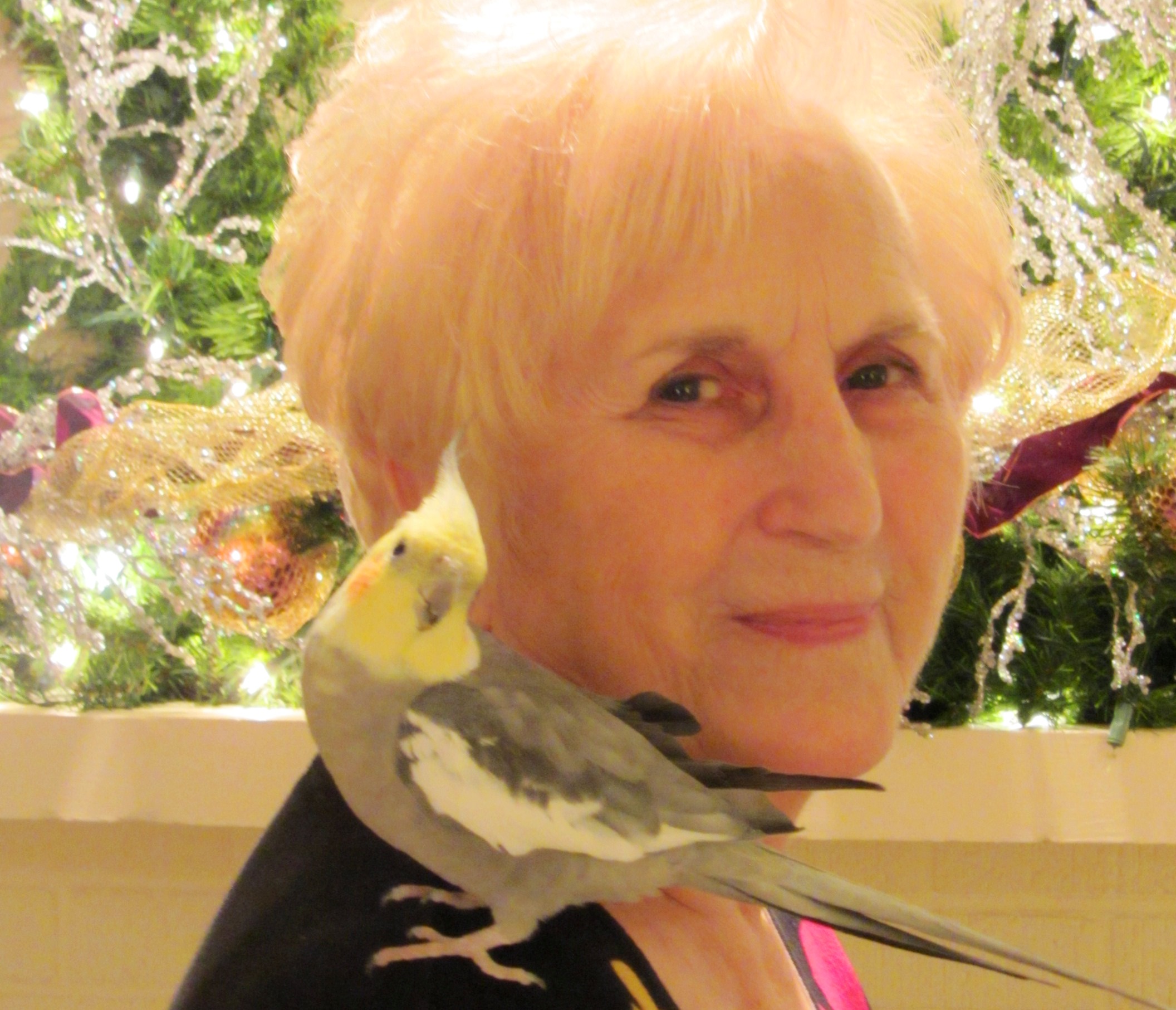
Sweetie with a sweetie: Aunt Peggy with her winsome cockatiel, December 2011
“A good disposition is a virtue in itself, and it is lasting; the burden of the years cannot depress it, and love that is founded on it endures to the end.” — Ovid
I can’t think of anyone with a better disposition than my Aunt Peggy. She has endured more than a few experiences that would have made most people bitter, but she remains one of the most loving, giving and reliably fun people I have ever had the pleasure to know. When I visit her, I always leave wishing we had more time together. And I think anyone who knows her could say the same.
Not only does Peggy enjoy life; she helps others to do likewise. Her home, exquisitely decorated year round, is absolutely enchanting at Christmas. Her beautiful flower arrangements enhanced our wedding and every home we have lived in for over thirty years. Even her husband LeVerne and her cockatiel Sweetie are delightful – and who wouldn’t be, living with someone who is unfailingly comforting, supportive and compassionate?
I hope you will brighten your own day by thinking of those rare people you know who can face gracefully whatever life dishes out; those who make the burdens a little lighter for each person they meet. If it’s appropriate, maybe send them a quick thank-you note today, or let them know how much they have added to your happiness. I thank God for my Aunt Peggy, and for all the people like her whose good cheer adorns a world sorely in need of it.
Exactly like me

Even the most beautiful mask is no match for a real face. Venice, June 2008
“Nobody can be exactly like me. Sometimes even I have trouble doing it.”
― Tallulah Bankhead
Some of us are more reserved than others, but almost all of us don a figurative mask occasionally, or maybe even often. We feel vulnerable and a bit intimidated about being ourselves, since we harbor a vast inner archive of our shortcomings, past mistakes and embarrassing experiences. If we aren’t careful, we can let our insecurities rob the world of the gifts only we can give it.
When I think of the people who most appeal to me, whether they are friends I know personally, writers I know only through their works, or celebrities I will never meet, the common trait among them is their willingness to be themselves, honest about their own hopes, fears and failures. Those who mask their unique personalities tend to blend into the background, inoffensive but forgettable.
For many years, Fred Rogers closed each of his programs for children with these simple but profound words: “There’s only one person in the world exactly like you.” Considering how many people are in the world, isn’t it amazing– almost miraculous — that each of us is unique? That fact alone makes the world a very interesting place! And you are part of that big fascinating picture.
What can you give others today that can come ONLY from you?
Waiting to be enjoyed
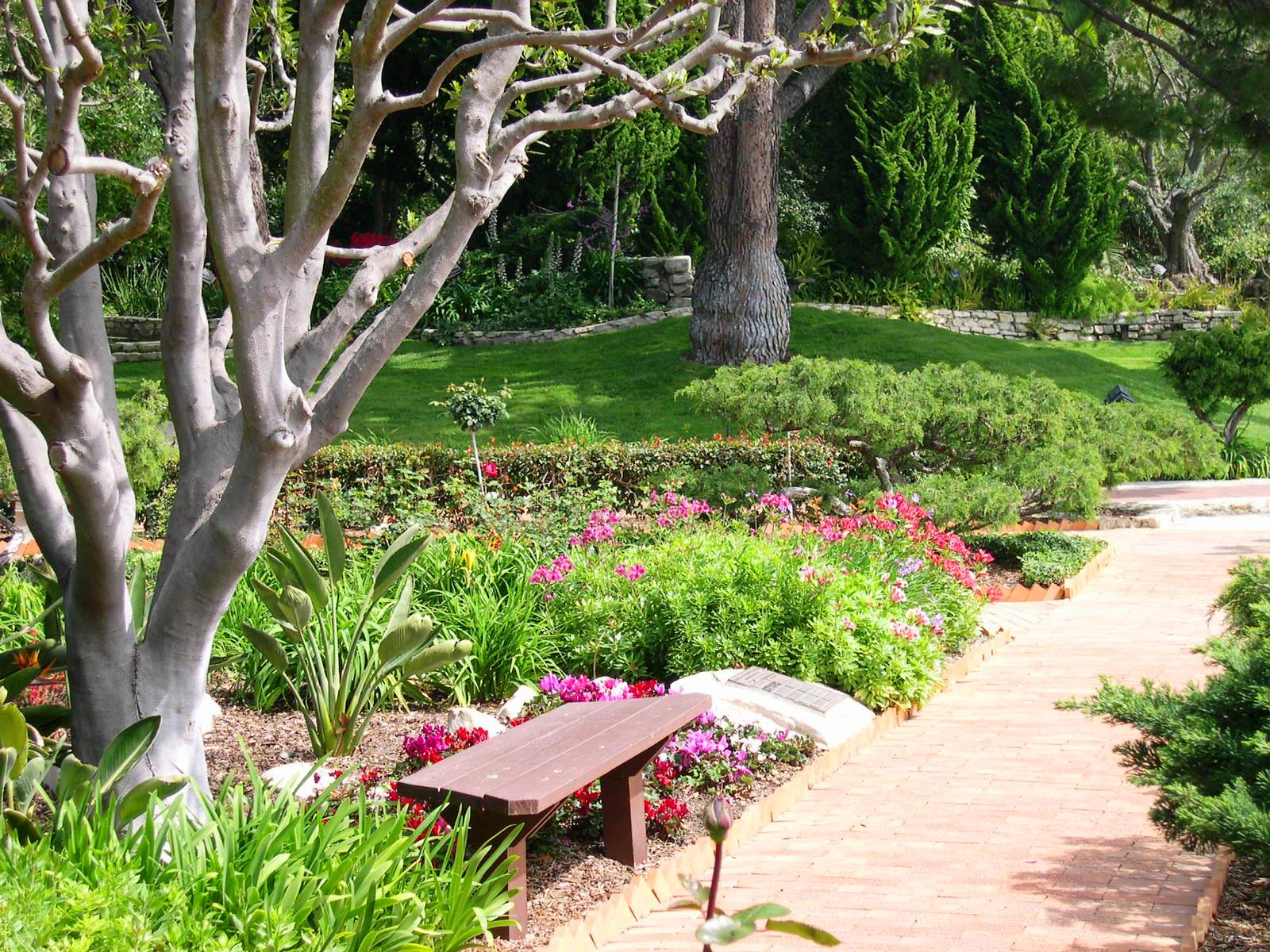
Palos Verdes, California — one of countless free pleasures awaiting you! March 2004
“…no matter where you live, the woods and parks, the trees, sky and sun are free and only waiting to be enjoyed. You never know what you’ll learn from a walk in the park.” — Tammy Strobel
Whenever the weather is nice — not too hot or cold, sunny with maybe a light breeze, or in the early hours of the evening or morning — I always feel I’m wasting something precious if I don’t spend some time outdoors. Even if it’s only a few minutes, there is something rejuvenating about taking in the greens and blues and splashes of other colors found in nature.
Be on the lookout for the next really nice day. Maybe it will be the first touch of fall for those who live in the northern climates, or an unusually mild day in the southern climates, or just a pleasant evening when the sun is down but still lighting the sky. There is something beautiful out there, just waiting for you to enjoy it. I hope you will find it!
Alchemy in sorrow

Statue of a fisherman’s wife and child, Katwijk, the Netherlands, March 2007
“Sorrow fully accepted brings its own gifts. For there is alchemy in sorrow. It can be transmitted into wisdom, which, if it does not bring joy, can yet bring happiness.”
— Pearl S. Buck
I believe that true optimism must include comprehension of the role sorrow plays in all our lives. A positive outlook is not a form of denial; rather, it’s a conviction that even our deepest grief has meaning; that our trials and tragedies bring understanding and transformation more than superficial knowledge ever could.
In the years since Matt was born, Jeff and I have dealt with sorrow upon sorrow as the medical and developmental challenges continued one after another, and practical daily support was often scarce. It has changed us forever, in more ways that we can describe or even know. But I truly believe that our lives have been made richer for all Matt has taught us, that we could never have discovered without him. It’s no coincidence that the author of the quote above walked a similar path years ago, and left us a priceless literary legacy as a result.
For as long as I can remember, I have heard Jesus referred to as “the man of sorrows.” I didn’t understand how profound and ultimately beautiful a concept that was, until I experienced recurring sorrow for years on end. The terms “God with us” and “man of sorrows” are now linked in my mind, as I contemplate the full implications of a God who, in granting humans freedom of choice, allows us to undergo suffering — an omnipotent God who chooses to walk beside us and share in that sorrow, rather than render us powerless to choose our own destiny.
There could be no deep joy if we did not know sadness, just as a person who has never gone hungry is unable to appreciate food as fully as those who have been without it. It’s a kind of paradox; a mystery we can’t fathom. Yet its truth has sustained people through circumstances far worse than the ones we now face. If you are in a time of suffering or grief, I pray you can hold on to the belief that your sorrow may yet be transformed into happiness deeper than you could have imagined.
The answer to a great many things
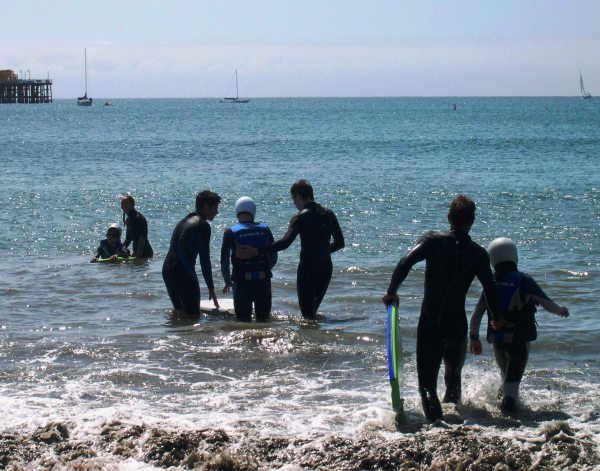
Matt trains at Ride a Wave in Santa Cruz, California, June 2003
Each year, Olympic surfers and first responders provide free training
for people with special needs learning to surf and kayak.
“I have a feeling that in the end, probably, that training is the answer to a great many things. You can do a lot if you are properly trained, and I hope I have been.”
— Her Majesty Queen Elizabeth II of the United Kingdom
With characteristic reserve, Queen Elizabeth II summed up her secret for handling the demands of her long career as she marked the 40th year of her reign. As her biographer Sally Bedell Smith pointed out, “Her formal education was spotty by today’s standards. Women of her class and generation were typically schooled at home, with greater emphasis on the practical than the academic.” Now, with the Queen having passed the 60-year anniversary of her reign, and seemingly destined to be the longest-ruling monarch in Britain’s history, it would appear that her practical education has served her well.
As Matt’s multiple learning disabilities were diagnosed one by one, we learned firsthand the invaluable role of training, as developmental milestones that happen naturally for most children had to be taught to Matt with patience, practice and repetition. It’s really no different for anyone; when it comes to becoming more adept at a skill, even the gifted must rely on hours of disciplined training and practice.
The good news is that training for competence is within the reach of anyone who longs to improve, and is willing to put in the time required. Often, we will have to prioritize among many opportunities and focus on one, or just a few, to achieve mastery before moving on to other skills. But the opportunities for training, whether self-taught or with help, have never been as widely available and relatively affordable as they are now.
What would you like to get better at? Do you know of any online learning opportunities you’d like to share? Feel free to post links in the comments below.
What we enjoy

Some favorite things: teapots, tea, England, Lewis Carroll, Darla’s home
and pretty much everything in it, including Darla! Yorktown, December 2012
“I think we delight to praise what we enjoy because the praise not merely expresses but completes the enjoyment…” — C. S. Lewis
Tea. Books. Friends. Flowers. Animals. Family. I hope nobody is getting sick of seeing these and other topics here, over and over, because I have so much fun writing about what I enjoy — including anything written by C. S. Lewis, my favorite author.
I think it’s good exercise for our spirits when we praise what we enjoy, and express gratitude for the amazingly abundant blessings we share. Let’s make this post the online extension of the song “My favorite things.” Play the song linked there, and no matter whether you feel sad or happy right now, I bet it will lift your spirits. Then think of some of YOUR favorite things. Jump in and tell us about them in the comments below.
Meanwhile, lets see…Christmas. Springtime. Music. Cinnamon rolls. Photographs. Fresh fruit. Ice Cream. Cookies baking. Rain at night. Sunny days. Birds singing. Nice surprises…
More wisdom from C. S. Lewis:
Clarity from stillness
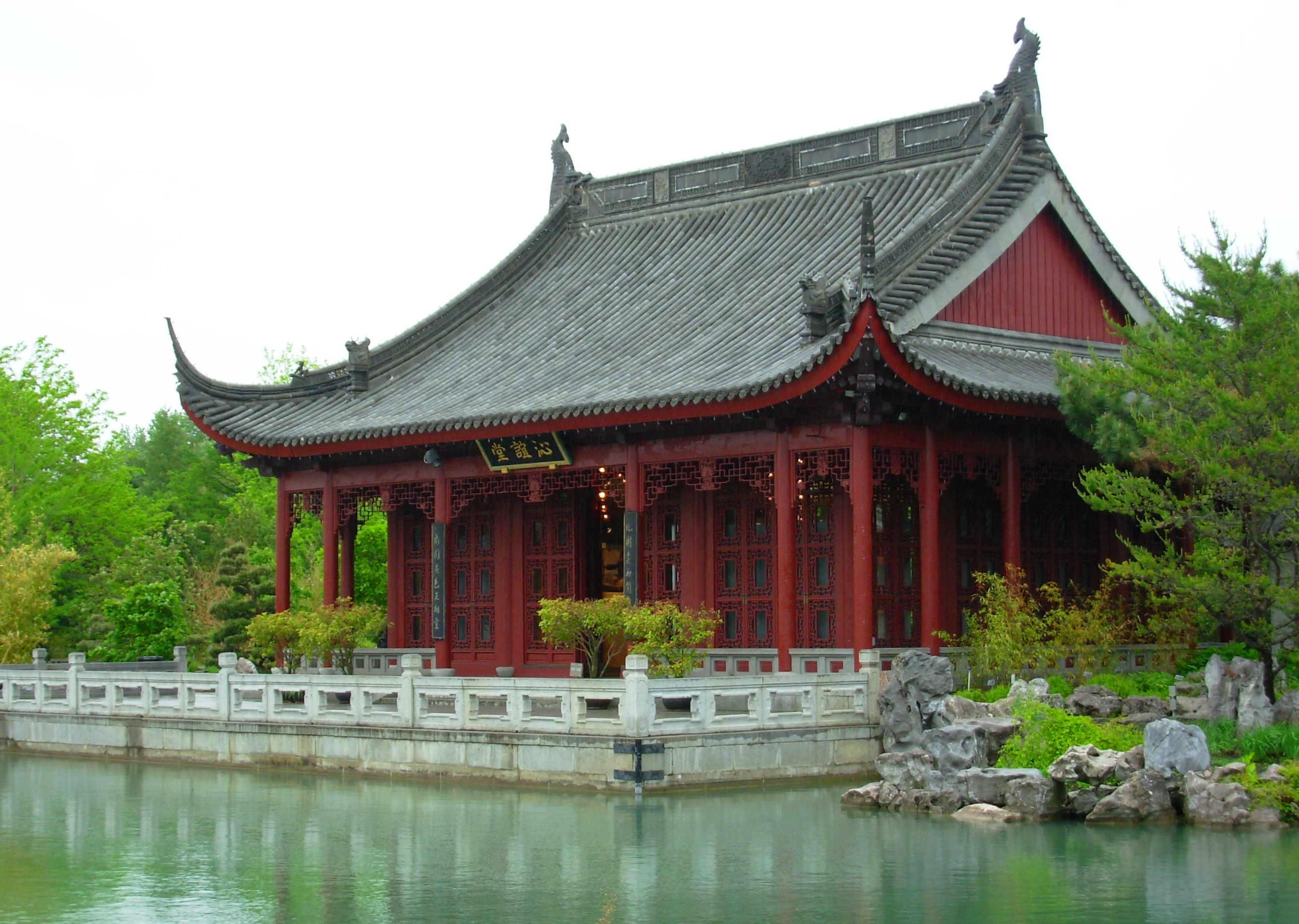
A snapshot of serenity at the Montreal Botanical Garden, May 2009
“If water derives clarity from stillness, how much more so does the mind!” — Zhuangzi
In a recent post, I discussed the fascination of watching moving waters. But still waters are captivating as well, particularly when they mirror beautiful scenery.
Stillness is a trait that doesn’t come naturally to me. Even when my body is not in motion (which is rare during waking hours) my mind is churning endlessly. I can’t count the number of times, mostly late at night, when I wished my conscious mind had an off/on switch such as Jeff seems to have. I’ve learned more than a few coping mechanisms to deal with insomnia, but nothing ever chases it away permanently.
It wouldn’t be so bad if my mind accomplished anything useful when my thoughts are scattered or distracting. An active mind can be an advantage, after all. But I think my frequent inability to concentrate is often the result of all this perpetual motion in my brain, and it’s not a recipe for clarity inside or outside. It drives Jeff crazy when I interrupt my own sentences with tangential thoughts!
As one strategy to still my mind, I’m working on dialing back this societal fixation with what is called “multi-tasking” but all too often means “partial and interrupted tasking.” I could use a little more mental clarity, especially as I age! Do you have any “stillness secrets” to share with me? Please post them in the comments, and HURRY, before my mind wanders to a different topic!
The incredible gift

Welcome to a typical morning with Mama and Daddy, August 2013
“The incredible gift of the ordinary! Glory comes streaming from the table of daily life.” — Macrina Wiederkehar
One of the hardest things about the past year has been the need to cancel no fewer than three scheduled visits to see my parents. It’s good that our grandson happened to be born in Atlanta, so I was finally able to stay with Mama and Daddy when I went to see Grady. I had not seen them for more than a year, and it felt like forever.
I took this photo one morning after arising to an everyday scene that becomes more dear to me each time I see it. I know a day likely will come when I would give so much for one more chance to wake up to this sight. Mama and Daddy were preparing freshly picked beans from their organic garden, and Mama protested when I brought out my camera (and she might be mortified if Daddy tells her about the photo appearing on this blog), but she has always been a good sport about such things.
I think she looks pretty good for a woman in her 80’s who has just gotten up and hasn’t yet dressed, combed her hair or put on makeup. As is her frequent custom, she prioritized getting a start on dinner before tending to her personal appearance. I know you can probably guess who she sent out to pick those beans, long before I got up!
I had enthusiastically devoured the freshly picked purple-hull peas and cornbread they fixed the day before, so I appreciate her fresh vegetables and wanted a photo of her as I’ve seen her countless times. To me she is beautiful any time, as is my Daddy, whose longsuffering smile has always brightened my spirits.
Today you probably will come in contact with at least a few people who are dear to you. Chances are there won’t be any special occasions to photograph, but it’s the everyday memories we will treasure most anyway. Take a minute or two to snap some digital or mental images of your extraordinary ordinary life, and cherish these incredible gifts for many years to come.
Jump in the lake

Jump in the lake if you must, but at least choose a nice one. Lake Louise, September 1999
“The writer is only free when he can tell the reader to go jump in the lake. You want, of course, to get what you have to show across to him, but whether he likes it or not is no concern of the writer.” — Flannery O’Connor
I admire Flannery O’Connor, but I was somewhat taken aback by her stark advice. Not because I disagree with it, but because my first thought was, “I NEVER want to tell anyone who reads my blog to go jump in the lake.”
On second thought, though, maybe I do. If any of the people reading this blog are cruel or mean-spirited, they can go jump in the lake. Those who refuse to open their eyes and be grateful for the blessings that grace their lives can go jump in the lake. Those who want to bring us all down to wallow in the mire of despair and hopelessness: jump away.
But I hope they won’t stay there. I hope the water in the lake will be of a bracing temperature, waking them up to life. I hope they will swim vigorously if they know how, or learn to dog paddle if they don’t. I hope they will emerge from the lake feeling a little happier, saying to themselves, “What was I THINKING?!”
To the rest of you, the majority who are here because you have faith, or tenacity, or courage, or good will, or all of the above: I do sincerely hope you like what I write, even if O’Connor thinks it’s no concern of mine. And if someone tries to sabotage your determination to defeat despair, well…you know what to tell them.
Waiting

Passengers waiting at Charles de Gaulle Airport, Paris, June 2008
“Waiting is one of the great arts.” — Margery Allingham
It’s fitting that this quote came from an author of detective stories, because the seemingly glamorous life of a private eye requires a great deal of tedious waiting.
For Jeff and me, it seems as if the past year has held well more than its share of waiting. Countless hours, days and weeks we spent in hospitals and clinics involved mostly waiting. Waiting to be called into the examination room, waiting for consults with other doctors, waiting for IV drips to finish, waiting as overbooked schedules were adjusted to allow another appointment.
We also waited in other locations, too: in the traffic between Bethesda and northern Virginia, for phone calls to physicians to be returned, for test results to be reported, for prescriptions to be ready for pickup at the pharmacy.
And of course, we waited for a grandson who, like his father before him, took his time arriving into our world!
I came across Allingham’s quote months ago, and I had to give it a bit of thought to understand what she meant. I had never considered waiting to be an art; rather, it was a nuisance, a necessary evil of these rushed and impatient times.
But I’ve come to the conclusion that waiting is indeed an art in many respects. It requires stillness coupled with action, the discipline of knowing when to be passive and when to move. It’s not the same thing as procrastination; indeed, in some ways it’s the opposite. Often, we have to wait because are on the receiving end of someone else’s procrastination, or their overly busy schedule.
As with any other art, there are skills that can be practiced to make waiting more bearable. We can learn what activities we can accomplish while waiting, and note which habits of mind tend to lead us away from our agitation rather than increase it. We can develop a literal or symbolic “tool kit” to redeem these potentially wasted hours, and put them to good use.
Are you good at waiting? If so, share your secrets with us! If not, try to brainstorm with us about ways to appreciate and utilize this unavoidable aspect of life. I’ll be waiting to hear from you! 🙂
Because we are so loved
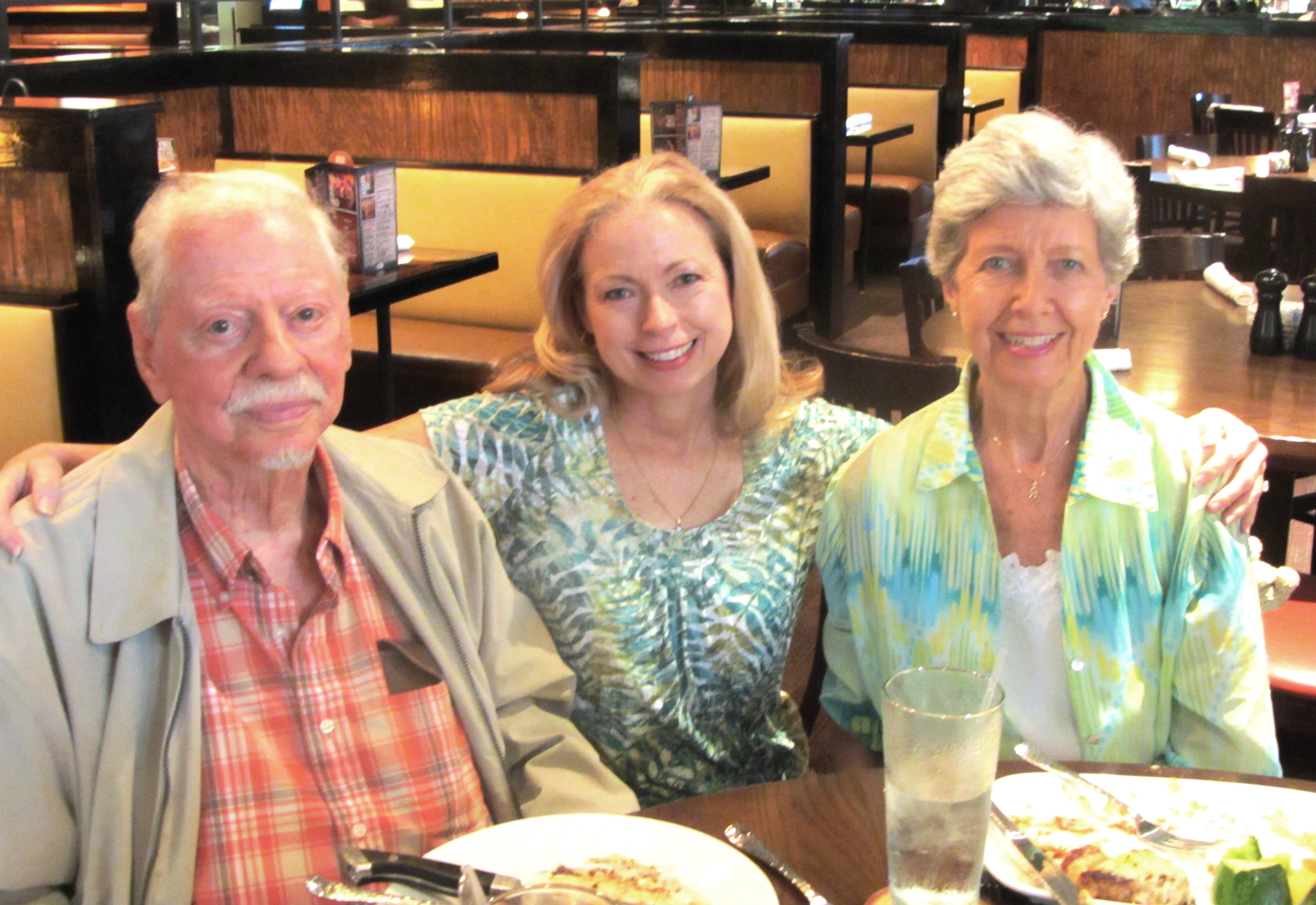
A beautiful afternoon with Dr. Santos Rodriguez and Ellen Rodriguez
Fayetteville, Georgia July 2013
“I believe, with every fiber of my being, that when we are struck down by adversity, God weeps with us and, then, because we are so loved, heals us in ways we can never expect or even imagine.” — Sarah Ban Breathnach
I’ve shared here in previous posts that the past eleven months, although fraught with devastating events, have also been filled with unexpected graces. Among these are the many reunions, mostly by mail or online but also occasionally in person, with people who are praying for us and supporting us with good wishes and expressions of love.
Each letter, gift or visit comes with its own unique blessing. To those of my readers who have sent me things in the mail: you will never know how much I treasure these tangible symbols of kindness from people I’ve never met face to face. To the many friends we heard from for the first time in years: it has been such a joy to be back in touch! Meeting with Cindy and Henry, my friends from the Upper Room fellowship online, whom I’d never met in person, was another wonderful experience.
As I write this, I am thinking especially of how the past ten days have brought to mind the words “my cup runneth over,” and I’m not thinking only of our precious grandson. Months ago, when Jeff was diagnosed with stage 4 colon cancer after receiving the first diagnosis of apparently unrelated cancer in the appendix, I got a very special surprise in the mail.
It was a letter from my all-time favorite teacher, whom I had not seen since I was in her fourth grade classroom 1965-66. She and her husband frequently visit my mother’s health food store and chat with my younger brother who works there, who also was in her class several years after I was. Through him, she learned of our circumstances and sent me a lovely letter. It would not be an overstatement to say I was thrilled to hear from her.
A few weeks later she sent me a beautiful devotional book, and I phoned my mother and said “please tell Ms. Rodriguez that the next time I come to Atlanta, we MUST have lunch together!’ That dream came true the day after I held my grandson for the first time, as my parents and I enjoyed lunch with this remarkable couple. She looks amazingly like she did almost 50 years ago! And her husband (a physician who is 94 years young) was absolutely charming. I told my mother she should pay them to hang around her health food store; they are the best advertisement for nutrition that I have ever seen!
Those of you who are also Facebook friends (anyone is welcome 🙂 ) may have seen this photo before, which I shared with a couple of my classmates who are on Facebook and were equally happy to see the photo of our beloved teacher. Sharing memories of our childhood years was another blessing. As with most of God’s gifts, this one just keeps on giving.
During the very dark days of Jeff’s devastatingly poor prognosis, before we knew he would have such a good response to treatment and again when the healing after the liver resection seemed an almost impossible goal, it was hard to focus on or imagine all the ways God could bless us through the many crises we had endured since September. Many days, all we could do was put one foot in front of another and get through that day.
Yet we continue to be upheld and sustained by the myriad ways God is taking care of us, mostly through people such as you. Thank you for being part of a healing that we could never have expected or even imagined. Should you find yourself in a dark and lonely place, HANG ON and have faith in the goodness that surely awaits you in the future.
Summer afternoon
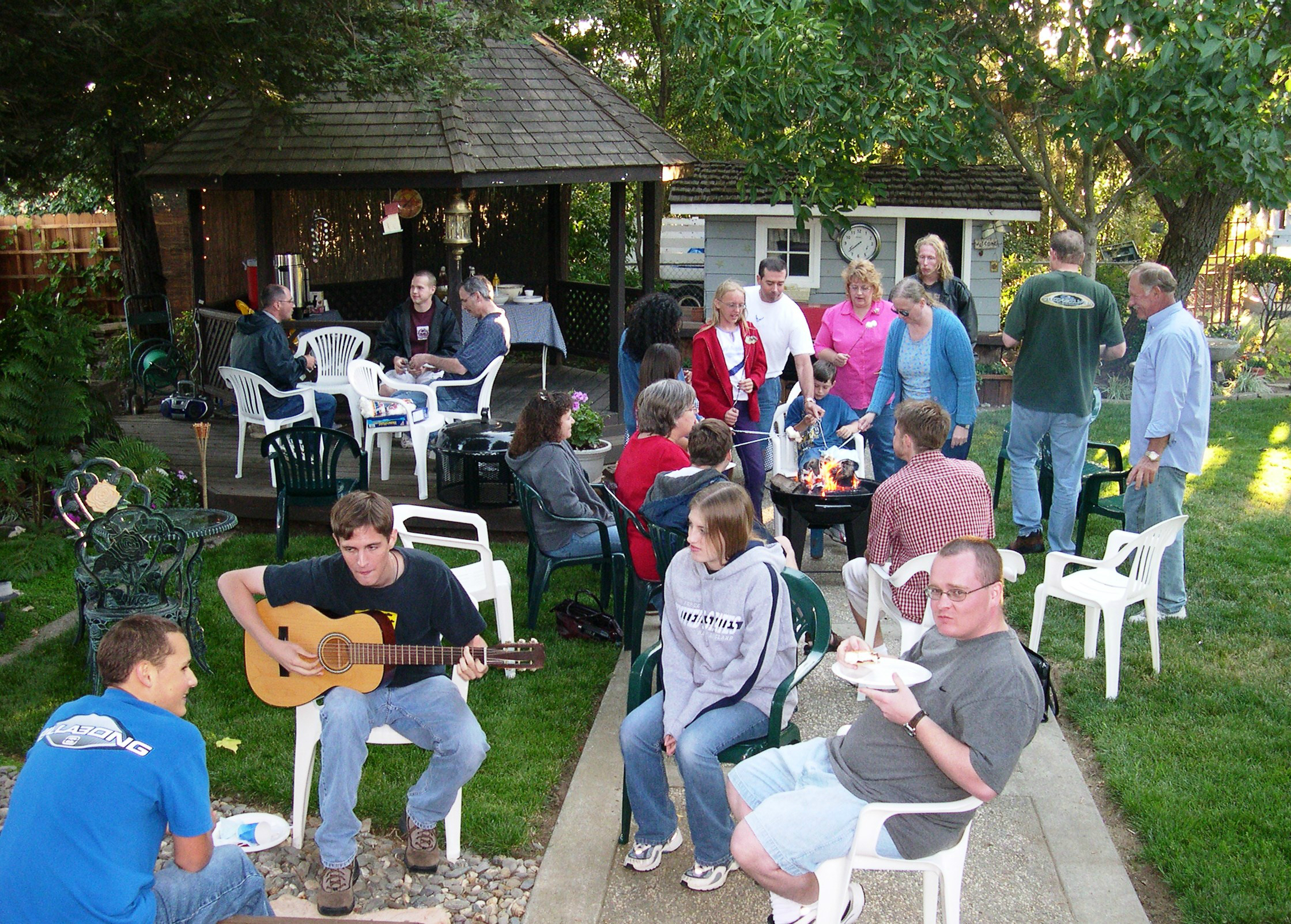
An afternoon cookout with friends in northern California, June 2004
“Summer afternoon—summer afternoon; to me those have always been the two most beautiful words in the English language.” — Henry James
Though summer has never been my favorite season, I can understand why the words “summer afternoon” are beautiful, especially for someone who lives in a cooler climate than the one where I grew up. Summer coaxes us outdoors for games, cookouts, conversation — all sorts of things that bring people together just for fun.
Several blog readers may recognize someone they know — maybe even themselves!– in the photo above. Trivia question for those who don’t know any of the people pictured: can you guess which two people, newly met in this photo, ended up getting married to each other? (All giveaway clues will be censored from comments, so no cheating!)
Here’s hoping you will be able to get out a few more times this summer, and cook up some fun!
Some things
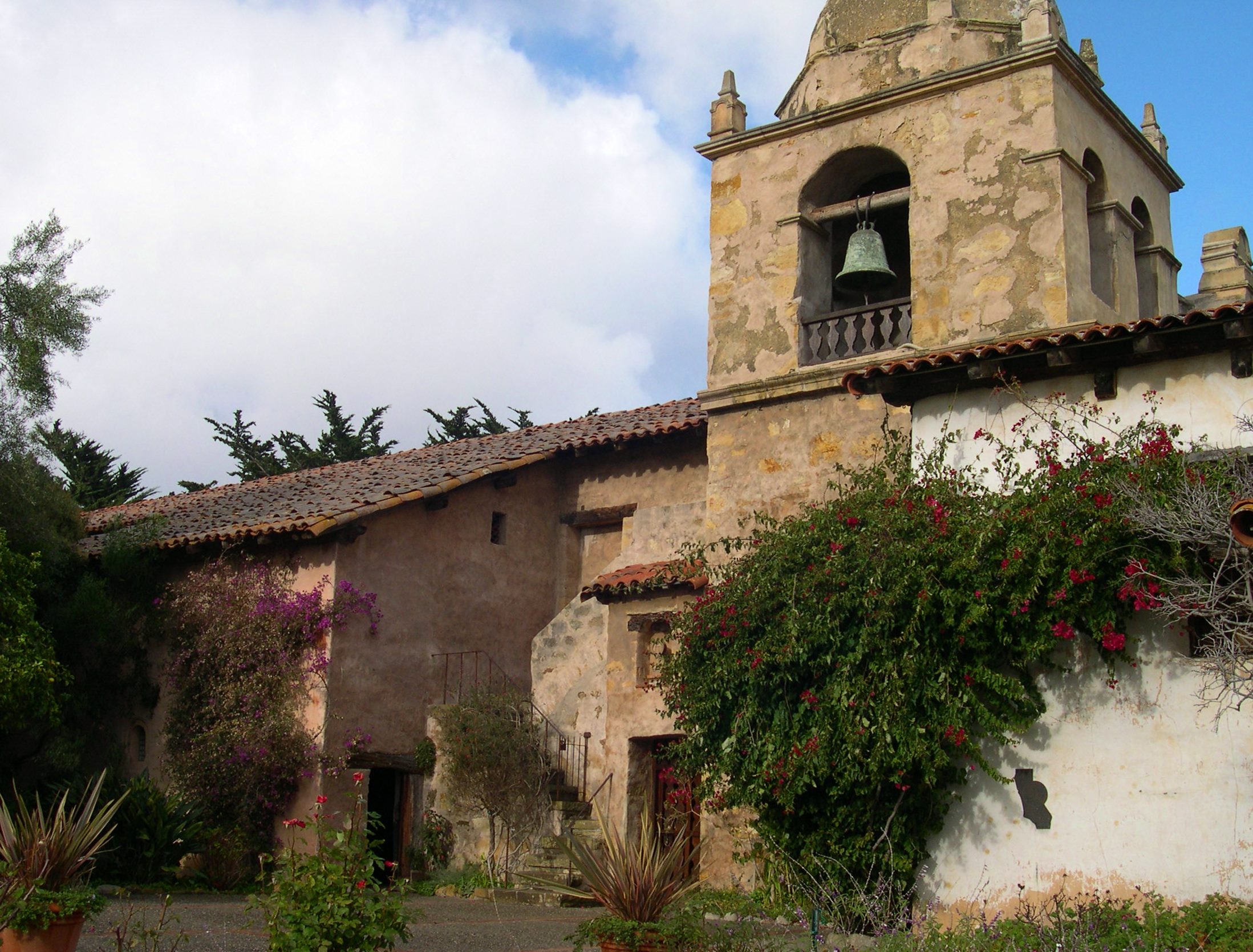
Mission Carmel is one of the oldest buildings still standing in California. December 2002
“We know some things they didn’t know in the past, but they knew things that we’ve forgotten.” — Ashleigh Brilliant
Here’s something to ponder: if you were to time-travel and suddenly swap places with a person of your age, gender and ability who lived two or more centuries ago, which of you would have a harder time functioning independently in your new surroundings? It’s a safe bet that either of you would need a good bit of help from people who might be baffled at your ignorance.
In any case, we have one distinct advantage over our ancestors: we have the option of learning some of the things they knew. Whether we learn and practice age-old skills on a camping trip, at a living history center or in a classroom, it might be strangely calming to focus our attention on something not requiring electricity, climate-control or a tight schedule.
The California missions are among many places all over the world where bygone ways of life can be studied. It has become popular to look at the past through a harshly critical lens, but future generations will have ample reason to do the same to us, equipped with the benefit of hindsight. In our determination to rise above the mistakes and wrong actions of those who lived long ago, let’s not forget that people who lived in past centuries also have positive things to teach us.
If you could spend a day with your great-great-great grandparents, what would you most want to learn from them?
Exquisitely dependent
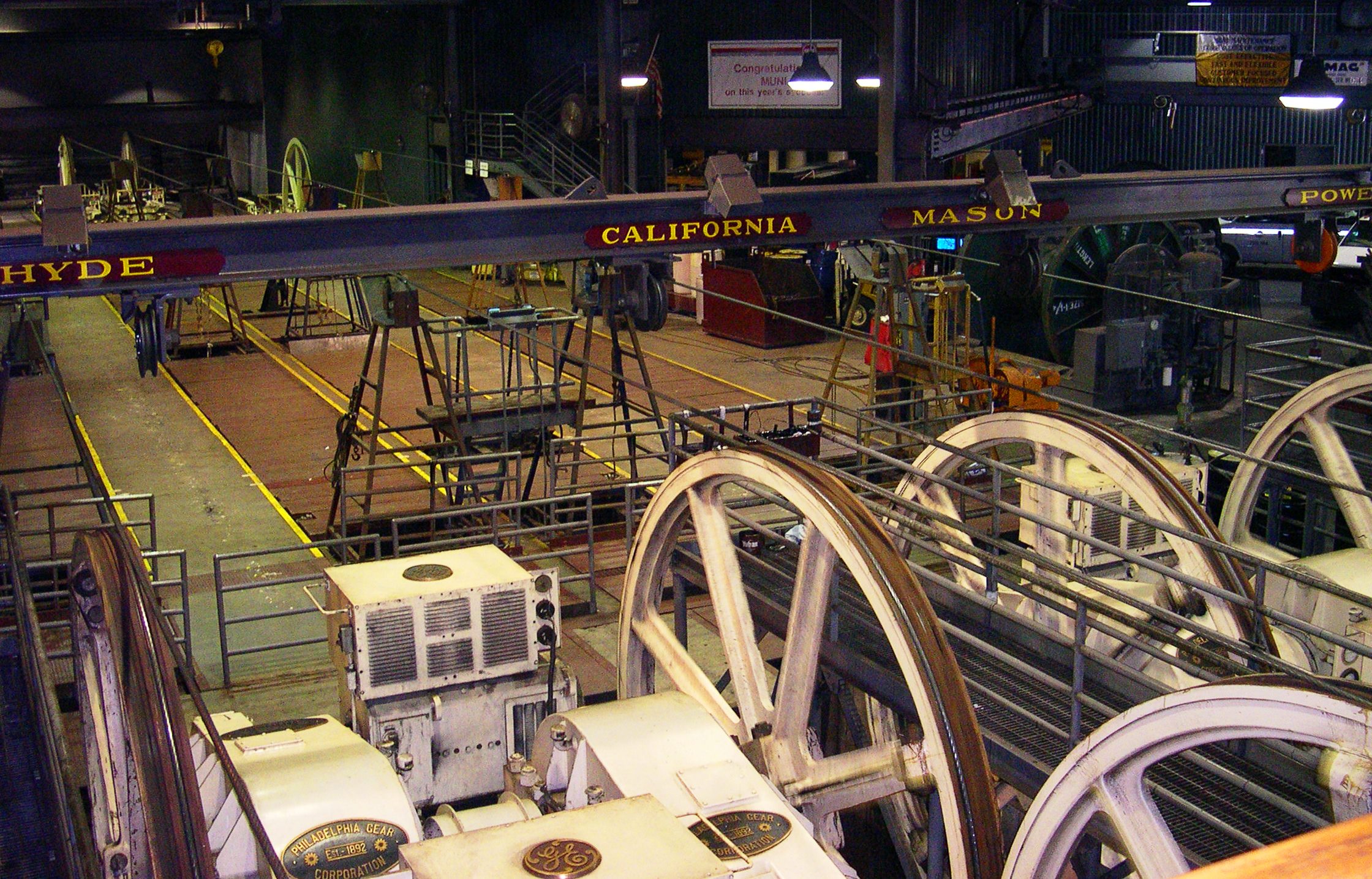
Simple but strong, the cables keep the cars running. San Francisco, July 2003
“We live in a society exquisitely dependent on science and technology, in which hardly anyone knows anything about science and technology.” ― Carl Sagan
I plead guilty to that! Or maybe not.
On my list of things I find fascinating, my impulse would be to place “science and technology” near the bottom. Actually, though, I’ve always enjoyed learning about it. In my immediate family, my experience with computer technology is far ahead that of my husband or sons; sort of a stereotype-buster. And I’ve always been interested in learning how things work. As a kid, I would take apart broken watches and toys to figure out why they stopped running. So I guess being analytical is not too far removed from enjoying science or technology.
I don’t know anyone who ever went to San Francisco without at least seeing (if not riding) the justly famous cable cars, which are one of only two moving landmarks on the National Register of Historic Places. Relatively few take advantage of the free admission to the Cable Car museum, where I snapped the photo above.
One day when I was riding the Powell-Hyde line I heard a tourist ask the gripman, “What makes the cable cars run?” He smiled and answered “Cables!” It sounds too simple, but the actual machinery that is visible at the museum validates that answer. The muscles of the gripmen and the incredible strength of the cables — one for each line — pull thousands of people each day (over seven million each year) up and down the steep hills of San Francisco.
One of the first science lessons I remember is “What is a machine?” The cable cars are a great example of a relatively simple machine that provides an easily understood introduction to technology for the science-impaired such as I. What are some of the simple or complex machines on which you depend every day? When I ask myself that question, I come up with a whole new list of things for which I’m grateful. I hope you will do the same.
A fascinating vitality

Jeff at Franconia Notch State Park, New Hampshire, May 2009
“Moving water…has a fascinating vitality. It has power and grace and associations. It has a thousand colors and a thousand shapes, yet it follows laws so definite that the tiniest streamlet is an exact replica of a great river.” — Roderick Haig-Brown
We lived in Memphis during the years Jeff was in dental school, and I loved the city for many reasons, but what I loved best was the mighty Mississippi River. I never tired of sitting on the bluff at Tom Lee Park and watching the river flow.
There’s something mesmerizing about watching water in motion. Ocean waves, woodland brooks and waterfalls all have a calming quality, lovely to the eyes and soothing to the ears. It’s no wonder there are so many indoor and outdoor fountains that enhance the appeal of parks, city squares and indoor atriums everywhere. But even the most beautiful fountain is no match for the experience of standing on a riverbank, wading through a creek or feeling the cooling mist of a waterfall.
The hot days of August are perfect for enjoying the beauty of water. Head for a nearby park that has a creek or waterfall tucked away on a shady trail, or take a few minutes to enjoy a fountain at a plaza, hotel or shopping center. If you don’t have time to find one in real life, enjoy the sights and sounds recorded here or here or here. I’m wishing you a few minutes of cool mental refreshment on this warm August day!
Going to the desert
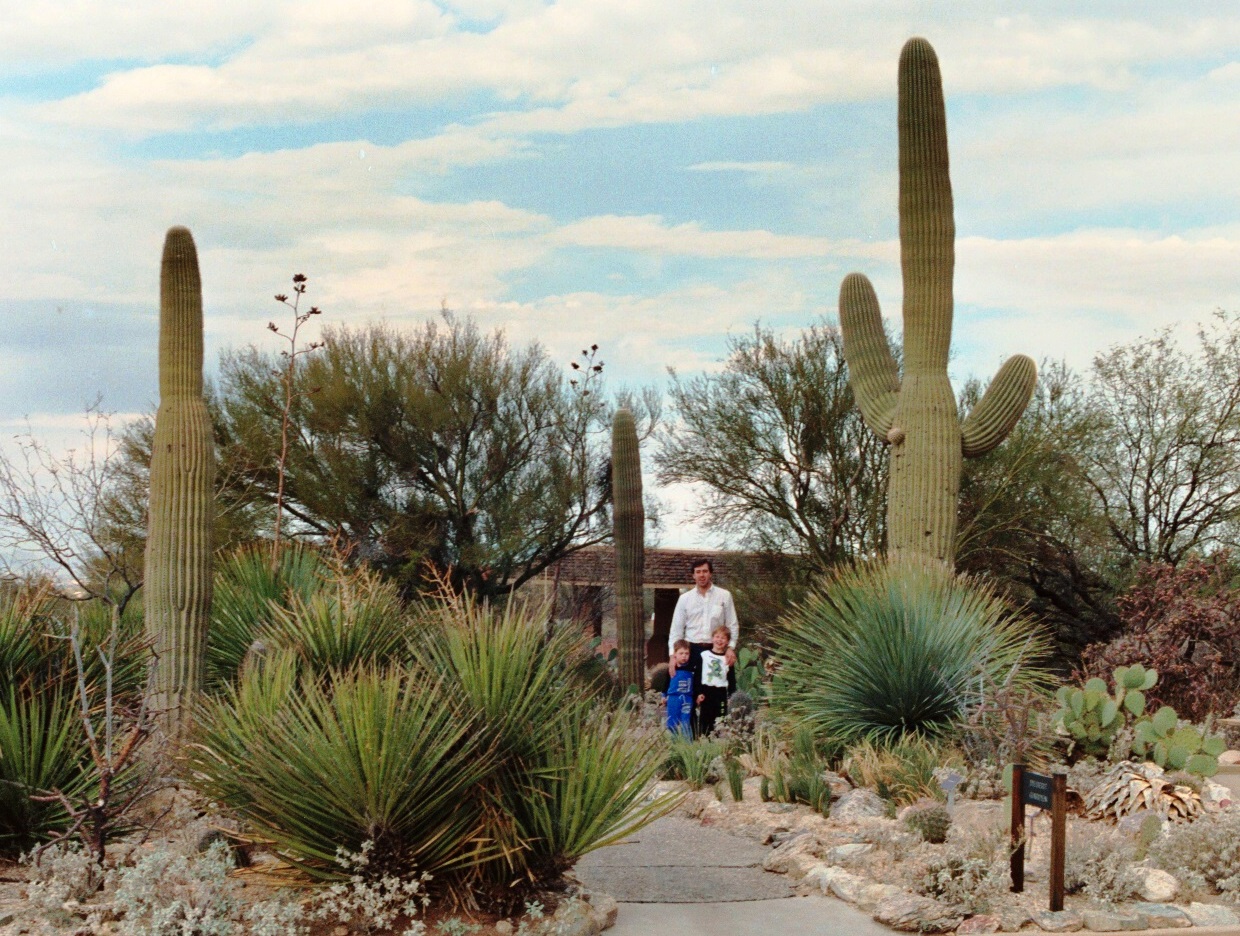
Jeff with our sons near Palm Springs, California, January 1990
“Modern life is becoming so full that we need our own ways of going to the desert to be relieved of our plenty.” – Thomas Moore
The first time we ever drove across the United States en route to our new home in California, we thought we were making pretty good time when we arrived in Texarkana, on the border between Texas and Arkansas. Two days later we were still in Texas, after driving what seemed like forever through the parched landscapes on the way to El Paso. Then through New Mexico, Arizona and California, the desert went on and on. Jeff said “It’s kind of hard to worry about over-population after making this drive.”
Amid the traffic and crowds of the cities where we had lived and traveled, we had no real idea how much barren and unpopulated land still exists in America. Of course we knew it was there, but the vast extent of it was something we couldn’t imagine until we journeyed through it.
In the same way, contemporary life tricks us into believing there is no escape from the noise, rush and demands of every day. Routines our grandparents would have thought bizarre, such as being on call for dozens of people all our waking hours via cell phones and texting, have come to seem not only normal to us, but inescapable. But there are still places of refuge from such urgency, and I suspect they are more plentiful than we think they are until we have learned to visit them.
As I write this, I’m feeling very overwhelmed by all the tasks I did not get done yesterday, or a week ago, or even father back than that. My head spins as I try to sort out my thoughts and prioritize what must be done first. Yet I can’t escape the nagging feeling that I might be more efficient if I could somehow clear everything away for an hour or two and just breathe deeply without thinking much about anything. I’m not sure I could achieve that even if I tried.
But, I can do a few things today that might help. I can allow myself to work on one task at a time, and not allow interruptions to de-rail me. I can prioritize clearing away visual clutter to keep my eyes from contributing to the sensory overload. Most importantly, I can turn down that inner voice that continually chastises me for being so far behind in the first place. I can spend some time in quiet reading, prayer or gratitude, and “just say no” to self-imposed pressure.
What are some of your favorite ways of going to the desert?
No time

This turtle had time to pose for me near the Palace of Fine Arts, San Francisco, July 2003
“I have no time to be in a hurry.”— Henry David Thoreau
When I was a child, I often heard talk of “the lazy days of summer.” I haven’t heard that phrase in a very long time. Indeed, summer seems more hectic than any other season, with vacations, activities and daily obligations packed so tightly that the time slips away before we accomplish half of what we had planned.
It’s no use getting into a rush, though. At least it’s not for me; I make more mistakes and get even farther behind when I try to do more than I’m capable of doing within a certain period of time. And the stress of running behind, trying to make up lost time, is almost unbearable. In my case, haste really does make waste.
My challenge is having a poor grasp of time and how long things will take. Thus I pack way more ambition into my plans than would be realistic for a time slot twice as long as the one I’m dealing with. The only way around this I have found is to leave huge cushions of time whenever I’m planning anything. It feels like sloppy planning until the time arrives, during which I normally STILL run out of time, even with a generous allowance built in. I keep hoping I’ll get better at planning, because just as Thoreau says, I really have no time for hurry.
Whatever you have planned today, or this week, or the remainder of the summer, don’t be afraid to SLOW DOWN if things start spinning past you too quickly!
In season
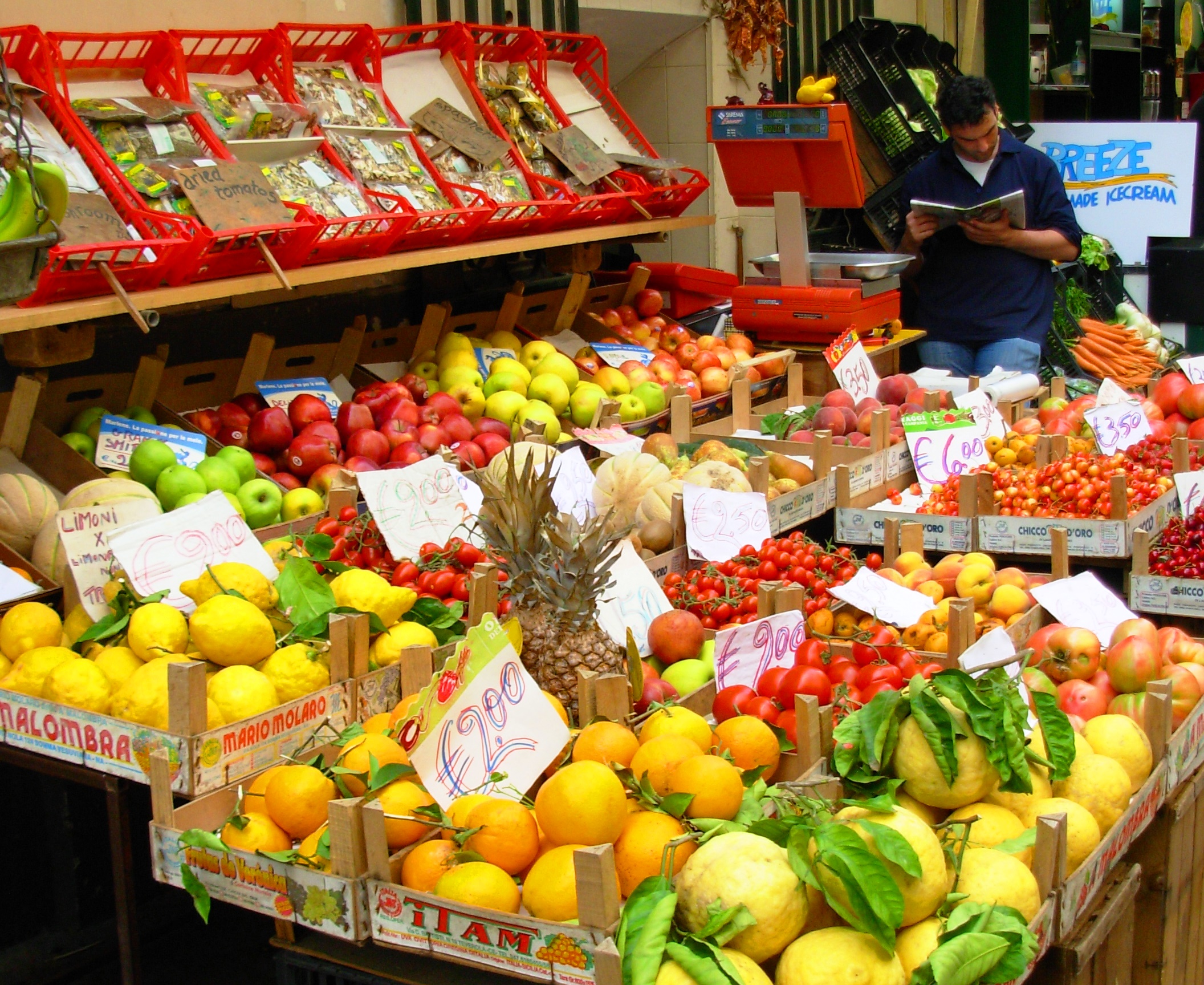
A fruit stand in Sorrento, Italy, May 2008
“Love is a fruit in season at all times, and within the reach of every hand.”
— Mother Teresa
With all the people in the world who are hurting for lack of love, can we really believe that it is within the reach of every hand? Absolutely yes, if we think of love as something to give rather than something to receive. A number of studies have established that loving others is inextricably linked with happiness. And anyone can love (or learn to love) others, regardless of whether that love appears to be reciprocated in the same measure.
Think of celebrities who are subject to the intrusive attentions of thousands or millions of fans who “love” them. Is this sort of one-way adoration and attention the key to happiness for these stars? I know few people who would say that it is. But genuine love for other people — not actions done with the hope of some sort of payback, but real, unalloyed affection — seems to increase our sense of purpose and well-being in ways not necessarily tied to what we get in return. Even tending to pets or houseplants has been correlated with increased life span and contentment.
There’s a wonderful moment near the end of the movie Marvin’s Room, in which an unmarried woman dying of cancer after years of care-taking her aging parents tells her younger, more selfish sister not to feel sorry for her. “I’ve been so lucky,” she tells her. “I’ve had so much love.” The younger sister replies, “Yes, they love you very much.” “Oh,” the dying sister says, “I mean my love for them. I’ve been so lucky to have two people in my life to love so much.”
That line has stuck with me. Love really is within anyone’s reach. Usually when we give love, we will be loved in return. But even if we are not, genuine love for others is the source of happiness because it takes our mind off of our own sorrows, and connects us to all that matters most. I wish you a life of love!
Ultimately worthwhile

I snapped this photo on the Amalfi Coast of Italy, May 2008
“Anything I’ve ever done that ultimately was worthwhile…initially scared me to death.”
— Betty Bender
In most ways I’m a cautious person, riddled with anxieties about all sorts of things, but some people get a false impression that I am bold or daring. I think this is because certain traits that run strongly in me — tenacity, curiosity, love of adventure, and being generally excitable, defiant and hotheaded — can masquerade as courage.
When we visited the Amalfi Coast of Italy, my terror of the winding, cliff-hugging roads and fast drivers was surpassed only by my awe at some of the most stunning sights I’ve ever experienced. It reminded me of when we drove up Pike’s Peak, and I was such a nervous wreck by the time we got to the summit that I sought (unsuccessfully) some other way to get down. Once we started the trek back, however, the panorama beneath us was so breathtakingly beautiful that I had no time to be afraid.
Fear in itself is a neutral trait, neither helpful nor harmful until we allow it to be one or the other. If we use fear as a motivating factor to learn, prepare and take reasonable precautions, it is our friend. But if we allow fear to chain us to an illusion of safety — and in the end, almost everything in which we trust for safety is at least partly an illusion — we will never really live, for fear of dying.
What scares you most? Does your fear play the role of friend or foe?
Enliven and transform

A cheerful setting can transform a cup of tea into a special occasion!
Yorktown, Virginia, May 2013
“Instead of resigning ourselves to lives in which 75 percent of the day is less enjoyable or at best, neutral, we can find ways to enliven and transform these moments.”
— Todd Kashdan
Whatever you have planned for today, tomorrow, or this week, see if you can think up some ways to add sparkle to the daily routine of life. It doesn’t have to take a lot of money or effort. Light a candle, use your good china, play some nice music or listen to an audiobook as you tackle mindless chores. Tape a treasured card or photo to your mirror where you see it first thing in the morning. Make a new recipe, or dig out one you haven’t used in awhile. Leave surprise “I love you” notes for family to find later.
There’s nothing like a brush with our own (or a loved one’s) mortality to reinforce a truth that we all know, but seldom enact: Life is too short to spend even one day dwelling on the discouraging, sad or frustrating. Whatever you plan for today, or this week, I hope you will get creative and brainstorm some ways to enliven and transform your routines. Please share your ideas with us in the comments!


 Defeat Despair